Gold Gold Adventure Gold Review
Recruit gold-thirsty heroes, raise a pet Godbeast, and get rich off their misadventures. A characterful reverse-RPG that's rough early but keeps improving.

A Majesty-shaped city-builder with more personality than polish. The loop where you recruit heroes, send them into dungeons on quests and turn the loot back into a bigger fantasy town is genuinely charming, and the studio patches on community feedback at a pace most indies never match.
What holds it back is the first few hours: the learning curve is steep, the onboarding is thin, and the balance swings hard between trivial and unfair. Push past that and there's a good game here — one that keeps getting better every month.
The verdict, in one line
Gold Gold Adventure Gold takes the indirect-control god game — you don't command heroes, you tempt them with the promise of gold and let them wander off to fight, die and level up — and wraps it in a cute, dark-humoured fantasy town where danger and profit share a fence line.
The whole thing runs on money. You build markets, taverns, gambling halls and guilds to draw adventurers in, then send them on quests into the monster-filled dungeons next door. Their loot pays for the next building, one gold coin at a time. A pet Godbeast grows beside your city, and you cast powerful spells to tip the odds. It's the kind of premise that either clicks instantly or leaves you staring at a screen wondering what the game wants — and for a while, it's the second one.
Recruit heroes, then get out of their way
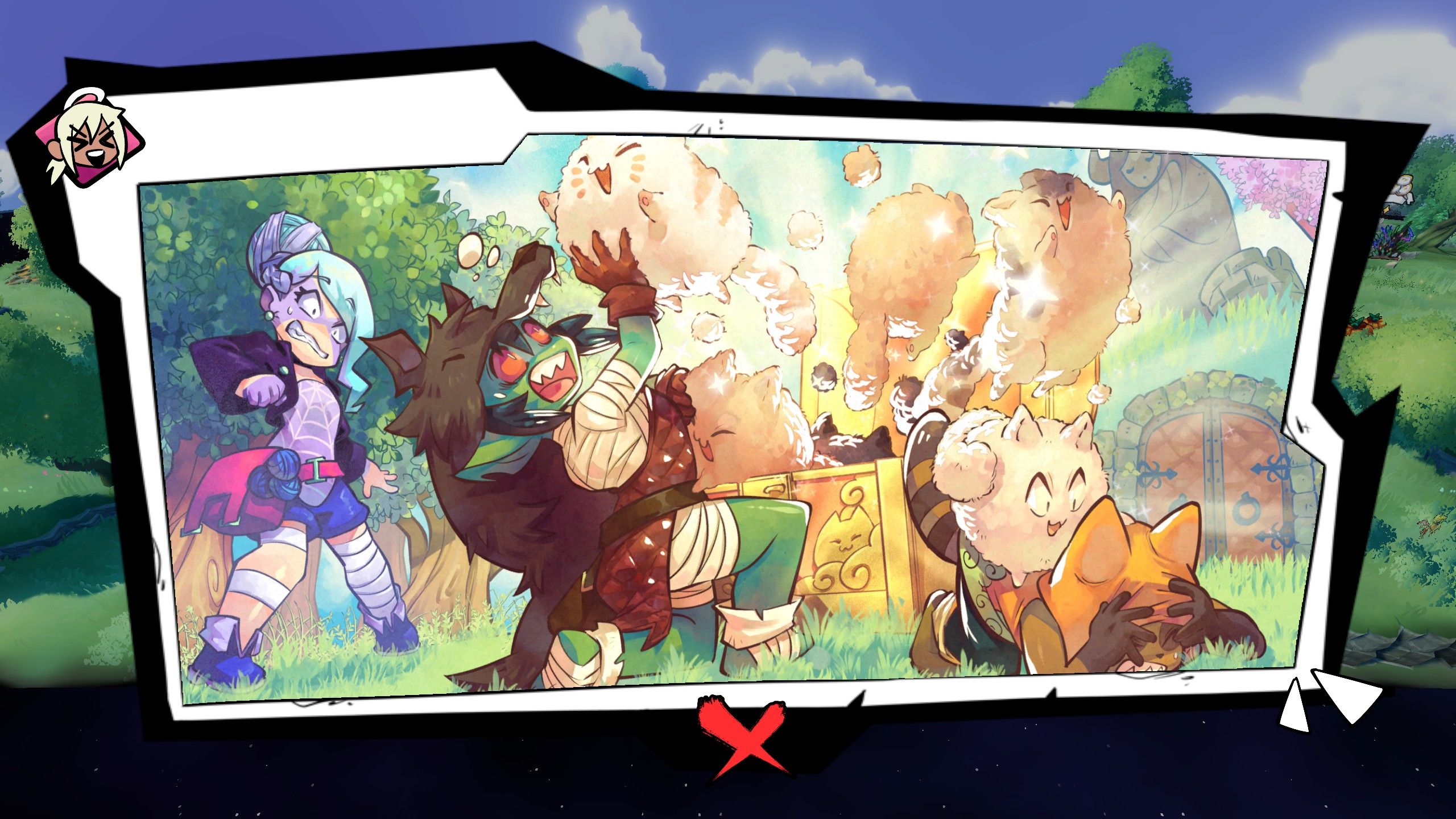
The personality is what carries this game, and it's carrying a lot. The cast is the strongest thing here by a distance — every adventurer is hand-drawn with its own quirks and voice lines, and each sits a few levels short of a "forbidden evolution" that's genuinely worth chasing. A Gobbo that dreams its way into angelic divinity, a Fox Musketeer, a Mooladin whose rivalry with its heretic twin unlocks a combo attack: these aren't filler units, they're the reason you keep a run going. Watching a scrappy nobody claw up into something absurd and powerful is the loop the whole game is built to deliver, and when it hits, it's the best thing GGAG does.
The framing sells it, too. Your adventurers' loyalty lies with the coin, not your cause — they arrive from every corner (humans, beasts, the undead and stranger things), some wander in on their own, and you keep them only by staying rich enough to be worth their while. That mercenary streak gives the town a texture most cozy builders lack; you're not a benevolent mayor, you're the one holding the purse. It's a smart bit of tone, and the writing commits to it instead of going soft.
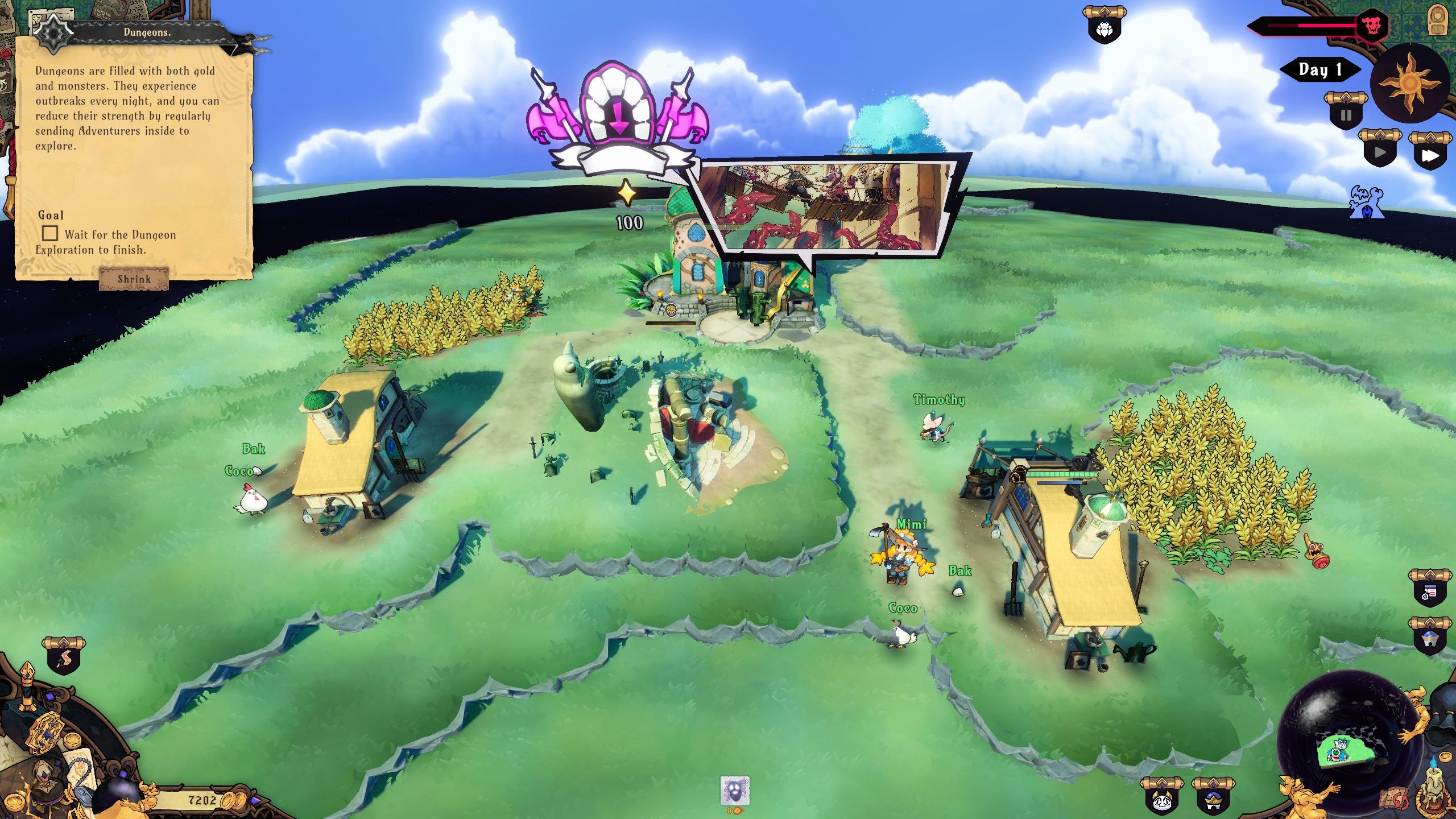
Underneath the charm is a real economy, and this is where the design earns its Majesty comparison. You don't place the dungeons — they're pre-existing monster dens dotting the map — so the actual decision is how close you dare build your markets, guilds and towers to them. Hug a dungeon for fast loot and fast levelling and you invite the attacks that spill out of it; play it safe and you grow slowly. The quests themselves are part of that arithmetic: posting one and attaching a reward costs gold up front, and you only earn it back — with a profit if you've judged it right — once the heroes come home and you tax the loot they sell. It's a genuinely nice touch that a bounty is a bet, not a free command, and it's the small detail that makes the greed feel real. You can also lean on it directly: bump a quest's reward and its "attractiveness" climbs, so heroes pick it over the competing jobs on the board. That single tension — spend to motivate, recoup through tax, decide what's worth pushing — does a lot of quiet work, and it's the part I'd point to as the game's real strength: the greed is always the interesting choice, and the map keeps asking you to make it. Directing heroes only indirectly — bounties, quest markers, spells on the wall when a wave hits, never a direct order — is a harder sell, and whether it lands depends entirely on how much you enjoy nudging over commanding. I do; some won't.
And the game is a moving target in the best way, which matters more than it sounds. It came out of early access with five content updates behind it, a whole Conquest mode added along the way, community-shaped units and near-weekly bugfix passes. More to the point, the developer actually answers feedback threads on Steam — confirming fixes, explaining delays, taking notes on UI requests — and it shows in what gets patched. For a rough-edged game this is the difference between "abandoned and janky" and "janky but clearly heading somewhere," and GGAG is firmly the latter. It's a real factor in the buy decision, not just a nicety.
"Never seen a dev team be this active with the community; keep it up, hoping for the best."
— a player on the Steam discussion boardsRaising a pet god beast, and the catch
The god beast is the other half of the hook — a divine pet you brush, discipline and feed until it evolves and learns powerful spells — and it's a charming idea that's underserved by how little the game explains it, which is the through-line of the whole early game. The systems all connect once you see them, but GGAG does a middling job of showing them to you. The tutorial is easy to skip and thin when you don't, so the honest new-player experience is losing two or three runs before it clicks — a bad first impression for a game that's much better than those opening hours suggest. A perk encyclopedia and perk list did arrive around launch and they help, but plenty still isn't surfaced in-game — not everything has a tooltip yet, and the dungeon and world text in particular is tiny with no size option. If you like reverse-engineering a game yourself, you'll read this as depth; if you don't, it reads as unfinished, and right now that's a fair reaction.
Balance is the other rough edge, and it bites hardest in Conquest. The star-rated missions vary wildly in difficulty, and the higher-rated ones sometimes feel impossible — you get swarmed by higher-level enemies with no roster capable of dealing with them. Players have flagged starts effectively lost before you act. Colony mode is friendlier but has its own quirks, like dungeon rescues quietly homogenising your town's population.
Then there's performance. Large late-game towns can hitch for a few seconds when you open the hero list or when monsters spawn from a destroyed lair. It's not constant, but it's noticeable once your colony gets big. The good news: the developer has laid out a big content patch, planned for around August, that targets exactly these pain points — difficulty options for Conquest, tooltips for everything, a new tutorial, a spell-casting and mission-screen overhaul, minimap and readability fixes, plus more optimisation. The catch about the catch is that it hadn't shipped as of early July, so right now you're buying the pre-patch version and taking the roadmap partly on trust.
- Thin onboarding — the tutorial is skippable and light; expect to lose a run or two before it clicks.
- Information still buried — a perk encyclopedia exists, but not everything has a tooltip yet and the dungeon and world text is tiny with no size option.
- Swingy difficulty — Conquest missions especially can jump from trivial to unwinnable with little warning.
- Late-game hitches — multi-second freezes on big colonies when opening menus or on mob spawns.
Where it sits right now
Two paths in front of the game, and which one you're buying matters.
- You loved Majesty or indirect-control god games and want a modern one.
- You enjoy figuring systems out yourself and don't need hand-holding.
- You back active indie devs and like watching a game improve month to month.
- You want a smooth, well-explained onboarding from minute one.
- Conquest mode is your main draw — its balance pass is still coming.
- You're sensitive to late-game stutter on a large save.
Who it's for
This is a game for the patient tinkerer — the player who reads Majesty as a compliment, who's happy to lose a run to a systems quirk and come back to solve it, and who gets a kick out of a Gobbo ascending to angelhood. If that's you, the wonky balance and steep learning curve are speed bumps, not walls, and the developer's pace means the version you buy today won't be the version you're playing in a month. If you need your builders polished and legible on day one, give it a season and check back after the big patch lands.