Guildrun demo review: the demo is excellent and one thing is missing
A dozen runs through the free Steam demo: Guildrun lands Slay the Spire's relics and TFT's items, but hero ranks decide too much of a run and there is no trait system. 7.5/10.

I went into Guildrun expecting a Teamfight Tactics clone with the players filed off. What I got was more careful than that: a single-player PvE autobattler roguelite that borrows Slay the Spire's relic economy and TFT's item logic, and then quietly refuses to borrow the one mechanic I most wanted it to steal.
The 7.5 is a really good foundation with one hole in the middle of it. Two acts, an endless mode with a global leaderboard, and I kept restarting the demo long after I had seen everything it had to show me. What holds it back is an upgrade economy that decides too much of a run, and the missing layer of team-level synergy that would make the parts add up.
Who this game is for, before you spend an evening on it: if you like systems you can take apart, and if you have ever kept a run going purely to see whether a build comes online, Guildrun is aimed squarely at you. It rewards playing the same demo again and reading what changed. If what you want instead is an autobattler where you look up a winning list and execute it, this is not that — there is no PvP meta to copy from, which is both the pitch and, as I will get to, the problem.
What the Steam page promises, and what Guildrun actually is
Leyline, a Munich studio staffed with people who have worked on Hearthstone and at Riot and EA, has been running this demo on Steam since 16 July 2026, patching it roughly every week. You build a party, you watch it fight, and you spend the gaps between battles making decisions: shop, relics, items, who is in and who is on the bench. There is no PvP, no queue and no timer, and you can save mid-run, so a run is yours to pause and think about.
The clever part is the bench. Guildrun lets you look at the enemy team before you commit, and swap. It also has a keyword called Backup, where a reserve hero still contributes from the sideline with a heal or a shield, which turns your bench from a storage box into an actual position. Abilities carry timing keywords on top of that — Rush triggers early in a fight, Stall late — so who sits out and when your damage lands end up being the same decision. That is a small idea with a lot of downstream consequence, and it is the sort of thing that tells you a designer was paying attention.
89.6%
Steam demo, 1,808 of 2,019
25
Heroes in the demo
300+
Relics, plus 100+ items
8
Difficulty tiers, then endless
The other clever part is that heroes are not locked to their job description. There are 25 of them to choose from in the demo, alongside hundreds of items and relics to explore, and every hero climbs a rank ladder — C then B then A then S — with each step handing you an ability choice. Multiclassing is the engine underneath that: the modifier pool stacks across classes, so a hero can pick up abilities that belong to somebody else's job. Take the right ones and a tank stops being a tank and becomes a carry that debuffs everything it touches. Mobalytics's worked example is a Duelist growing into an Assassin.
How a fight works: the hex board is the decision
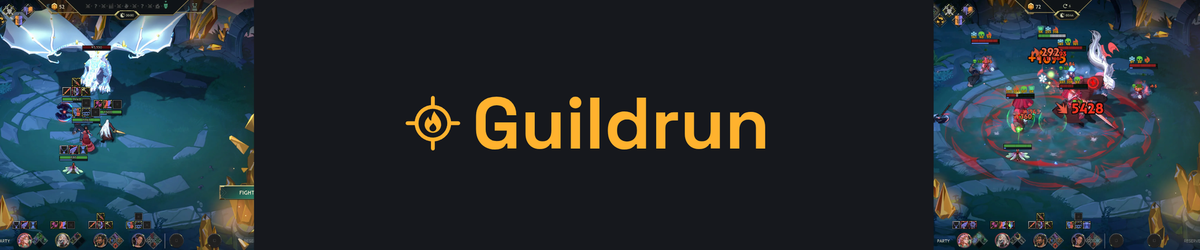
A fight is watched, not played. Your units attack on their own once the round starts, so everything that matters happens before it: the shop, the reward screen, and the board itself. You draft your heroes and position them in a hex arena four rows deep — the front two rows are the frontline, the back two the backline — and that split is the whole of Guildrun's spatial game. It is also the part that does not hold still. Some enemies pull or push your units into the backline, so a frontline you set up carefully does not necessarily stay a frontline, and the carry you parked at the rear can end up somewhere it cannot work.
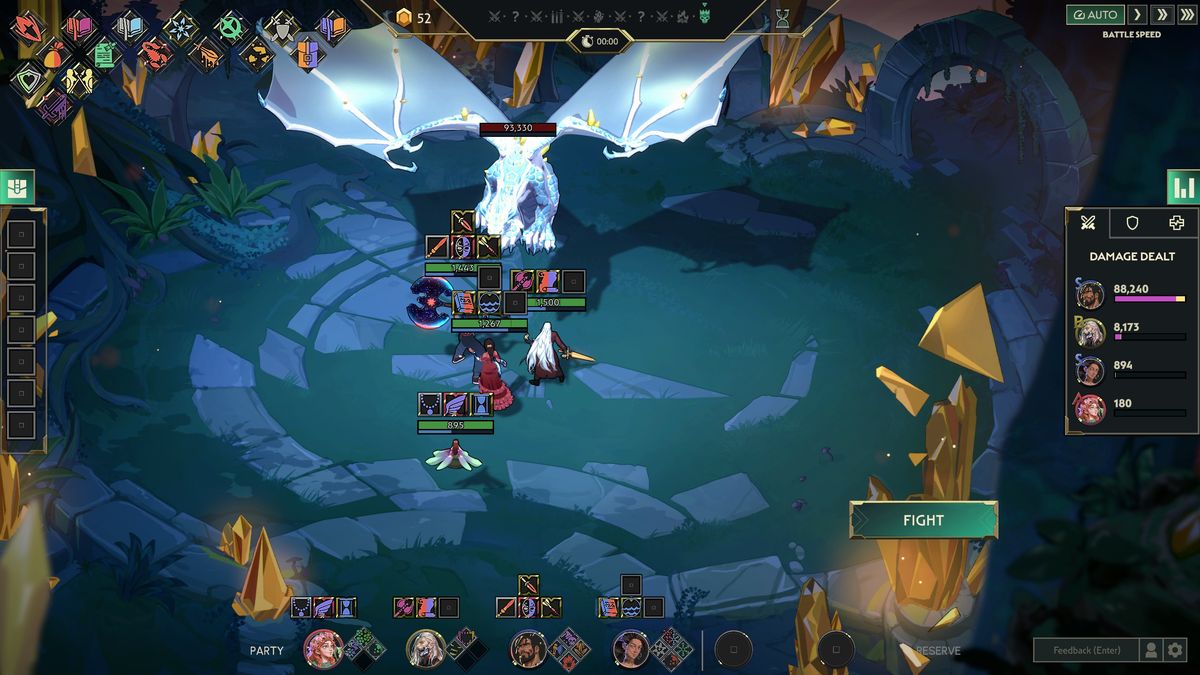
The board grows, too. You start a run with three heroes fighting and three on the bench, and you can upgrade your way to five fighting and one in reserve. That reads like a small number and is not: two extra bodies on a four-row board changes which rows you can afford to fill at all, and it is the single biggest structural swing available to you in a run. That is the autobattler bargain, and Guildrun keeps its side of it — the decisions are dense enough that watching feels like the payoff rather than the filler. If you would rather get to the next one, you can hand the fight to auto-battle and wind the speed up.
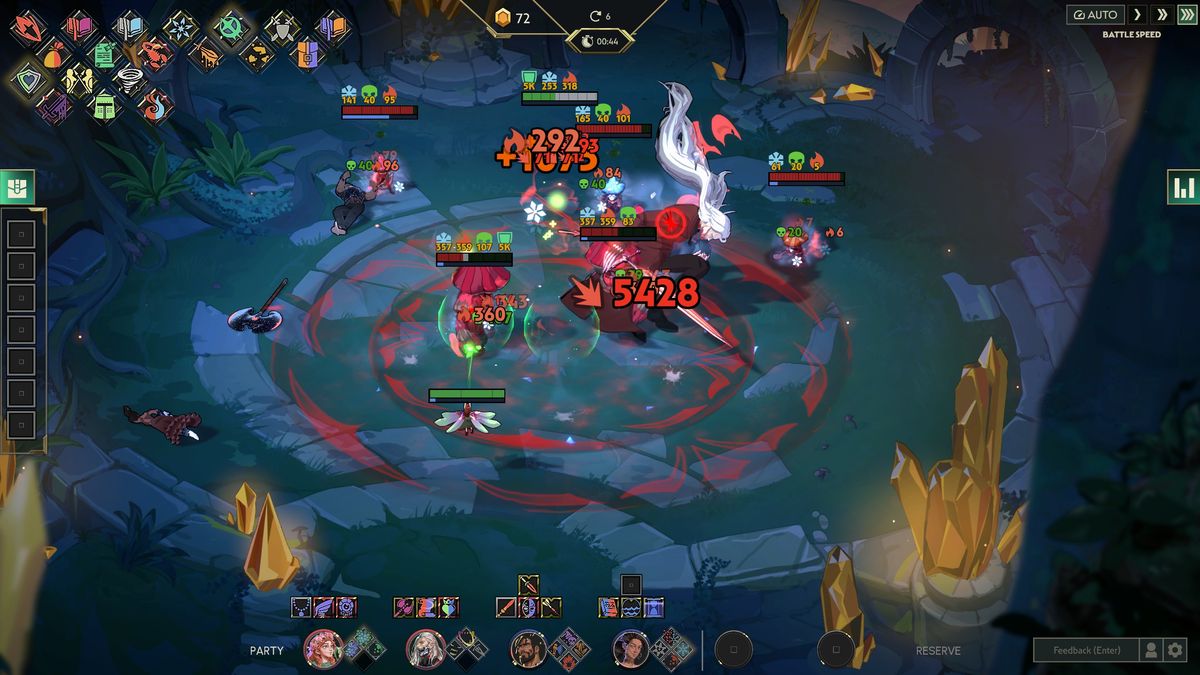
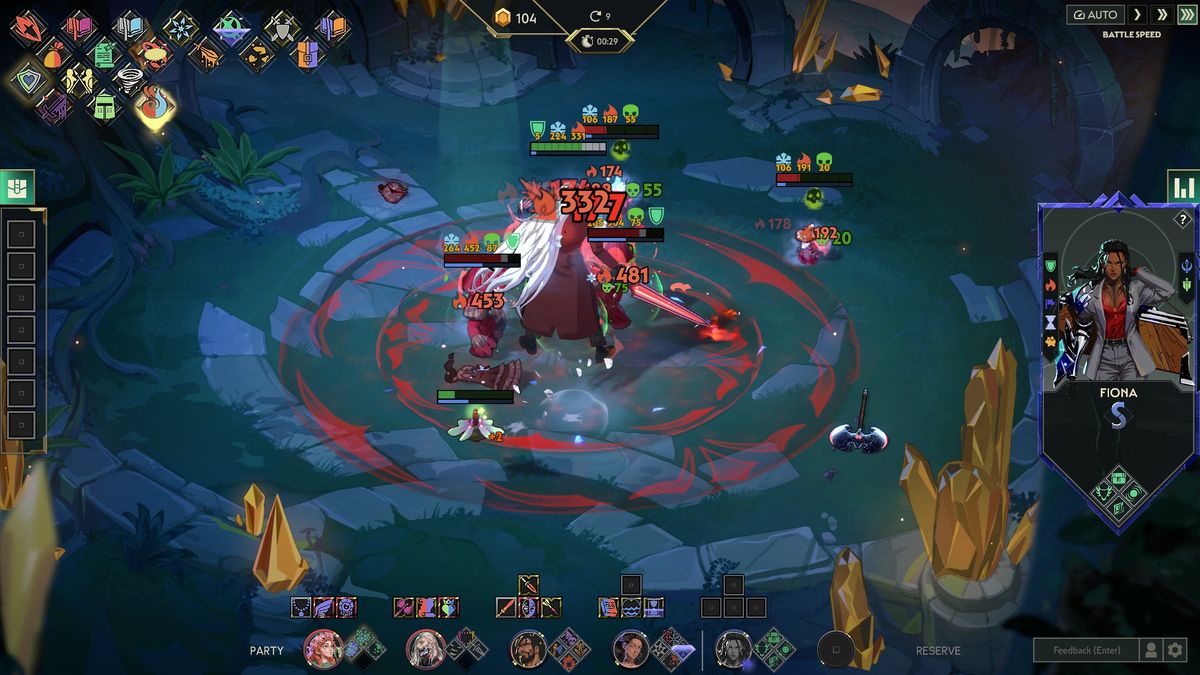
It also looks good doing it, which matters more here than it sounds. You spend a lot of a run watching, so the board has to be readable at a glance, and Guildrun's is. Damage numbers arc off the units at a size you can actually parse, status effects like burn and poison are legible without hunting for a tooltip, and enemies telegraph their big attacks with rings on the floor. Rogueliker singled out the cel-shaded art when the demo landed and I would agree, though I would put the emphasis on legibility rather than looks. Combat is not turn-based, for the record: the round plays out in real time and the clock in the corner counts up while it does.
Items, relics, and the quests attached to them
Items transform a character the moment you equip them, they come in rarities, and some of them solve a specific board problem rather than adding a number. An omnivamp item that heals a carry while it attacks is not a stat bump, it is the answer to a carry that keeps dying to the boss on turn three. Relics sit on the other side of the scale and change how the whole team plays for the rest of the run, which is where the Slay the Spire comparison actually earns itself. After each act there is an auction for better heroes, items and exclusive relics, including relics that let you field a larger guild.
Both of them also carry quests. Some are attached to relics, some to individual items, and clearing one does not hand you a reward from a pile — it unlocks more of the thing you are already holding. The item you picked up in act one is not a finished object; it has a condition on it, and meeting that condition triggers an unlock that opens up features it did not have when you equipped it. That is a quiet second progression running underneath the hero ranks, and it points at exactly the kind of second lane I am going to ask for in a minute.
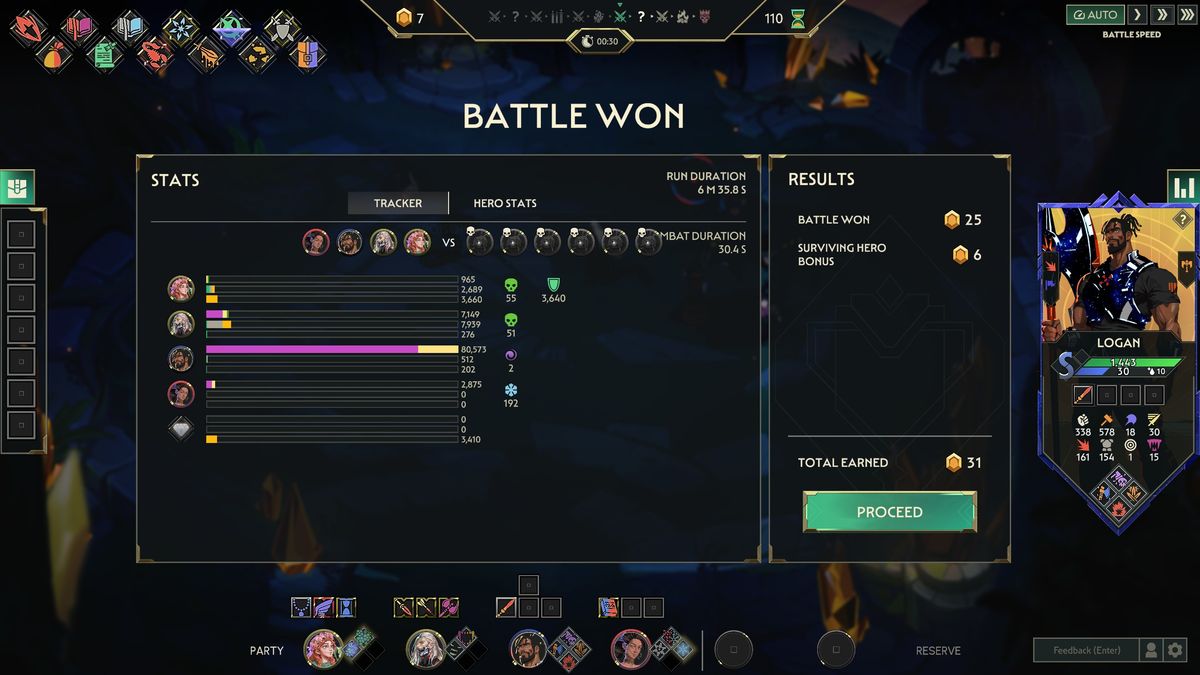
The gaps between battles carry the rest. There are Slay the Spire-style event dialogs to choose your way through — Kotaku picked those out too — and after each fight a stats screen with a tracker tab that shows which of your heroes actually did the damage. That last one is not decoration. An autobattler has to tell you whether the plan worked or the dice did, and most of them do not.
And the demo does have one synergy that pays you for pairing characters: put two lovers on the battlefield together and you get rapid scaling bonuses. Hold that thought.
Upgrades carry too much of the game
Here is where my score stops climbing. The rank ladder is not one system among several. It is the system. A C-rank hero contributes almost nothing, and the interesting upgrade combinations, the ones that make a run feel like yours, do not start showing up until B. So the first third of every run is spent not playing a build but waiting to be allowed to have one. And because the upgrades come out of a reroll, waiting is sometimes literal: I have burned ten rerolls in a row and come away with nothing.
I am not alone in this. It is the most persistent complaint in Guildrun's own Steam forum, where players describe act one as soft-capped at rank B and act two at rank A, and argue that a winning team essentially requires an S-rank plus two A-ranks kitted out in rare gear. Others push back and say they win with different comps every time, and I believe them, but "you can win with variety if the dice cooperate" is a different game from "you can build toward variety."
None of which means the randomness is the enemy. Adapting to what you are offered is the skill Guildrun is really testing: you do not arrive with a plan, you pivot into one, and a team that opens around a ranged damage dealer can finish built around burn damage because that is what the shop and the events put in front of you. Since the demo's launch in July the weekly patches have kept shuffling which of those routes is strongest, so the active best answer moves from month to month.
What I would want is not a nerf. It is a second lane. Give me a way to invest in a hero that is not the reroll, a slower path I can steer toward that costs me something else. And the frustrating part is that Guildrun already knows how to build one: that is exactly what the item and relic quests do. Gear gets a route that rewards playing toward a condition. Heroes only get the slot machine.
The missing TFT idea
The thing I kept reaching for and never finding: there is no trait system. No "three Duelists and you all get X." I assumed I had just missed the interface for it. I had not. A Leyline developer confirmed on the Steam forum, back in July, that classes are tags which modify base stats and nothing more, and that this is exactly why no synergy bar appears on screen. The lovers bonus above is the exception that shows the shape of the hole: the game is happy to reward a pair, but it will not reward a class.
I understand the reasoning. Trait tables are how TFT enforces a meta, and Guildrun's pitch is a game with no forced meta because there is no opponent to net-deck against. Fine. But the trade is real, and it costs something specific: team identity. In TFT, committing to a class is a promise you make early and get paid for later, and that arc is most of the emotional shape of a run. Guildrun replaces it with per-hero upgrades, which are individually more interesting and collectively less legible.
I can tell you what each of my characters does. I can't tell you what my team is.
The cost of having no traitsThe irony is that on the highest difficulty the game does start demanding a shape — a physical damage dealer, a magical one, a tank — which is a forced composition without the payoff of a trait bonus. That is the least attractive version of both designs, and it is the one place where I think Guildrun has chosen wrong rather than chosen differently.
Endless mode and the difficulty ladder
Beating the demo is not the end of the demo. Eight difficulties stack fresh modifiers on each successful run, and once you are through, endless mode runs until you die and feeds your result into a global leaderboard. Kill the demo boss and the victory screen does not send you to a menu, it says "Victory! Starting endless run" and keeps going. It is the Ascension ladder by another name, and it is the reason a free preview has been holding people for weeks rather than an evening: the median demo player had put in nearly four hours by late July, on the studio's own numbers.
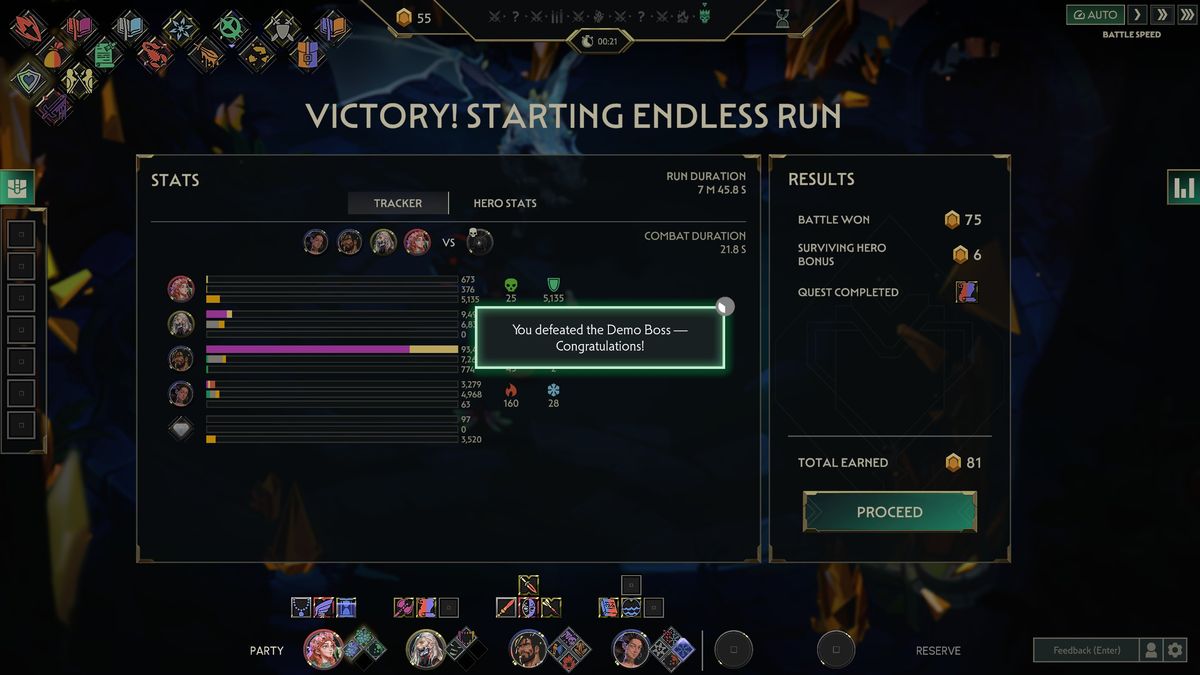
A word on length, because the twenty-minute figure gets repeated a lot: that is the design target, not a floor. With auto-battle on and the speed wound up, one of my winning runs clocked in at seven minutes and forty-six seconds, of which the deciding fight was twenty-two seconds. You can play Guildrun slowly and think. You can also inhale it.
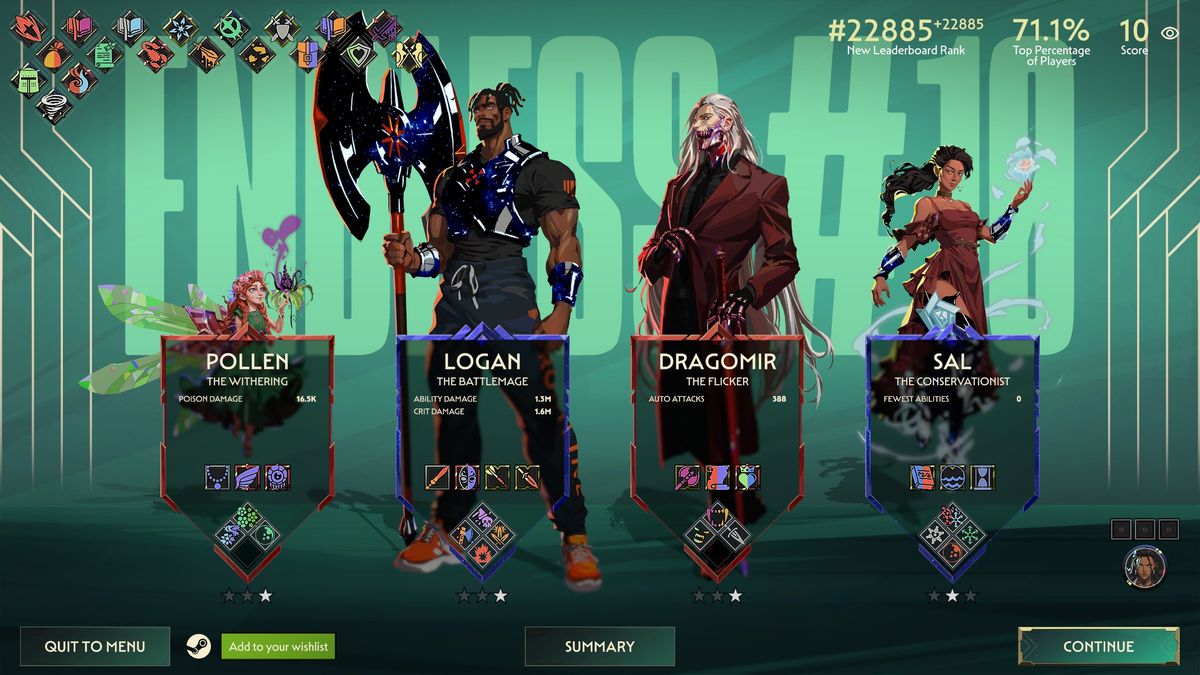
The end-of-run screen is the detail I did not expect to like as much as I do. Every hero gets a title for what they actually did that run, scored off their own numbers: my poison carry came back as The Withering, the mage who did 1.6 million crit damage as The Battlemage, and the support who never cast a single ability as The Conservationist. Underneath sits your leaderboard rank and the percentile you landed in. It is a small piece of theatre and it does more for the one-more-run pull than the leaderboard number does on its own.
What the reception looks like from outside
Nobody has scored this game, which is unusual for something this visible. Kotaku called the demo good enough to take on Slay the Spire and left it there. Mobalytics went deepest on the systems and landed positive, with one reservation that lines up with mine: the multiclass options are fixed per hero, so you cannot quite build the thing you are picturing. The Steam demo sits at 89.6 per cent positive across 2,019 user reviews as of 6 September, very positive by any standard, though the last thirty days run a couple of points below the lifetime figure and the review count has flattened out over the past week.
The forum is louder than the score suggests, mostly about the weekly balance patches. Regulars feel the nerfs are sanding down the builds they liked; other players show up specifically to praise how the patch notes are written. Leyline replies in both threads, which is more than most studios manage.
Some of that noise is by design. There is a Feedback button sitting in the corner of the game itself, bound to Enter, and the studio has been shipping balance changes every week since the alpha launched in January. An active community arguing about balance in public is a healthier sign than silence, even when the arguing is unpleasant to read.
Who the Guildrun demo is for
Download it today
It costs nothing and it is more game than most demos.
- You like taking a system apart and you read item text for fun.
- You want Slay the Spire's relics without Slay the Spire's card game.
- You liked Teamfight Tactics but never wanted the opponent.
- You have twenty minutes, or seven if you wind the battle speed up.
Wait for the full release
Nothing here is broken. Two things are unfinished.
- You want to plan a build from turn one rather than pivot into one.
- Reroll RNG deciding your first act is a dealbreaker.
- You came for TFT-style trait payoffs — there are none.
- You would rather wait for a finished game, which is targeted at 2027.
The split is cleaner than it usually is with a demo, because the thing that would move Guildrun from a 7.5 to a 9 is not more content. It is one more way to spend what a run gives you.
Should you play the Guildrun demo?
Yes, and it costs you nothing: the Guildrun demo is a free download on Steam and stays free. It is unusually generous — two full acts and an endless mode is more than some games ship — and if it clicks, twenty minutes is a dangerous run length. The store's line is that no two runs feel the same, and that one holds up: there is enough to explore here that the fun does not run out when the demo does.
7.5 out of 10. This is a really good foundation, and I say that as someone who could not stop playing around with it: a good idea executed with more care than a demo requires, held back by an upgrade economy that decides too much and a missing layer of team-level synergy that would make the parts add up. Both are fixable before the full release, which Leyline is targeting for 2027. If they get fixed, I will be revisiting this number.
Guildrun demo questions
Is the Guildrun demo free?
Yes, and it stays free. It has been on Steam since 16 July 2026 and carries two full acts, eight difficulty tiers and an endless mode with a global leaderboard. There is no time limit and no purchase gate at the end of it. The full game has no price on the store page yet, so nothing about the demo tells you what the finished release will cost.
How long is one Guildrun run?
About twenty minutes is the design target, but that is a target and not a floor. With auto-battle on and the battle speed wound up, one of my winning runs finished in seven minutes and forty-six seconds. There is no timer and no matchmaking, and you can save mid-run and come back, so the number is really whatever you want it to be.
Does Guildrun have TFT-style traits?
No, and this is the most common misreading of the game. A Leyline developer confirmed on the Steam forum that classes are tags which modify base stats, with no automatic bonus for stacking several heroes of the same class. Synergy comes from items, relics and per-hero upgrades instead. The one exception is a pair bonus for two lovers fielded together.
Is Guildrun PvP?
No. It is a single-player PvE game and Steam lists it as such. Difficulty scales through a ladder of eight tiers and then endless mode rather than through opponents, and the leaderboard compares results after the fact instead of matching you against anyone. That is also why the game has no forced meta — there is nobody to net-deck against.
How many heroes are in the Guildrun demo?
Twenty-five, alongside 300-plus relics and 100-plus items. How many ways there are to build one of those heroes is less clear: the store page says 180 specializations in one bullet, 75 spec paths in another, and over 500 unique ways to level a hero in the body text. The demo unlocks them run by run rather than handing you the roster up front.
When does Guildrun come out?
Leyline's own FAQ states they are aiming for 2027, and that is the only figure worth quoting. Steam says "To be announced" with no price, the press release from July says 2027 in its body text, and a "first half of 2027" line appears only in the boilerplate at the foot of that release. A beta has been mentioned once, without a date.
Does the Guildrun demo run on Steam Deck or Linux?
There is no Linux build. Steam lists the demo for Windows and macOS only, with a minimum of a GTX 960 or RX 470 and 8 GB of RAM on the Windows side, and an Apple M1 with 16 GB on the Mac side. Valve has not published a Deck compatibility rating for it, so anything about Proton performance would be a guess.