Is Black Desert Online pay to win? A 2026 reality check (PC)
A neutral, area-by-area look at how pay-to-win Black Desert Online really is in 2026 - cash shop, Cron stones, Value Pack and the silver pipeline, each scored on a slider.

“Is Black Desert Online pay to win?” is one of the oldest arguments in the MMORPG, and the honest answer is: it depends which part of the game you point at. Nothing lets you click a button and buy a maxed weapon — but money still buys silver, silver buys gear, and the cash shop sells a stack of convenience that quietly widens the gap between a paying player and a free one.
So instead of one verdict, this guide scores each area of pay-to-win separately, so you can see exactly where the money goes and how much it actually matters. Everything here is about Black Desert Online on PC (NA/EU, Pearl Abyss) — Black Desert Mobile is a separate, far more monetised game and isn’t covered.
The Black Desert pay-to-win scorecard
Scale: 0 = not pay-to-win at all, 10 = egregiously pay-to-win. Each area is scored on its own, because averaging them hides the whole point.
Overall read: Black Desert sits in the messy middle. It’s not cosmetic-only like Guild Wars 2, and it’s nowhere near a hard cash-for-power Korean grinder either. The pain points are time, convenience, and a storefront that runs like a permanent clearance sale — not a locked win button.
How Black Desert Online makes money
Black Desert is buy-to-play, not subscription — and it’s sold in three editions, each just the one below it plus a bundle of cash-shop convenience:
| Edition | Typical price | What you get on top |
|---|---|---|
| Traveler | ~$10 | The base game — everything you need to play. |
| Explorer | ~$40 | Traveler plus a starter bundle of Pearl and convenience items. |
| Conqueror | ~$90 | Explorer plus a larger bundle — more pets, weight, Value Packs and cosmetics. |
Crucially, the pricier editions don’t sell power — they front-load convenience (the exact pets, weight and Value Pack items covered below). And prices barely matter in practice, because Black Desert is on sale almost constantly: Steam discounts run regularly and deeply, with the Traveler edition routinely hitting up to around 90% off (roughly $1) and the higher tiers around 50% off. It also goes fully free for limited windows, so the real entry cost is close to zero, with no mandatory subscription.
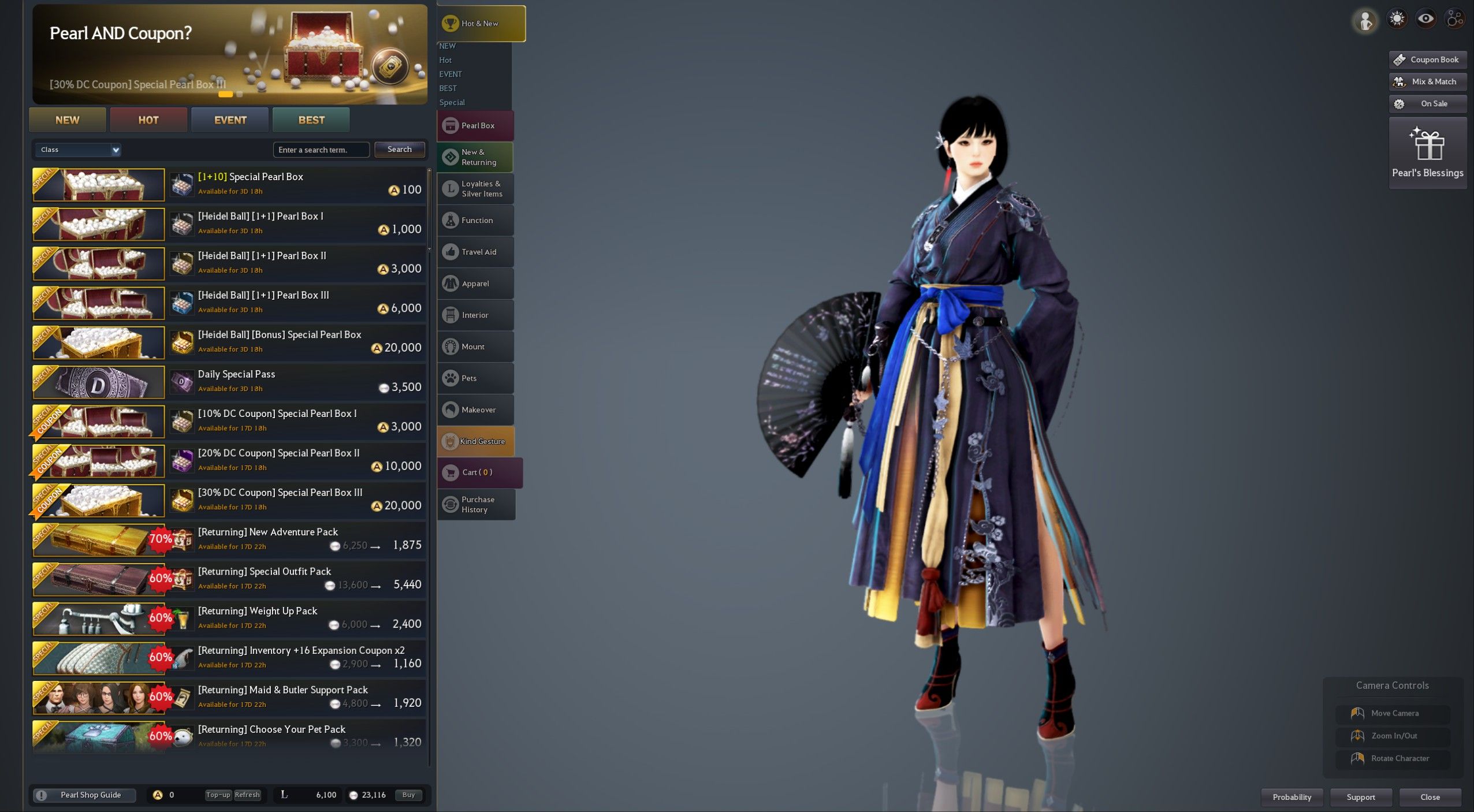
Real money buys Pearls, the game’s premium currency, spent in the Pearl Shop (opened with F3). The shop sells costumes, pets, convenience items, and a set of near-subscriptions. The single most important fact for the whole debate: the Pearl Shop never sells gear, enhancement levels, stats or silver. There is no “buy a PEN weapon” option. Everything that looks like pay-to-win is indirect — and that indirection is the whole story.
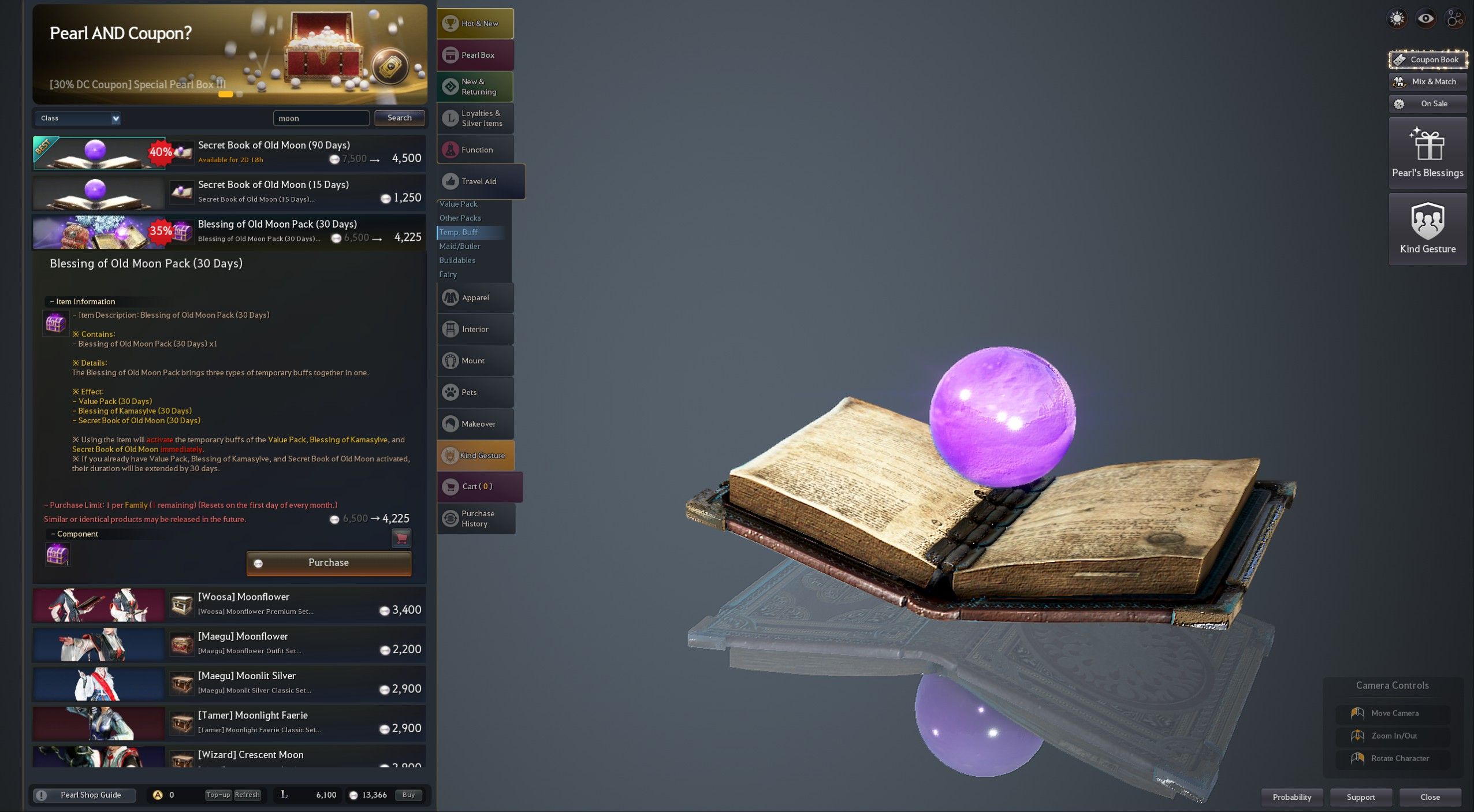
There is a subscription, though. It just isn’t called one. Three shop items are monthly passes in everything but name: the Value Pack, the Blessing of Kamasylve and the Secret Book of Old Moon. Pearl Abyss sells all three together as the Blessing of Old Moon Pack (30 Days) for 6,500 Pearls. Pearls run about €10 per 1,000, so the full stack lists at roughly €65 a month — more than any subscription MMO charges to play at all. The giveaway is in the fine print: one per family, and the limit resets on the first day of every month.
Two things soften that number. The bundle is discounted almost as a default — it was 35% off the day these prices were read, which brings it closer to €42 — and none of the three is required to play, progress or compete. What they buy is throughput: experience rate, carry weight, energy, drop rate, and the 30% of every market sale the Value Pack hands back to you.
Skip them and nothing stops you. It just feels like you’re playing inefficiently — which is a strange thing to feel about a game you play for fun, and a very effective thing to sell against.
The one thing you cannot buy: direct power
Pay-to-win score — direct power 1/10
You cannot pay Pearl Abyss for a stronger character. No power gear, no accessories, no silver, no guaranteed enhancement result is on sale. Compared to games that literally list stat gear in a shop, this is the cleanest part of Black Desert’s model — and it’s why longtime players bristle at a flat “it’s pay-to-win” label. The score isn’t a zero only because everything below exists because the shop feeds the economy.
The Central Market: the cap that changes everything
You can’t trade freely with other players, and you can’t buy silver from gold sellers inside the game’s systems. Every transaction runs through a developer-regulated Central Market with three features that define how much pay-to-win is even possible:
- Price caps. Every item has a base price and a hard min–max band (roughly 7.5% steps). You physically cannot overpay, and hot items sit on a pre-order (bidding) waitlist.
- Weekly limits on cash-shop items. You can only register a small number of Pearl items on the market per week (historically around five per family).
- A tax exemption that matters. Items bought directly from the Pearl Shop and resold skip the 30% market tax (event and box pearl items don’t).
The takeaway: Black Desert’s economy is a walled garden. That wall blocks the classic pay-to-win of buying a billion silver off a website — but it also builds the one legitimate cash-to-power pipeline, then throttles how fast silver can flow through it.
The real pay-to-win lever: turning outfits into silver and Cron stones
Pay-to-win score — cash to silver to gear 5/10
Here’s the actual mechanism players mean when they say Black Desert is pay-to-win:
- A paying player buys Pearl Shop costumes (or pets, or Value Packs) with real money.
- They sell those outfits on the Central Market for silver — tax-free.
- That silver buys enhanced endgame gear off the market. Money became power, one step removed.
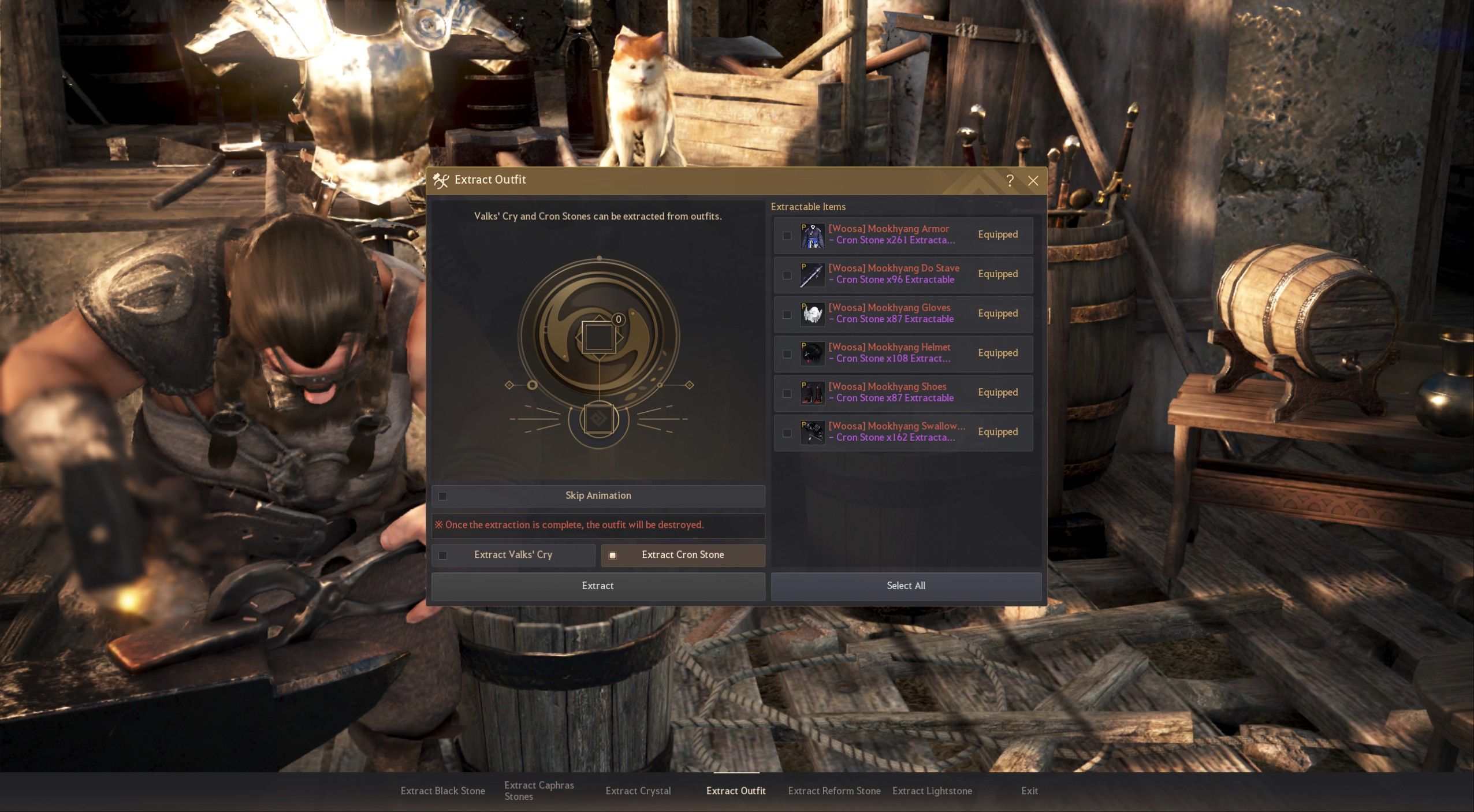
There’s a second, spicier route. A full Pearl outfit can be melted at a blacksmith into enhancement materials — either Cron Stones or Valks’ Cry, your choice at the extraction window. A six-piece set checked in-game in August 2026 came to 801 Cron Stones. That’s not selling the costume for silver; that’s converting a cosmetic straight into gear-progression fuel. When this launched in 2018 it triggered the original “Black Desert just went full pay-to-win” firestorm, and it’s still the strongest single argument for the label today. Pearl Abyss has raised the extractable amount since — an official 2023 notice lifted it from 621 to 993 per premium set — so older guides quoting a couple of hundred stones are badly out of date.
Why it’s a 5 and not a 9: the market caps and the roughly five-items-per-week limit mean a whale can’t dump a paycheck into instant best-in-slot. It buys a head start and a cushion, not a finished character — and everything they bought, a free player can also buy with silver they grinded.
Enhancement helpers: Cron, Valks and Artisan’s Memory
Pay-to-win score — enhancement helpers 4/10
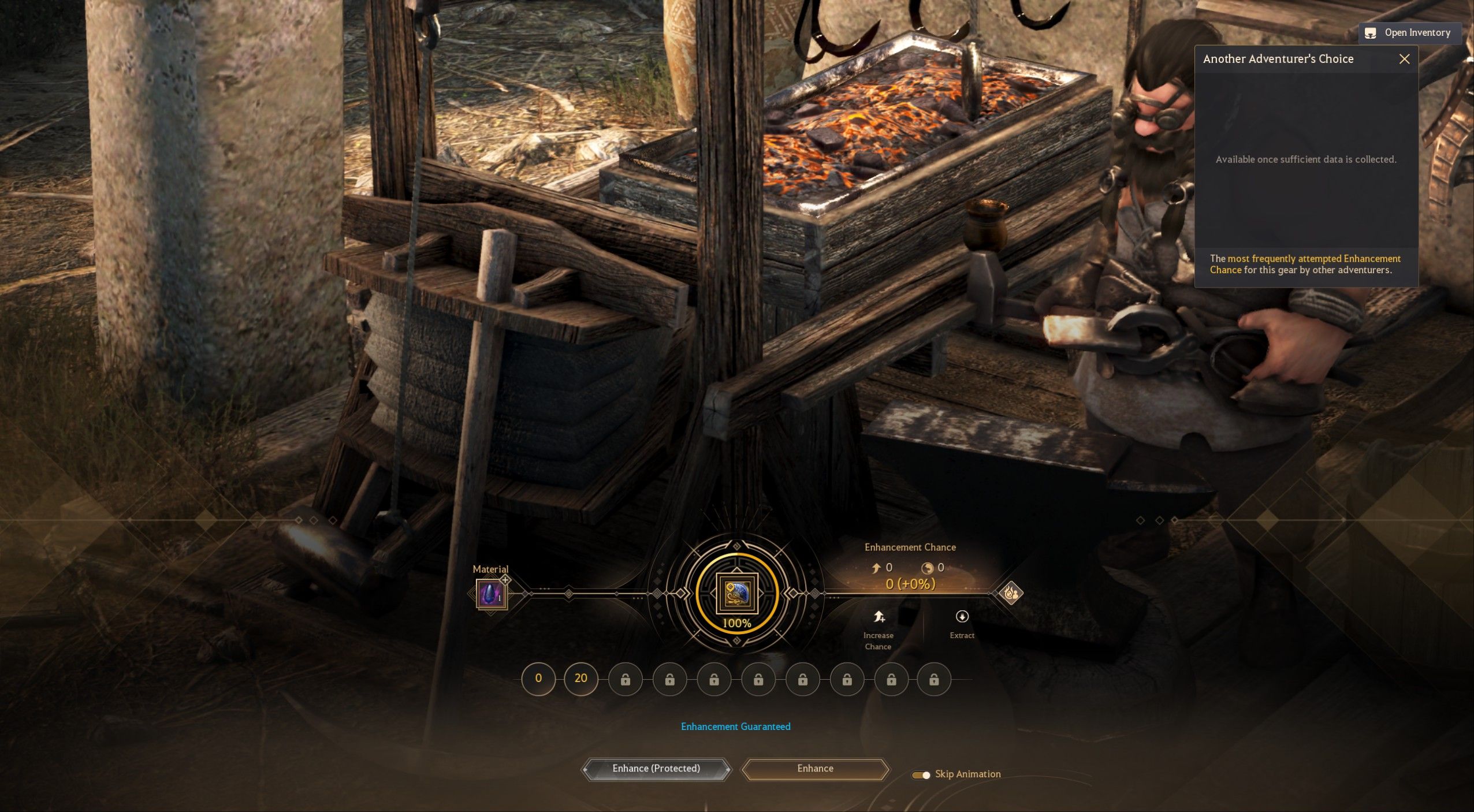
Gear power in Black Desert comes from enhancement (sometimes called enchanting) — an RNG upgrade system where high-level attempts can go backwards, dropping a level or destroying an accessory on failure. That gambling loop is the emotional core of the pay-to-win fight, because the cash shop sells ways to soften it:
| Item | What it does | Free route? |
|---|---|---|
| Cron Stone | Protects gear from downgrading on a failed enhance | Yes — attendance, events, 2–3M silver each, or outfit melt |
| Valks’ Cry | +1 failstack (higher success chance), up to +10 | Yes — Loyalty shop, Fairy’s Blessing, outfit melt |
| Artisan’s Memory | Repairs 5× max durability, saving big silver on top gear | Yes — Loyalty shop, slowly |
| Black Spirit’s Essence / Brand Stone | Save silver on crystals and durability | Yes — in-game |
Notice the right-hand column: every one of these is obtainable in-game. Paying skips the grind; it doesn’t unlock anything exclusive. Artisan’s Memory gets called “the most pay-to-win item in the Pearl Shop,” but even that is a silver-saver you can farm through Loyalty over time. That’s why this area scores a moderate 4 rather than a high number.
Why Black Desert is less pay-to-win than it used to be
This is the part outdated “Black Desert is pay-to-win” videos miss. Over the last few years Pearl Abyss has repeatedly added free, deterministic systems that shrink how much an advantage cash can buy:
- Caphras Stones (farmed in-game) add guaranteed stats to TRI+ gear and eventually push it to the next level at 100% — a non-RNG path to TET and PEN that money can’t meaningfully shortcut.
- The Ancient Anvil / Guaranteed Enhancement (added 2024, still live). Every failed attempt banks Agris Essence; hit the threshold and your next enhance is a guaranteed success. Persistence now converts directly into a result — exactly what Cron and Valks used to be bought to fake.
- Loyalty shop, Fairy’s Blessing and Laila’s Petals give free players real in-game routes to the same enhancement helpers.
- Seasonal servers, free Tuvala and Naru gear, and the Olvia Academy hand new and returning players a strong free running start that didn’t exist in the early years.
The trend line matters for a fair verdict: the mechanics that earned Black Desert its pay-to-win reputation are still in the game, but they buy less advantage every year.
Pay-for-convenience: pets, weight, Value Pack and maids
Pay-to-win score — convenience and time 7/10
This is where money actually changes your day-to-day the most — and, ironically, where the least power is sold. None of it makes your character hit harder, but all of it makes you richer and faster per hour, which in a grind-driven economy is the advantage.
- Pets — auto-loot (near-essential for efficient grinding, and they speed up AFK activities like fishing) plus EXP, weight and drop buffs. A full set of top-tier pets can climb into the hundreds of dollars at worst luck.
- Weight Limit — a character with high weight grinds, processes and crafts roughly three times longer before hauling back to town. Buying up costs around $100 of Pearls.
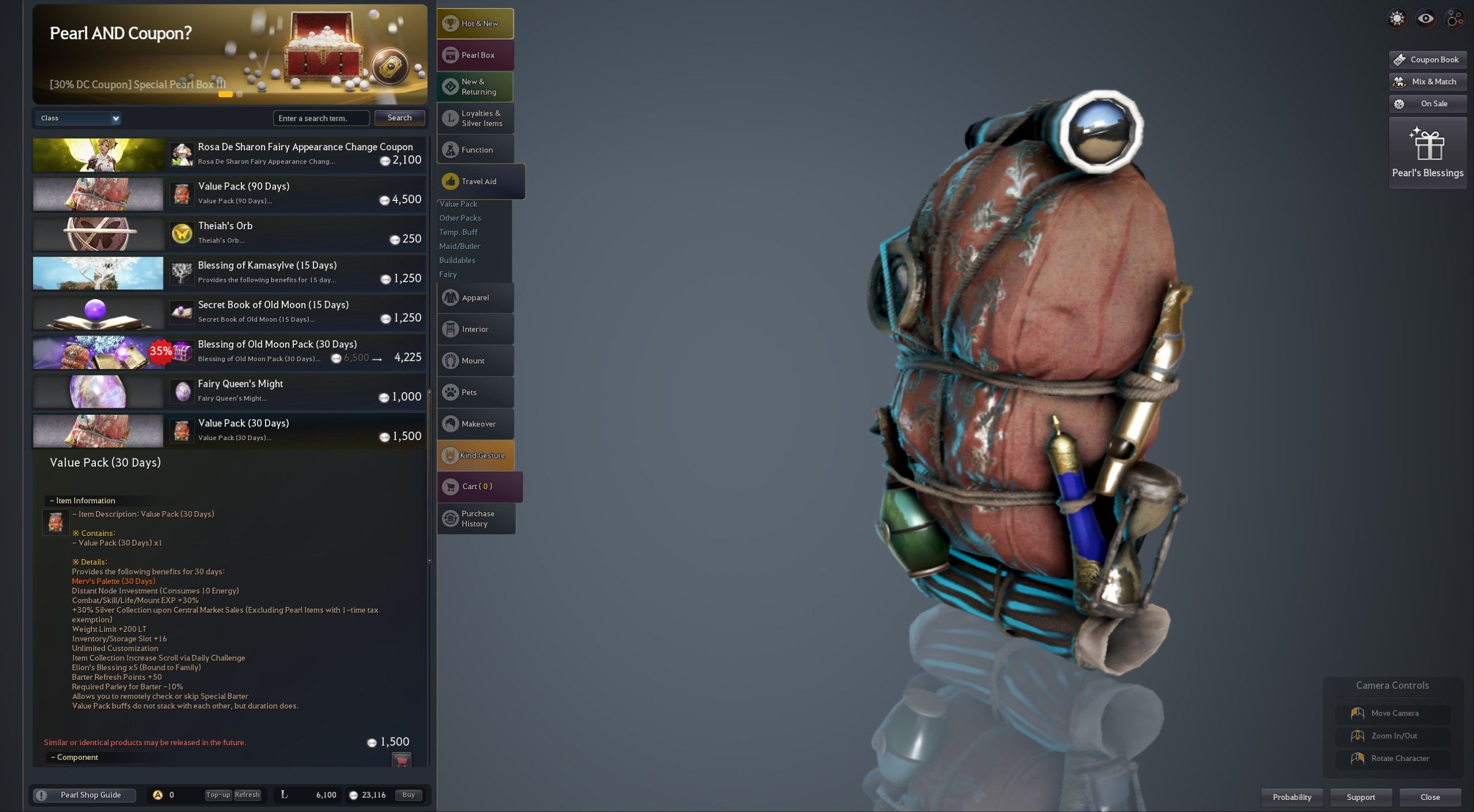
- Value Pack (30 days) — the big one: +30% marketplace sell proceeds, plus EXP, and more inventory, storage and weight. That market bonus alone is a permanent income edge.
- Secret Book of Old Moon — +100% Combat EXP and free skill resets.
- Maids — remote Central Market and storage access; a complete setup is often quoted around €240.
- Blessing of Kamasylve — +20% item drop rate and more; once controversially promised for removal, still purchasable.
The honest framing: call it convenience if you like, but +30% marketplace income and +20% drop rate are economic power. This is the strongest real-money advantage in the game, and it’s why this slider sits highest — a 7, not a 10, because it’s all grindable-around and time-based rather than a locked stat wall.
Is Black Desert pay to win for life skillers?
Pay-to-win score — life skilling 6/10
Most pay-to-win arguments are about combat gear, and life skillers get told the debate doesn’t concern them. It does — just differently. Gathering, cooking, alchemy, processing, farming, fishing and trading are all silver-per-hour jobs, and almost every lever the Pearl Shop pulls is a silver-per-hour lever. The exposure here is wider than combat’s but shallower: more of your daily routine touches the cash shop, and none of it touches the ceiling.
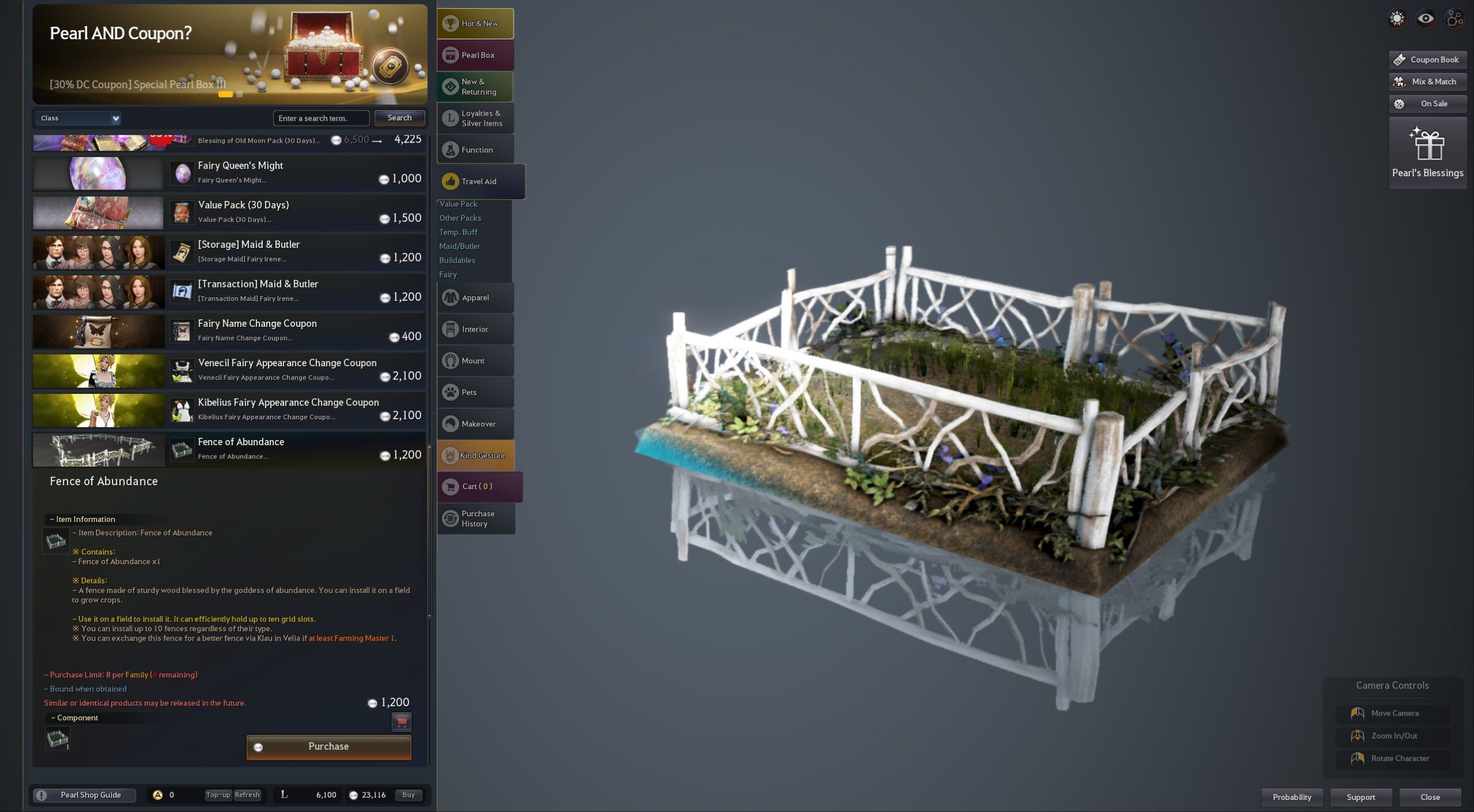
Farming is the clearest case. A family can place ten fences, one hundred seed slots, and rented fences cost Contribution Points — up to ten each. The Pearl Shop sells the Fence of Abundance, a ten-slot fence that costs no Contribution Points at all, up to eight per family. Buy eight, add the two free questline fences, and you run a full farm having spent zero CP — roughly a hundred points left over for workers, nodes and lodging. The CP on rented fences is refundable, so this is a loan rather than a loss, but it is the one place in the game where cash converts into a resource that free players ration.
| What you can buy | Pearls | What it does for a life skiller | Free route? |
|---|---|---|---|
| Fence of Abundance | 1,200 | 10 farming slots for 0 CP, up to 8 per family | Partly — rented fences cost 3–10 CP and are refunded when handed back; two 10-slot fences come free from a questline |
| Value Pack | 1,500 / 30 days | +30% Life EXP, +200 LT, and +30% of the silver on every Central Market sale | Partly — a 1-day Value Pack sits in the Loyalty shop, once per family per week |
| Secret Book of Old Moon | 1,250 / 15 days | +50% Life EXP and +50% Skill EXP | Partly — 1-day version via Loyalties, once per family per week |
| Blessing of Kamasylve | 1,250 / 15 days | +2 energy recovery, +20% item drop, +4,000 VT market warehouse, +1,500 LT storage transport | Partly — 1 day for Loyalties, once per family per week |
| Maids and butlers | 1,200 each | Move items between inventory and warehouse from anywhere, one stack per maid per 20 minutes | Yes — the Central Market itself works remotely without any maid, and two maids come free from Black Spirit quests |
| Pets | 900–1,800 | Up to +46% Life EXP across five, a hedgehog that procs extra gathering, otters that shorten AFK fishing | Yes — free pets from the story, Loyalties and events; breeding up to T4 costs nothing |
| Weight limit | 3,200 / 3,600 | Family-wide +350 and +400 LT bundles; weight decides how long you gather or process before a storage run | Yes — Strength level, Adventure Log, PEN Manos belt (+600 LT), Verdure Draught (+200 LT) |
| Functional Pearl outfits | per skill | Per-skill effects: +3% processing success and processing straight from storage, shorter cooking and alchemy timers, +1 Fishing | No direct copy — but the mastery clothes that matter more are in-game only |
| Energy Tonic | 60 | Restores 100 Energy — the meter that limits gathering, alchemy and node investment | Yes — energy refills by itself over time, and your cap grows as you collect knowledge |
| Worker’s Lodging coupons | 200 | +1 lodging slot in a town, permanent, for 0 CP | Yes — lodging normally costs about 1 CP per worker, and each town gives one slot free |
| Naphart Campsite | one-off | A permanent field anvil that repairs life-skill tools and gear at town cost | Yes — the free Old Moon tent does the same, but its anvil contract expires and renews for silver |
Pearl prices checked in the NA/EU client on 16 August 2026. Pearl Abyss discounts heavily and often — the Blessing of Old Moon bundle was sitting at 35% off the day these were read — so treat them as list prices, not what you’d actually pay.
What cash actually moves
- Silver per hour — the Value Pack’s 30% cut of every market sale is the single biggest number on this page for a life skiller
- Contribution Points, freed up by bought fences and lodging coupons
- Time — pets, weight and remote maids remove the walking, not the working
- Field uptime — a campsite anvil that never needs renewing
What it can’t touch
- Life Mastery — Loggia, Geranoa, Manos and Preonne are crafted, exchanged or bought with silver, never with Pearls
- PEN Manos clothes (400 Mastery) and a six-piece Preonne set (+98% Life EXP)
- The best consumables — Verdure Draught, and Royal Workshop food at +250% Life EXP
- Guild skills like Guru’s Touch, another +40% Life EXP for nothing
Why it’s a 6: higher than the cash-to-gear pipeline, because a life skiller meets the cash shop in more places and meets it every single day — the Value Pack in particular is close to mandatory if you sell on the market for a living. Lower than a hard verdict, because the actual life-skill power curve, from Loggia through Manos to Preonne, is silver and patience from top to bottom. You can buy a faster start and a better margin. You cannot buy Mastery.
Can you buy your way to winning PvP?
Pay-to-win score — PvP integrity 3/10
Black Desert is an open-world PvP game, so gear absolutely matters — a better-geared player can shove you off a grind spot or win a node war duel. Money that buys gear faster does buy an open-world edge. That’s the case for a higher score.
But the ceiling tells the other half of the story. In gear-normalised and skill-gated modes, like ranked arena, the community’s favourite line is that you could spend €10,000 and still not crack the top 500 — because those modes flatten gear and reward mechanical skill. You can’t buy a win the way you buy a costume. Money buys the on-ramp, not the trophy.
How in-your-face is the monetisation?
Pay-to-win score — aggressiveness 8/10
The Pearl Shop doesn’t interrupt your game. It doesn’t need to — it is a permanent sale.
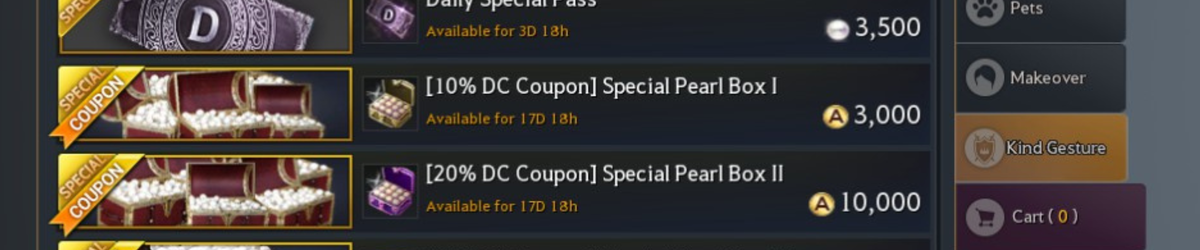
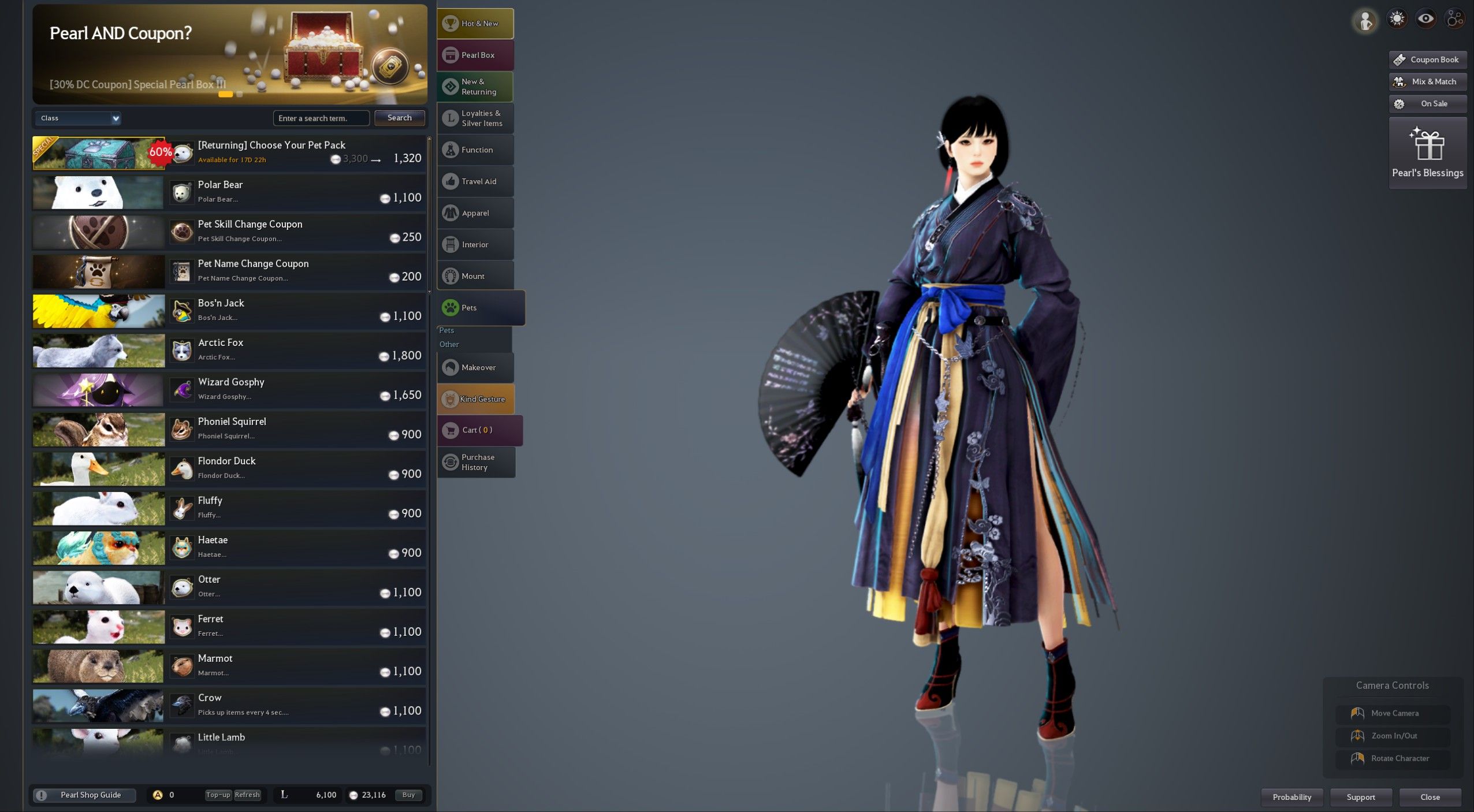
Open F3 on an ordinary afternoon and the top of the storefront is a rotating banner ad pushing a discount-coupon bundle. Below it, a wall of red percentage badges: 30, 35, 40, 60, 70 percent off. Most of the good items carry a countdown — available for 2d 18h, available for 17d 22h. Around the edges sit an On Sale tab, a Coupon Book, a Mix & Match builder, a Pearl’s Blessings panel and a gifting panel. That is five separate merchandising surfaces before you have looked at a single item.
Then the scarcity language. Purchase limits that reset on the first of every month, so a pass you skipped is a month you lost rather than money you saved. “1 remaining” counters on the bundles. And on nearly every tooltip, the line “Similar or identical products may be released in the future” — a legal disclaimer that functions as buy-it-now pressure.
Energy has a price, too. It is the resource that caps how much you can gather, brew or invest in nodes, and it refills on its own — slowly. The shop sells a tonic that restores 100 Energy for 60 Pearls, in singles and in packs of eleven. It isn’t a wall, but it is a meter with a price tag on it.
And the currency itself is sold on the same logic. Alongside ordinary Pearl packages the shop runs [1+1] boxes during events: pay for one, receive two. Which means the biggest purchase on the page is also the one that feels most like a bargain, and spending more reads as the frugal choice. That is the oldest trick in retail, and it works here as well as it works anywhere.
What is genuinely missing is the worst of the genre: no loot-box popups mid-combat, no interstitial demanding money before you can keep playing, nothing locked behind a hard paywall. That is why this is an 8 and not a 10.
It is not a quiet shop, though. Rotating discounts, countdowns and bundle maths are house style for a Korean-developed MMO, and Black Desert sits squarely in that tradition — this is what the category looks like, not a departure from it. Worth saying plainly, because the score above is on an absolute scale, not a graded-on-a-curve one. Measured against a buy-to-play game with a cosmetics tab, this storefront is loud. Measured against its own genre, it is ordinary. Both are true, and the second one is not a defence.
What the community says about pay-to-win
Ask ten players and you’ll get three answers, and the split is really about definitions. The Pearl Shop sells quality-of-life items that many veterans consider effectively mandatory — pets, weight and the Value Pack — so one camp calls the game pay-to-win on convenience alone. Another camp insists it’s pay-for-convenience, not pay-to-win, because none of it is exclusive: playing entirely free is doable, you can progress solo, and the usual advice is that gearing is a marathon, not a sprint. A third camp splits the difference — money buys time and an economic edge, not a locked win.
Two things both sides tend to agree on: the action combat and the open world are the draw, not the shop, and the fair verdict shifts over time, because most updates have made the game more spend-optional, not less.
The verdict, area by area
Is Black Desert Online pay to win? If your definition is “can I buy power that a non-payer can never reach,” no — everything is grindable and nothing is sold directly. If your definition is “does spending money make me measurably stronger and richer per hour,” yes — through the silver pipeline, enhancement helpers, and especially convenience items. The fairest label in 2026 is pay-for-time and pay-for-convenience, with a capped, shrinking pay-for-power layer — and a game that has spent years making the wallet matter a little less each patch.
There is one more cost, and no scorecard on this page can measure it. I bought the €100 Heidel Ball Pearl bundle the day before finishing this article — entirely because it came with double Pearls — and then spent two days quietly resenting a game I otherwise love. The honest question about Black Desert isn’t what the shop costs; it’s how the purchase feels forty-eight hours later, and that is the one figure Pearl Abyss never has to publish.
FAQ
Is Black Desert Online pay to win in 2026?
Partly. No gear, stats or silver are sold directly, so you can’t buy raw power. But real money converts into silver and enhancement materials, and convenience items like pets, weight and the Value Pack make paying players richer per hour. It’s best described as pay-for-convenience and pay-for-time with a capped pay-for-power element — and it’s more spend-optional now than in past years.
Can you buy silver or gear with real money in Black Desert?
Not directly. There’s no option to purchase silver, gear or enhancement levels. The workaround is buying Pearl Shop costumes and selling them on the Central Market for silver, or melting them into Cron Stones and Valks’ Cry. The market’s price caps and weekly listing limits keep this from becoming instant best-in-slot.
What is the most pay-to-win item in the Black Desert cash shop?
Players most often name Artisan’s Memory (5× durability repair, saving large amounts of silver) and the Value Pack (+30% marketplace income and EXP). Melting outfits into Cron Stones and Valks’ Cry is the most direct cash-to-progression route. All of them have in-game alternatives.
Do you need to spend money to play Black Desert Online?
No. The base game is buy-to-play and frequently free, and everything in the cash shop can be obtained in-game with silver or Loyalty over time. Spending mainly saves time and adds convenience. Free players are competitive in PvE and in gear-normalised PvP; they just progress slower.
Is the Value Pack worth it?
For active players, it’s the highest-impact purchase because of the +30% marketplace sell bonus plus EXP, weight and inventory. It functions like an optional subscription. It isn’t required, but it pays for itself in silver if you play regularly and sell on the market often.
Is Black Desert pay to win for life skilling?
Life skilling meets the cash shop more often than combat does, but less deeply. The Value Pack’s +30% market bonus, the Fence of Abundance that costs no Contribution Points, pets, extra weight and the functional Pearl outfits all raise silver per hour. None of them reach the ceiling: Loggia, Geranoa, Manos and Preonne life gear is crafted, exchanged or bought with silver, and the strongest buffs come from food, draughts and guild skills. Money buys a better margin, not more Life Mastery.
Is Black Desert less pay-to-win than it used to be?
Yes. Systems like Caphras Stones, the Ancient Anvil guaranteed-enhancement pity system, free Loyalty routes to enhancement items, and seasonal and Tuvala free gear have all reduced how much advantage money actually buys. The mechanics that built its reputation still exist, but they matter less each year.
How is this different from Black Desert Mobile?
Black Desert Mobile is a separate game and is much more pay-to-win, with gacha-style systems and dual premium currencies. It has earned roughly triple the PC version’s revenue. This article is strictly about the PC (NA/EU) game — don’t judge PC by Mobile’s monetisation.