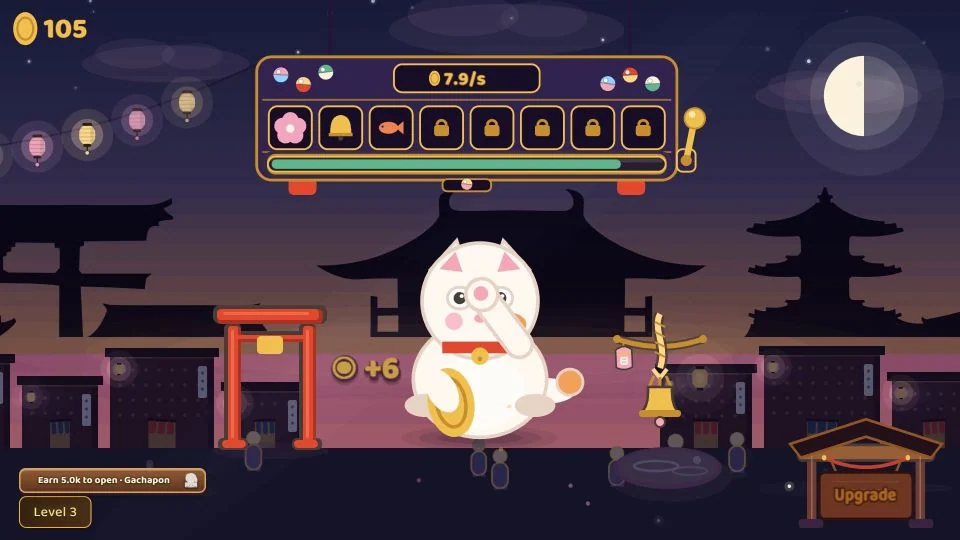
Pet the lucky cat, earn koban and spend it on a growing shrine. Maneki Mania starts with tapping and pulling a lever; later, an unlocked cat paw takes over the lever while machines pet the cat for you.
I asked solo developer Javier Lianes how he makes that automation feel earned, what players can change through the upgrade branches, and why the game began with his family.
Written interview with Javier Lianes, Lianes8 Studio · Answers received 30 October 2026. Answers reproduced in full.
Isabella · Crit Pick
What came first: the idea of a lucky-cat shrine, or the incremental mechanics? How did the two come together?
Javier Lianes · Lianes8 Studio
The game came first, and it started at home. I wanted to make something my family would really enjoy. My wife loves Asian culture and she loves cats, and she plays in short breaks, a few minutes here and there. So I wanted a game with the Cookie Clicker spirit, that is fun from the very first tap and that you can leave and pick up again. A lucky cat fit that perfectly, because the maneki-neko is already a symbol of good fortune. You pet the cat, coins come out, and putting a little shrine with slot machines on top of that felt natural: the cat brings the luck, the reels let you feel it.
Isabella · Crit Pick
At the start, players pet the cat and pull the lever themselves, before automation takes over. How do you keep that transition satisfying while giving players interesting choices?
Javier Lianes · Lianes8 Studio
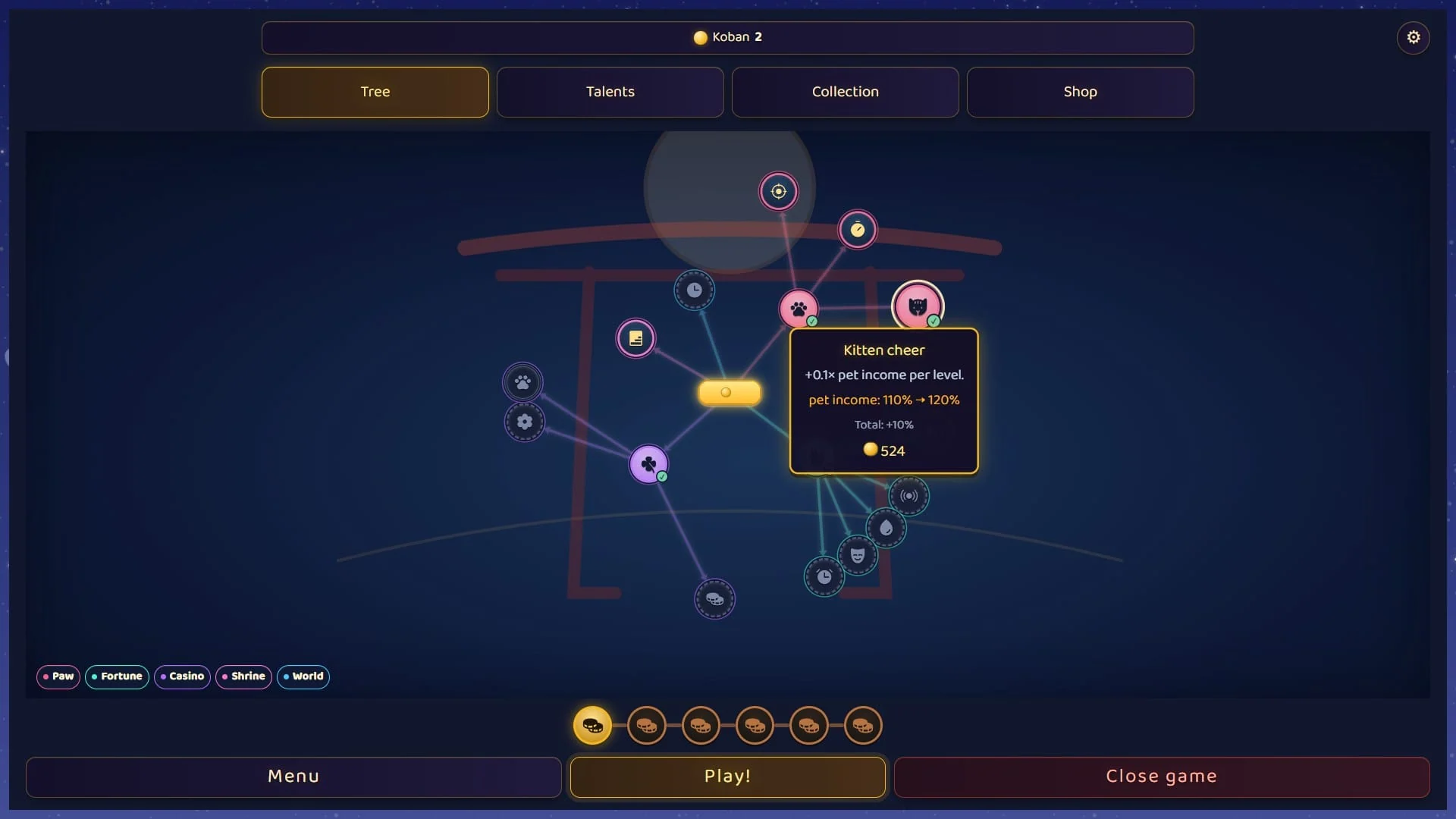
For me the key was that the automation has to be something you earn and see. A cat paw takes over the lever, and machines start petting the cat for you, and you watch all of that happen on the shrine. I gave myself a few simple rules: every purchase should change the screen right away, there should always be something you can buy in a couple of minutes, and something big every twenty or thirty minutes. And I didn't want a game where you just sit and watch, so there is always something on the map asking for your hand: boats to tap, little characters you can grab and throw, fish, kites, lanterns. The choices come from the upgrade tree, where you decide what to grow first: petting, fortune, the casino side, the shrine or the world around it.
Official screenshot supplied by Lianes8 Studio. The full-game press kit can show progression beyond the demo.
Isabella · Crit Pick
How much can players shape their own approach through the upgrade branches and lucky charms? Is there a combination you particularly enjoy?
Javier Lianes · Lianes8 Studio
Quite a lot, and more now than at the start. The tree has those five branches, the ten lucky charms arrive at upgrade milestones with their own powers, and the Wheel of Fortune gives you talents like Velvet paw, which makes every pet worth more. A player on Steam wrote a review in Chinese that was spot on: gold was piling up with nothing to spend it on, and everyone ended up with the same talents. They were right, so I reworked the tree and the economy because of it. That is why I don't want to point at one combination. The whole point of that rework was that there isn't a single right one, and I'd love players to find their own.
Isabella · Crit Pick
The demo ends at the fourth reel of the charm machine. What does that slice show of Maneki Mania, and what changes most as the full game progresses?
Javier Lianes · Lianes8 Studio
The demo shows the heart of the game: petting the cat, filling the fortune meter, pulling the lever, and the first upgrades starting to work together until the charm machine gets its fourth reel. In the full game the shrine grows a lot. More machines and characters show up on the map, the charms and talents start stacking, and the shrine travels, from cherry blossoms to a snowy onsen at night, so the place you are in changes as you grow.
Isabella · Crit Pick
As a solo developer, what has been the trickiest part to get right, and which small detail are you especially proud of?
Javier Lianes · Lianes8 Studio
The trickiest part has been the balance. When every system is simple, every number matters a lot. I built a small simulation that plays the game by itself, and I use it every time I touch a number, but a simulation always plays better than a real person, so real players are the ones who tell me how it feels. And as a one-person studio I also do the testing, the store pages, the trailers and the support, all on my own engine written in TypeScript, so there is never a quiet day. A small thing I like a lot is the sound. Every sound in the game is made by the game itself, in code, and the wins get bigger and brighter as you go from pairs to triples to the koban jackpot. The art is all hand-made too, from the big white cat in the middle to the paper lanterns and the torii gates.
Where to try Maneki Mania
The free Steam demo ends when the charm machine unlocks its fourth reel. The full game’s Steam Early Access release is planned for 3 December 2026. The interview describes both the demo and later full-game progression.
This is a developer interview and game introduction, not a scored hands-on review. The answers above are Javier’s account of the game and its development.
Sources
Written answers supplied by Javier Lianes on 30 October 2026.
Official Maneki Mania screenshot supplied by Lianes8 Studio.
Cookies
Crit Pick uses cookies and similar technologies. Essential ones keep the site
working; analytics and YouTube videos are optional and stay off until you allow them. Some optional
services are run by US companies, so data may be processed in the USA. Pick what you allow, then save —
you can change it any time via “Cookie settings” at the bottom of every page.
See the Privacy Policy for details.
Essential
Required for the site to work — remembering your cookie choice,
member sign-in and the contact form. These can’t be switched off.
Always on
Analytics
Google Analytics 4 (page views, how you arrived, rough location) and
Microsoft Clarity (heatmaps and session recordings of clicks, scrolling and mouse movement),
pseudonymous — so I can see what’s useful. Also counts steps within a page using our own Cloudflare service, without a visitor ID or form content. Google and Microsoft set cookies, Microsoft also on
clarity.ms and bing.com. Off unless you turn it on.
External media
YouTube (Google) — video previews and embedded videos. Loading them sends
your IP address to Google, and YouTube may set cookies once a video plays. Off unless you turn it
on; you can also allow a single video when you click it.