
The Guild – Europa 1410 demo review
The bones of a good medieval sim are here, but the demo keeps you fighting its menus — and fans won't find the old Guild feel yet. A cautious 4/10 first look.

This review covers the demo — the free Steam Next Fest slice of The Guild – Europa 1410, played hands-on, not the full Early Access game.
The Guild – Europa 1410 has the bones of a living medieval town and an interface that keeps getting in the way of it. The seventeen-turn Steam Next Fest demo is a thin, menu-first slice that left me more wary than won over.
There are good ideas in here — characterful events, a production chain, house upgrades that open up new mechanics — but the demo holds you at arm's length from all of them. More promise than payoff, and not much of The Guild feel yet.
Bias first, because it shapes everything below: I grew up on The Guild 2, and I came to this wanting the old hands-on, character-first feel back. This one is written for longtime fans of the series and for newcomers weighing it up, because the demo is the first proper, playable look at where this cult series goes next.
If the series is new to you: The Guild – Europa 1410 is a management- and menu-driven medieval life sim, where you create and run businesses, play politics and manage social relationships and a family dynasty — with politics and crime both central to advancing your ambitions. The demo dropped during Steam Next Fest ahead of an Early Access launch that has since moved to September 2026, an early glimpse of where the Guild series goes next. It sits in a line that runs back to Europa 1400 in 2002, and like the previous games it is set in medieval Europe, drawing inspiration from the original while rebuilding it from scratch. You pick one of three professions and run a single dynasty for seventeen turns — each roughly a season — in the Bohemian city of Kuttenberg: a taster, not a vertical slice, long enough to judge how it feels, not how it balances.
The case — a real medieval Europe in here
City events and atmosphere
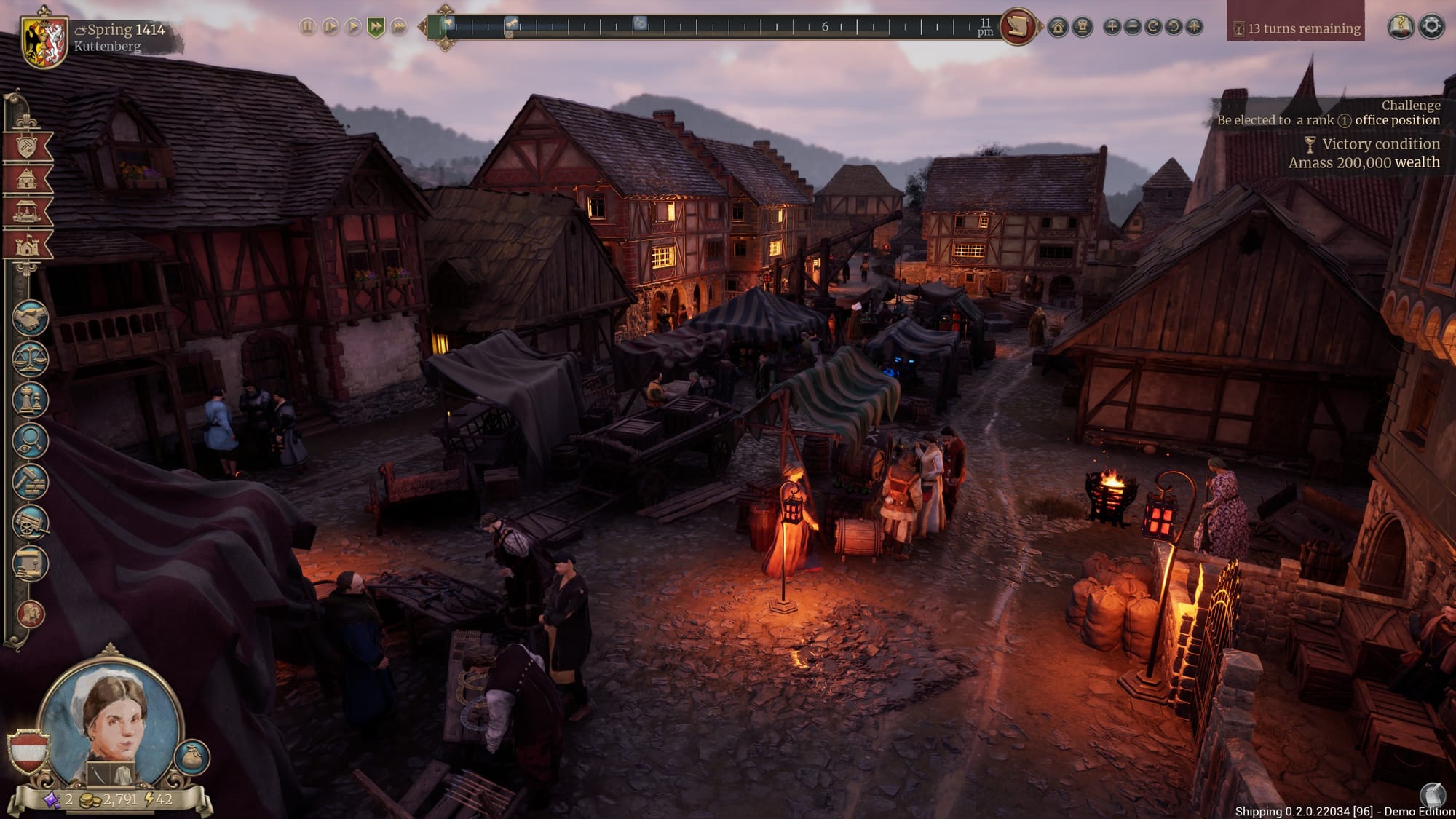
Spend ten minutes in Kuttenberg and the simulation starts showing its hand. The bustling city has a lot going on — scams, a brawl in the tavern, opportunities and shakedowns — and the content of it has real character, the kind of incidental medieval drama the older Guild games did well. The one caveat is delivery: these events reach you as pop-ups, surfaced through a panel rather than something you catch happening in the streets. The variety is a genuine strength; the framing is the same interface-first story the rest of the demo tells.
Trade, politics and the town hall
The pitch is the immersive economic simulation the series built its name on: master trade or a craft, climb the social ladder, build wealth and power, and — because business alone gives you no voice in the town hall — steer the politics too. On paper that political layer is the most interesting part: secure a prestigious office to advance your own ambitions while impeding your rivals, lean on blackmail when you must, and mind that every criminal act leaves evidence that can be used against you in court.
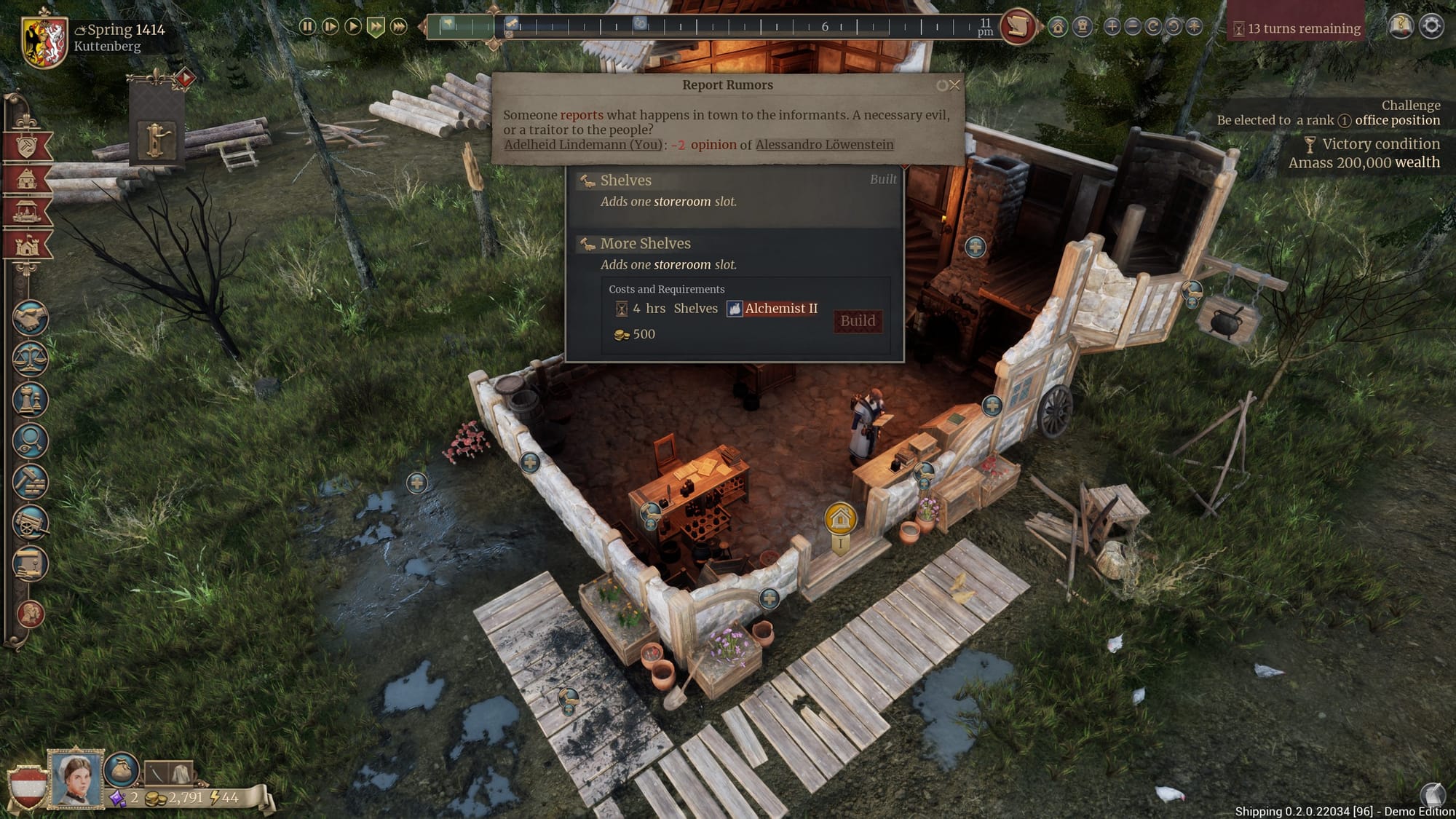
What the demo actually puts in your hands is narrower. You get three of the full game's eleven professions — Smith, Innkeeper or Alchemist — three employees, and a handful of goods to make and sell; upgrading your house is what opens up the more interesting mechanics, spying among them. The economic and political systems that should let aspiring merchants expand a business into a dynasty are here in skeleton form, but seventeen turns do not show much divergence between the three professions — the depth is a promise the demo points at, not one it delivers. The reveal trailer sells all of it better than the demo plays it.
The bigger promises are not in the demo to test at all. The up-to-twelve-player multiplayer, where friends and rivals share one city, arrives later in the Early Access phase — alongside the extra language support.
- Varied, characterful events. Street scams, tavern brawls, opportunities and shakedowns — plenty of flavour, even if they arrive as pop-ups rather than playing out in the streets.
- Systems with room to grow. Three of eleven professions, a production chain, political offices to chase and house upgrades that unlock mechanics like spying — a promising skeleton, even if the demo only sketches it.
- Quick-nav that respects your time. Jumps to your business and the marketplace keep the early friction from becoming a chore.
- Controls that warm up. The first few minutes fight you; by the back half of the demo the inputs are smoother and the muscle memory starts to form.
Right now it is a city you manage, not one you live in.
Hands-on · the Steam Next Fest demo
The catch — the interface keeps getting in the way
Interface friction
Almost every rough edge in the demo is an interface edge. The game does try to help — there are extensive tooltips and pop-ups explaining what each menu does — but being told what a button does is not the same as the interface getting out of your way. None of the issues is fatal on its own; together they are the reason a longtime fan can spend an hour fighting the menus more than the game.
- Esc does not close windows. A small thing you reach for constantly, and it never stops being a small annoyance.
- Old muscle memory does not carry over — but you stop noticing fast. Right-click no longer closes a menu, double-click no longer enters a building. The scheme is just different, not worse; you accept it within a few turns and move on.
- Indirect control everywhere. You do not steer your character; you act through menus. Even watching your workers is a menu action rather than something happening out in the world.
- Carts and the like are handled at arm's length, which reads as clunky — possibly something that clicks with time, possibly not.
Life simulation limits
The life sim happens to you, not with you. Courting a potential spouse is fiddly to even find, and the big beats — marriage, a pregnancy, the heir meant to secure your legacy — arrive as pop-up events rather than something your character does. Founding a dynasty to dominate history is the whole fantasy, and in the demo you mostly approve it from a menu. Paired with the pop-up world events, it is the same pattern throughout: the game reports life to you through a panel, and that breaks the “I am a person in this town” feeling more than any single button.
That is the gap to sit with. The Guild 2 made you a citizen by letting you do things directly; here the same beats are reported to you through a panel. It is a different design philosophy, not a bug — but it is the gap between “a Guild game” and “The Guild” for the people who care most. The community is split along exactly this line: read the demo's comments and you find longtime fans and curious new players talking past each other, with the developers in the threads offering support and answering both camps.
Who it's for
This is a demo, so the honest recommendation is about whether to spend the time, not the money — it is free, and that is the point of it.
- Strategy-RPG players interested in the kind of deep, patient gameplay the full game is promising, who can look past an unfinished slice.
- New players to the series, with no expectations carried over from the old games.
- Anyone weighing a wishlist before the 16 July Early Access — it is free, and this is exactly what it is for.
- The Guild 2 loyalist chasing the old hands-on, character-first feel. This is a different animal, and the demo will not win you over.
- Anyone expecting the depth the previews promise — the seventeen-turn slice does not show it yet.
- Players who want German at launch — the demo is English only.
- Anyone who bounces off menu-heavy UIs; the interface is the front door, and it is busy.
For what it is worth, I want this one to land. The Guild has history and a community that still shows up, and the systems are the kind I get excited about when they work. Right now the fun is buried under the interface, and the hope I came in with took a knock. The studio is early in development and active with players, so stay tuned — when the Early Access build arrives in July, we will play it and review it properly.
FAQ
Is there a demo, and what is in it?
Yes. It is free on Steam and live now during Steam Next Fest (June 2026). You pick one of three professions — Smith, Innkeeper or Alchemist — and play seventeen turns in Kuttenberg, roughly two to four hours. It is English only for now.
When does Early Access start?
Early Access on Steam from September 2026 — the studio pushed it back from 16 July 2026 on 9 July. There is no 1.0 date yet.
Who is making it — Ashborne Games or THQ Nordic?
Both, in the usual split: Ashborne Games, a Czech studio, develops it, and THQ Nordic publishes. It runs on Unreal Engine 5, and it is a reboot drawing on the original Europa 1400: The Guild from 2002.
Does it play like The Guild 2 or 3?
Not really. It leans far harder on menus and indirect control, with no direct character steering. The old inputs are remapped — you adjust within a few turns — but the bigger change is that life happens to you through pop-ups: events, courtship and the big family beats all arrive as prompts rather than things you do.
Does it have multiplayer?
The full game promises sessions for up to twelve players, where friends and rivals trade, compete and undercut each other in one city. It is not in the demo, which is single-player only — multiplayer and extra language support are both set to arrive during the Early Access phase.
Is it worth wishlisting?
If the depth appeals and the menu-first feel does not put you off, yes. The demo is the cheapest way to test the gameplay experience before paying for Early Access.