Skip to content
Crit Pick

Search Crit Pick

Type at least two characters.

Browse all stories →

Creator interview · Crit Pick

Zombies Aren’t Real interview: the cost of saving more people

JoGameDev talks safe-zone budgets, minefields on bridges and the balancing experiment that changed the pace of Zombies Aren’t Real.
Written interviewAnswers · 10 Nov 2026
Behind the gameShare ↗
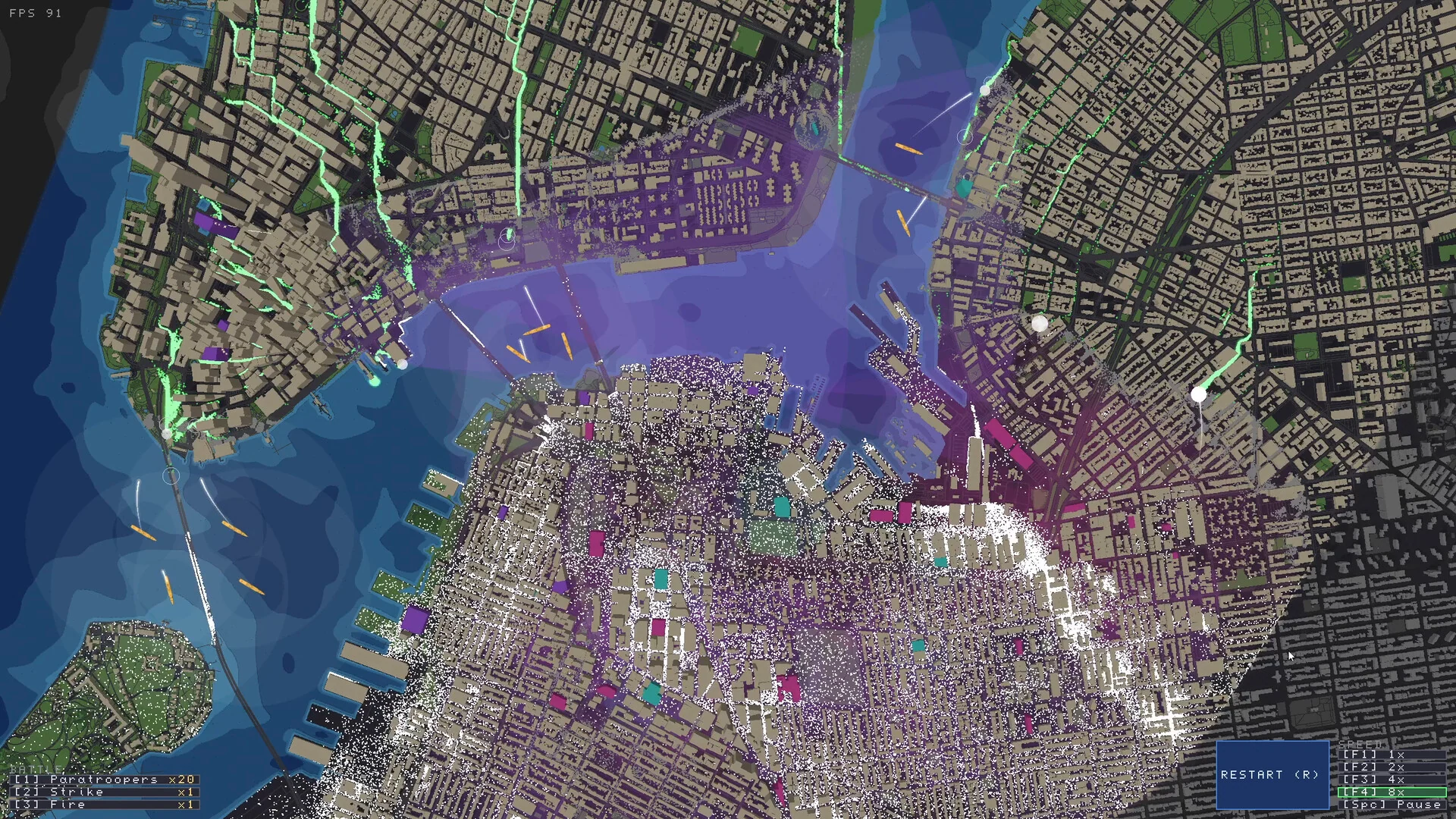
Bird’s-eye view of the New York map in Zombies Aren’t Real, with bridges, spreading crowds and the battle controls visible.
Official Zombies Aren’t Real development screenshot from Steam.

Release update · 16 November 2026: Zombies Aren’t Real launched in Steam Early Access on 13 November 2026. You can play it now on Windows PC. The interview below was conducted before launch.

In Zombies Aren’t Real, drawing a larger safe zone can put more civilians behind its walls. It also costs more, leaving you less money to defend them. JoGameDev describes a game where choosing what you can protect matters as much as choosing where to fight.

I discovered the game through Jo’s YouTube videos and sent him ten questions about its design. His answers cover learning from a breached wall, a playtester’s minefield-on-a-bridge combination, and an experiment with renewable abilities that pushed the game toward a very different pace.

Written interview with JoGameDev. Answers received 10 November 2026 and reproduced in full; whitespace has been normalized. The answers describe the game and development experiments at the time of the interview.

From watching an outbreak to defending a city

Isabella · Crit Pick

You mention an older zombie-outbreak simulation that helped inspire you to become a game developer. What stayed with you from that game, and what can you finally do with the idea now that you couldn’t then?

JoGameDev

The original zombie outbreak simulation I saw didn't have any interactivity. It was just watching the zombies spread and I was totally enraptured by it. With Zombies Aren’t Real I’ve taken it a lot farther and I’m simulating actual real-world cities and then allowing the player to defend them. (Although many zombie outbreak simulations between my version and the original added things like missiles and ways to defend the civilians )

Showing where a plan failed

Isabella · Crit Pick

You use Into the Breach as an example of a game where a loss feels like the result of a bad decision. When a city falls in Zombies Aren’t Real, how do you help the player understand which decision failed?

JoGameDev

Generally failure is the result of a safe zone wall being breached. During the next planning phase I show little red flags where the safe zone was breached so that the player can make decisions for their next attempt.

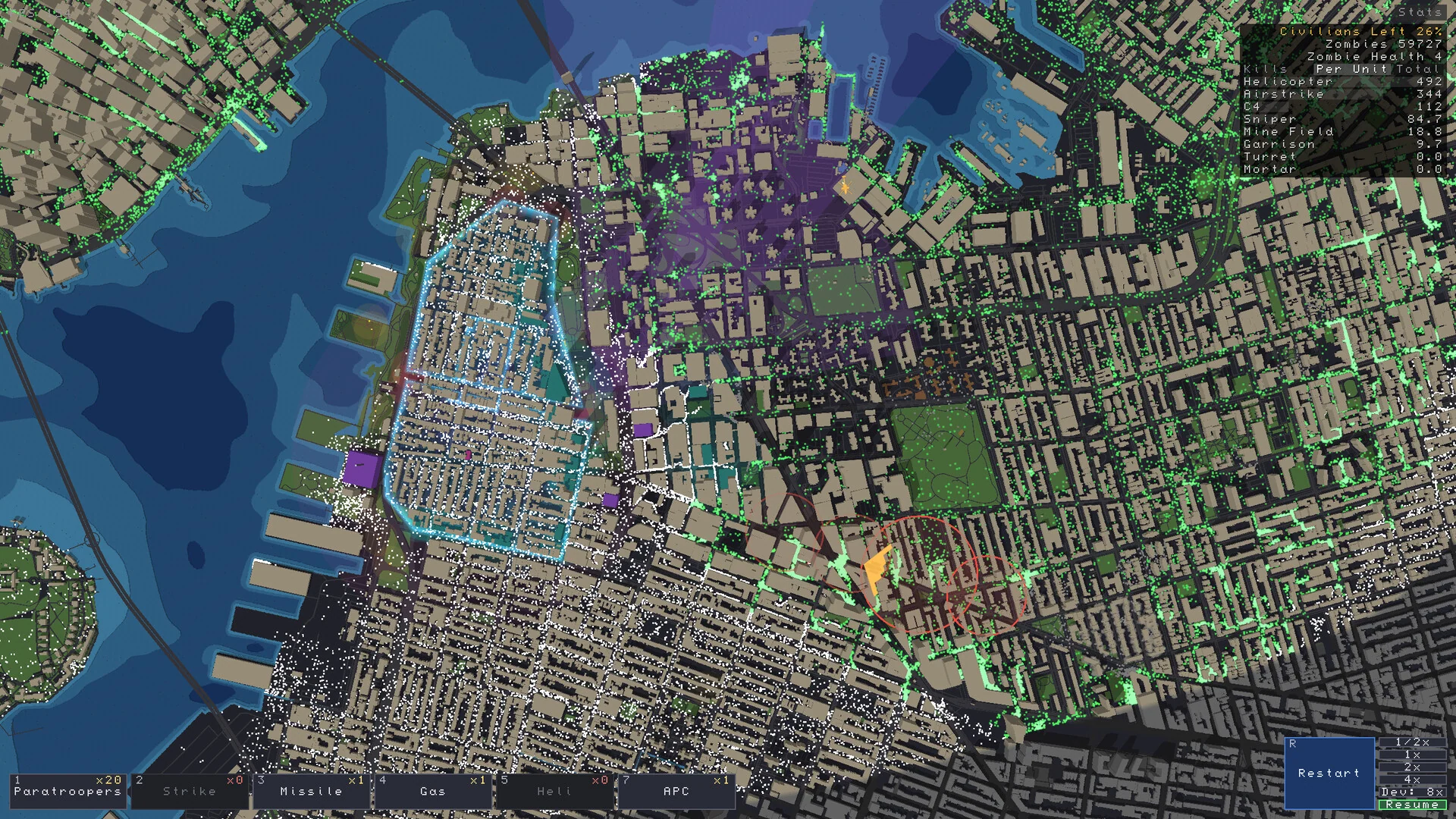
Zombies Aren’t Real shows a blue-walled safe zone in New York, crowds outside it and an on-screen battle statistics panel.
An official development screenshot shows a safe zone within the New York map. The interview below explains why its size is a budget decision.

Choosing where to build and how to defend

Isabella · Crit Pick

With a fixed budget for each scenario, how do you make room for several clever solutions instead of one arrangement the player has to discover? Can you give an example from a level you’ve been balancing?

JoGameDev

First of all you can choose wherever you want to build your safe zone and different areas have different advantages. There's also lots of interesting ways that the units interact. For example fire spreads over green space, and snipers have a longer range when placed in taller buildings. The first choice the player has is where they want to set up their safe zone and the second choice is what units and battle-time abilities they want to use to defend it. Bridges are extremely tactically important because they're natural choke points and they can also be destroyed. I've been working hard in the New York campaign to figure out the right balance of how important bridges should be.

The cost of a larger safe zone

Isabella · Crit Pick

A larger safe zone protects more space but is harder to defend. Can you walk through a moment where trying to save more people becomes the wrong call, and what you want the player to learn from it?

JoGameDev

This one's as simple as: larger safe zones cost more money. You might be initially protecting a larger group of civilians but if you don't have enough money to defend the safe zone walls, then the entire safe zone will get breached and all the civilians will be lost. It's a careful balancing act.

A minefield on a bridge

Isabella · Crit Pick

You single out stun gas because it gives snipers and garrisons time to deal with the outbreak. What makes a combination like that satisfying to design, and have testers found a combination you hadn’t planned for?

JoGameDev

I find combinations to be satisfying when they come out emergently from the game's systems. One playtester recently discovered that placing large minefields on a bridge is a good combination. Because it both eliminates zombies that are funneling through the narrow bridge and also deals damage to the bridge when it explodes

Patch note (v0.43.1, November 16, 2026). If a destroyed bridge leaves zombies with no route to your safe zones, those zombies no longer reset the timer that ends a stalled battle. When that timer reaches 60 seconds, the battle ends in victory. Read the official patch notes.

Winning and pushing for a higher score
Isabella · Crit Pick

Passing a scenario and climbing its leaderboard are different goals. How do you balance a level so that a basic win feels satisfying, while saving those last few civilians still demands a better plan?

JoGameDev

Zombies Aren’t Real is fairly challenging so any win, no matter how close, already feels satisfying. And given how many options are offered to the player, there's plenty of room for pushing oneself to get a higher score.

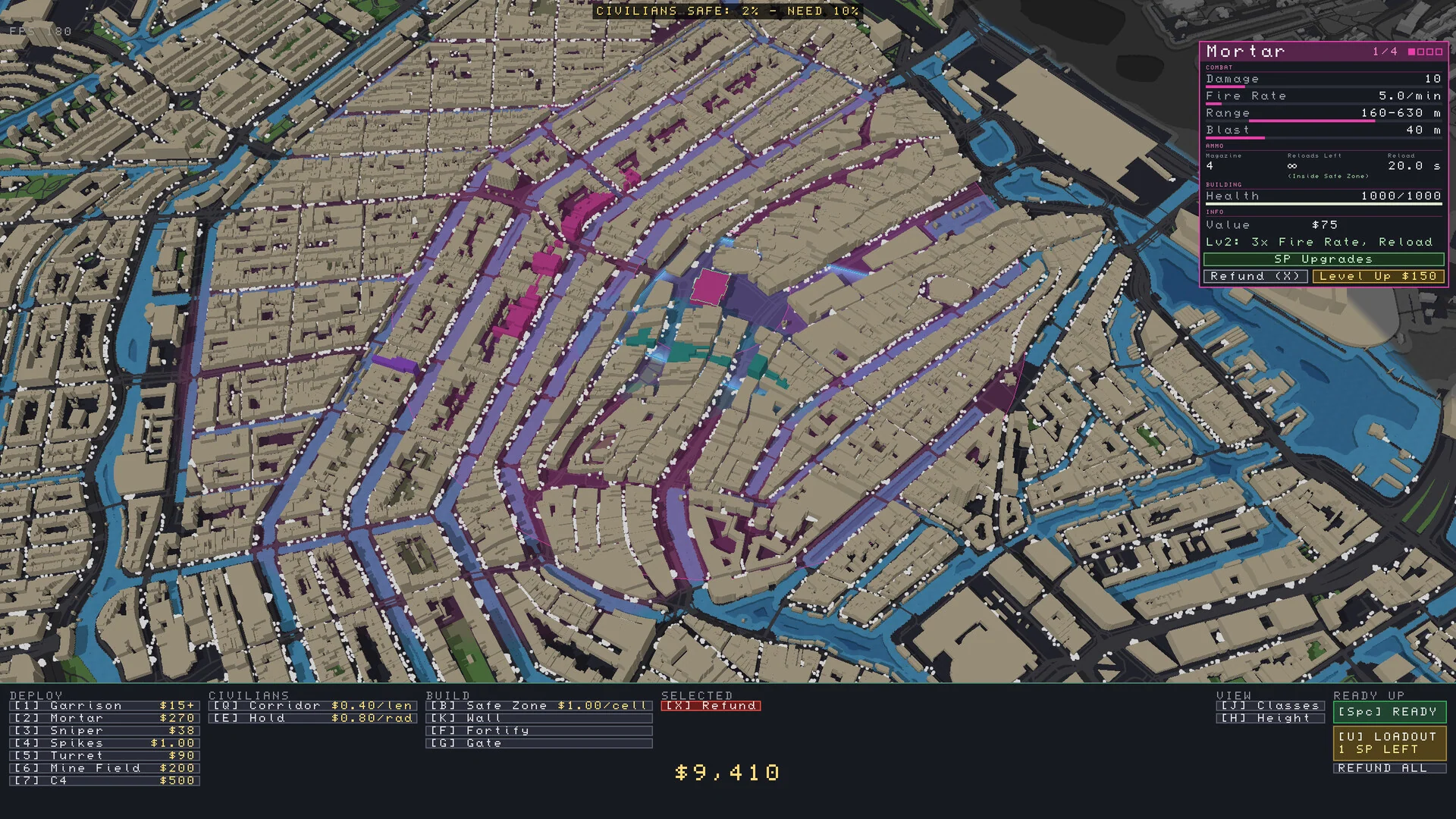
Planning view in Zombies Aren’t Real with a selected mortar, its range overlay, unit costs and the remaining budget.
The planning interface shows unit costs, a selected mortar and the available budget. Official development screenshot; values may change.

How renewable abilities changed the pace

Isabella · Crit Pick

You say a clone can reproduce the premise without reproducing the experience you’re crafting. Which small design or balancing decision best shows what you mean—something that looks minor on paper but changes how the game feels?

JoGameDev

I've already been through what feels like dozens of these small decisions that drastically change the feel of the game. Something as simple as shifting the reload time of a unit or the cost of a safezone can signifiantly alter playstyle. I even tried out making battle-time abilities renewable and it practically changed the whole genre of the game from a thoughtful, strategic game to a high-intensity boss-battle type experience (due to using the abilities as soon as they were off cooldown)

From implementing features to designing games

Isabella · Crit Pick

After sixteen years of programming, you describe your role shifting toward game design. What has been hardest about that shift, and what has it made possible for you?

JoGameDev

Previously I would spent most of my time thinking about how to implement a feature rather than if I should implement it. Game Design is a much deeper domain than I previously thought. Now that I've finished two whole games and am working on my third, I've been leveling up as a designer and realize that making a "great game" is much much more about design decisions, balancing, game feel, etc than it is about "implementing cool mechanics" which was my focus previous.

Checking whether the game feels right

Isabella · Crit Pick

When you use AI for the technical work, how do you check that the result supports the experience you intended? Has there been a case where the code worked, but the game still didn’t feel right?

JoGameDev

Tons and tons of QA and playtesting. It's been a tremendous amount of work tweaking things to make the game feel good (again, the Design is the hardest part). There have been many ways where I see how this game could easily become un-fun if I had made different decisions

Why viewers wanted destructible bridges

Isabella · Crit Pick

Your YouTube videos are how I discovered the game. Has explaining a mechanic on camera, or responding to a viewer’s reaction, changed a design decision? Which example comes to mind?

JoGameDev

Commenters provide great insight into what people want. I've had about a hundred people asking if bridges can be destroyed. It wasn't something I thought of initially, but seeing how much people are excited about it makes it a must-have feature

Find Zombies Aren’t Real

Zombies Aren’t Real on Steam · Official press kit and credits

Sources

← All creator interviews