
LORE LIBRARY VOLUME 04
The Aqir and Troll War
Rival tribes. A common enemy. A divided legacy.
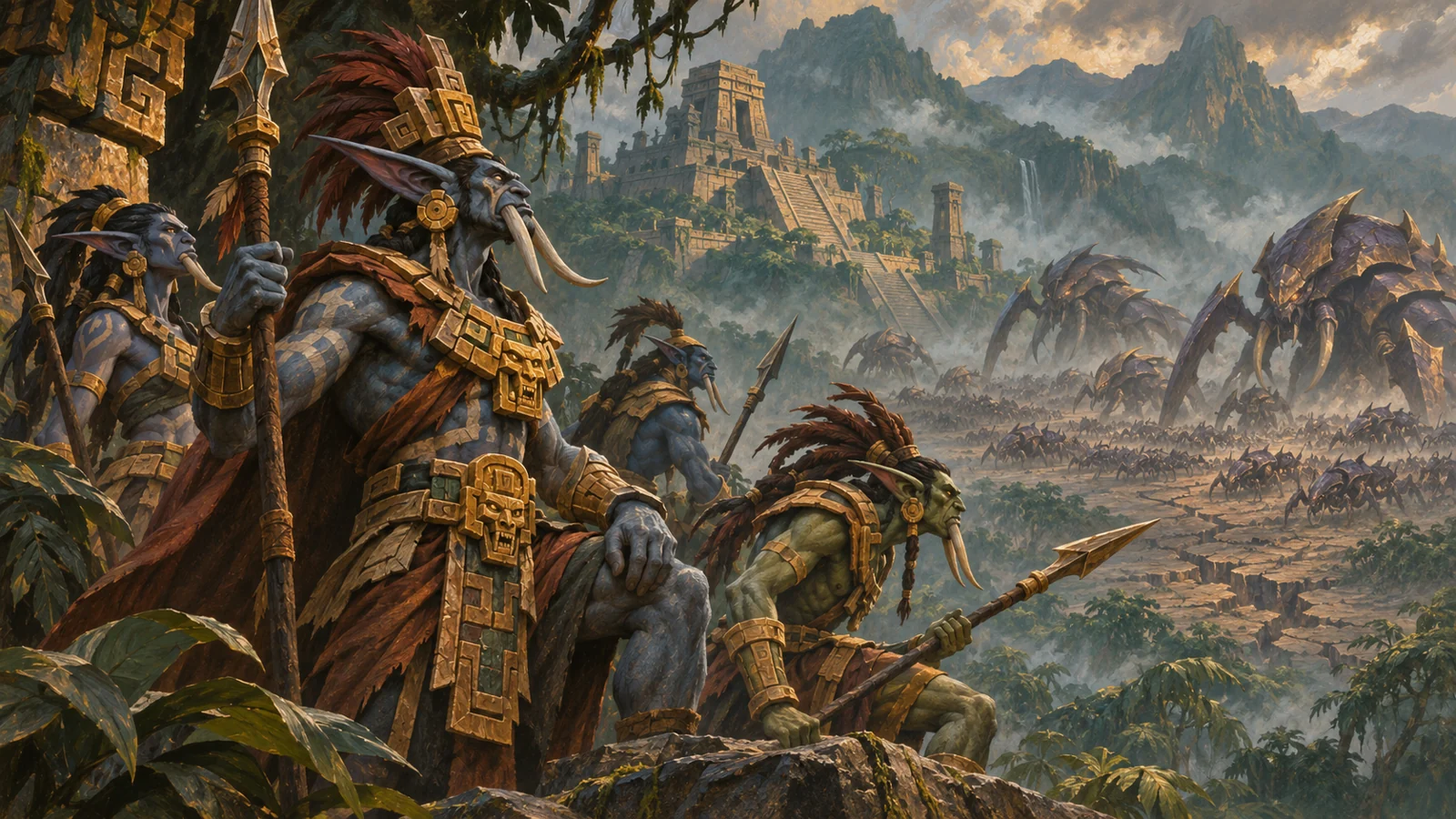
Long before the Horde and Alliance, the Aqir and Troll War threatened to erase troll civilization. Around 16,000 years before the First War, Kith'ix rallied the insectoid empire of Azj'Aqir against the peoples of ancient Kalimdor. The Zandalari answered by uniting rival troll tribes as the Empire of Zul. Their resistance broke the aqir's expansion, but left surviving colonies from which the nerubians, qiraji and mantid developed.
For WoW Forever players new to Warcraft lore, this chapter traces the invasion, the troll campaigns and the surviving aqir branches. Their shared origins explain connections between enemies and ruins in later stories. It follows the Chronicle-era account; older in-game versions are distinguished below.
On this page
Before the war: the Black Empire's survivors
The aqir were intelligent beings, not ordinary insects. They arose from the Old Gods and helped build their Black Empire, alongside the n'raqi. The titan-forged defeated that civilization, but some aqir escaped destruction by retreating underground. The fall of their masters' empire did not end their existence. Aqir origins
That survival matters here. The trolls were confronting an older power returning to the surface, rather than a newly created race. The conflict also belongs to primordial Kalimdor, when much of today's world was still one continent. “North” and “south” in this story describe that ancient landmass. They are not instructions to place today's separate continents on an unchanged map.
Kith'ix awakens
Kith'ix was a C'Thrax: one of the Old Gods' enormous warbringers. Wounded in an earlier confrontation with the titan keeper Tyr, he had withdrawn into a long sleep. His return gave the scattered aqir a leader and a purpose: reclaim the surface.
The priest artifact history Word of the Conclave connects his awakening to Xal'atath. The blade manipulated the outcast troll Zan'do into blood rituals near the Zandalar Mountains. The creature those rituals stirred was no protector of the trolls. Kith'ix turned against them and gathered the aqir into Azj'Aqir. Word of the Conclave
The distinction is useful: Kith'ix led the invasion; the aqir were its armies. He was neither an aqir king who had simply grown larger nor one of the Old Gods themselves. Kith'ix
How the troll tribes held their ground
The Zandalari trolls helped turn scattered resistance into the Empire of Zul. Cooperation gave rival tribes a shared defense against a threat that could destroy them all.
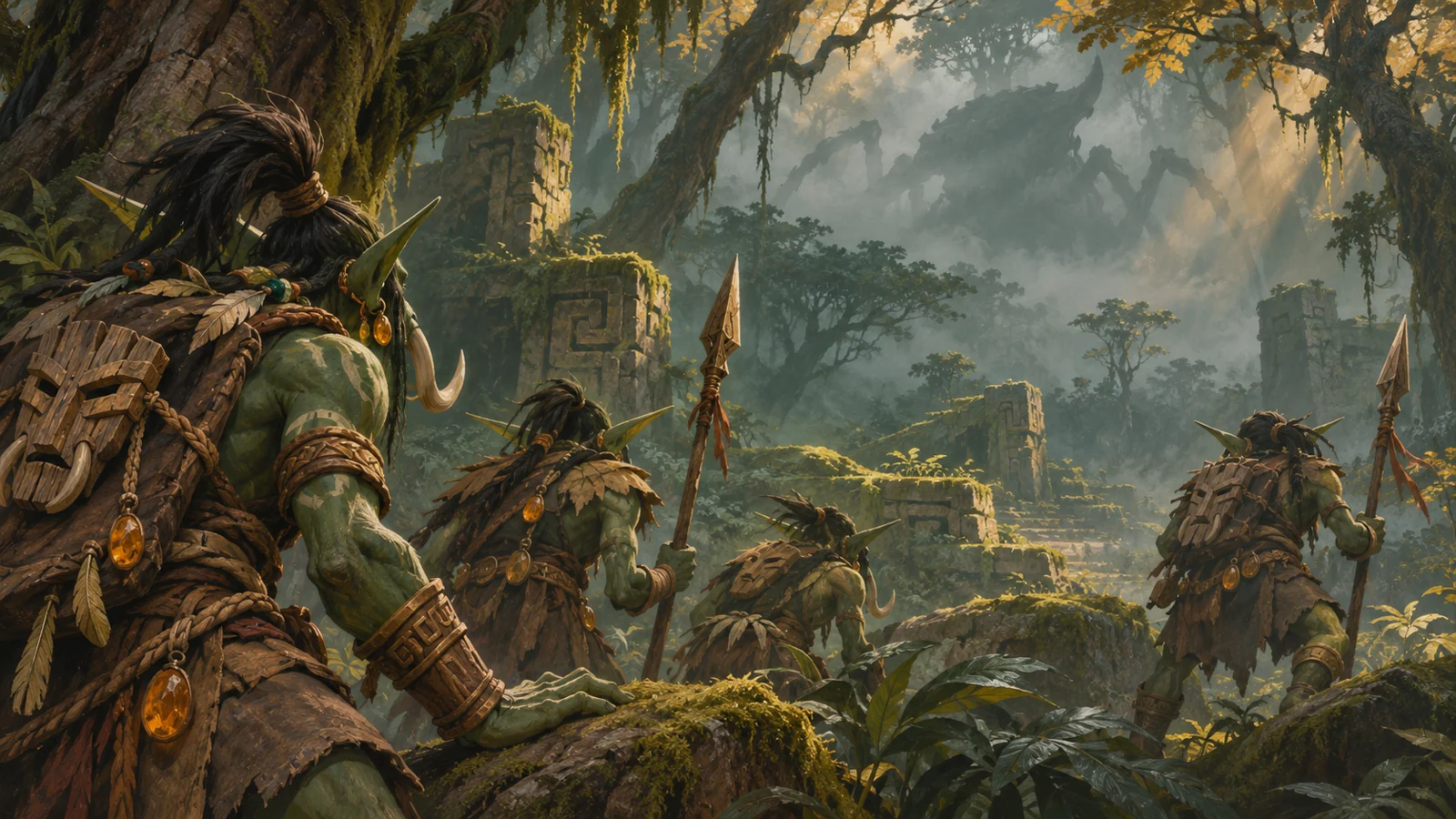
Numbers alone would not stop the insectoids. The trolls used familiar jungle terrain to ambush approaching forces, while Zandalari priests called on the loa for aid. They wounded Kith'ix and forced him to retreat northeast. That protected the Zandalar Mountains, but did not destroy the aqir's network of colonies.
The war therefore became a struggle over several regions. The Drakkari, Gurubashi and Amani pushed outward instead of waiting for another assault at the same defensive line. War overview and Chronicle references
Three campaigns, different problems
| Troll force | Ancient theater | Why the fighting mattered |
|---|---|---|
| Drakkari | Northern Kalimdor, around Ulduar | Northern aqir had enslaved local tol'vir. The trolls faced both an insectoid colony and the titan-forged beings it controlled. |
| Gurubashi | Southwest, around Ahn'Qiraj | Aqir occupied a titan-forged stronghold and used anubisath against the attackers. Large troll camps proved vulnerable; smaller raiding groups made the campaign more sustainable. |
| Amani | Northeastern forests | They pursued Kith'ix himself. The Chronicle account describes a costly final attack and places the founding of Zul'Aman at the site of his defeat. |
These fronts explain why one battle near Zandalar could not settle the war. The coalition had to stop a leader, disrupt distant strongholds and endure a much longer struggle for land. The northern colony's capture of tol'vir is also part of the background to the later nerubian civilization. Northern history
What survived the defeat?
Azj'Aqir lost its unity. The trolls succeeded in ending its continent-spanning offensive, yet they did not eradicate every aqir. Separated populations developed into distinct civilizations:
- Azjol-Nerub in the north: the nerubians.
- Ahn'Qiraj in the southwest: the qiraji, shaped by C'Thun's influence.
- Manti'vess farther south: the mantid, whose history remained tied to Y'Shaarj.
This was a process of separation and change, not three new peoples appearing at the instant Kith'ix fell. The mantid branch was already taking shape during the later stages of the conflict. Mantid origins · Qiraji history
For the trolls, campaigning also meant settlement. Wartime footholds helped the Drakkari, Gurubashi and Amani grow into powerful empires. Their common enemy had encouraged unity; its defeat reduced the reason to maintain it. Zandalari religious influence survived the coalition's loosening.
The lasting result was a divided political world: expanding troll powers above ground and surviving aqir descendants in distant strongholds. Victory had changed the balance of power without removing the Old Gods' legacy.
Why older books describe two empires
The Twin Empires, an in-game history, emphasizes the Amani and Gurubashi, describes thousands of years of fighting and names two surviving aqiri city-states. The older Troll Compendium presents a similar outline.
Chronicle Volume 1 expanded this history with the Zandalari-led coalition, Kith'ix, the Drakkari campaigns and the mantid branch. Its war unfolds over centuries. This chapter uses that framework rather than combining both durations into a false exact date. Later stories also revisit Kith'ix; his ancient defeat here is not a summary of modern quest outcomes. The Twin Empires and continuity notes
A different war from the Shifting Sands
The War of the Shifting Sands happens many millennia later. It concerns the qiraji of Ahn'Qiraj and the forces opposing their expansion, including night elves and dragons. It is not another name for the ancient war between Azj'Aqir and the troll coalition. War of the Shifting Sands
Keep this sequence in mind: Black Empire survivors → Kith'ix and Azj'Aqir → troll resistance → separated aqir civilizations → later wars. The Aqir and Troll War explains how those later enemies came to exist. Their next campaigns belong to their own chapters.
Return to the WoW Forever lore library to follow the timeline, or read the previous book, Galakrond and the Dragon Aspects.
YOUR READING JOURNEY
The war ends. Its legacy survives.
Load your account progress to keep your place.