
WoW Forever Combat Rogue build: a beginner’s dual-wield guide
Learn how this WoW Forever Combat Rogue build plays, inspect its talent tree, and understand the uncertain effects.

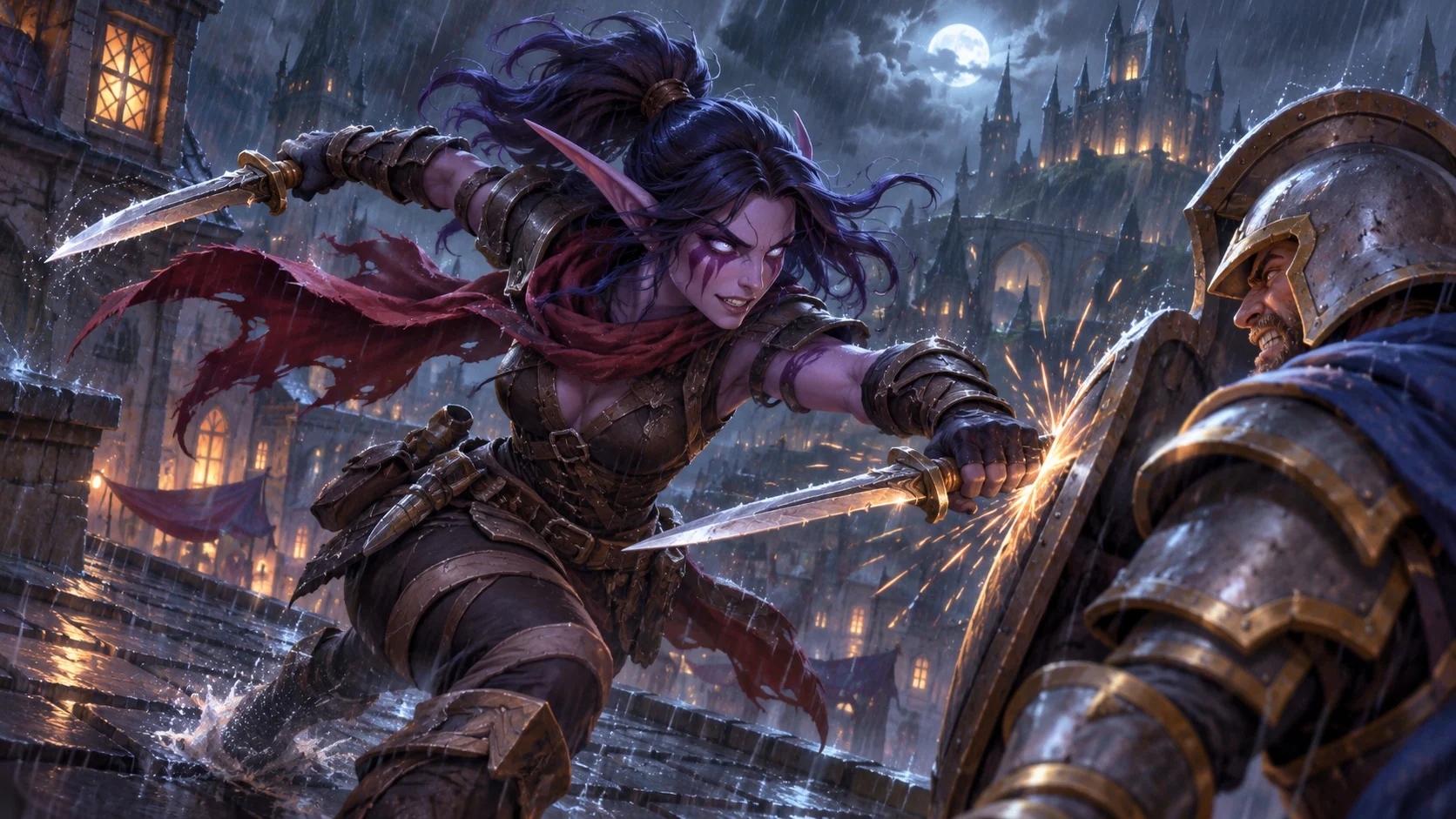
Original AI-generated class illustration for Crit Pick · not gameplay or official artwork.
This WoW Forever Combat Rogue build is a level-60 example with 31 points in Combat and 20 in Assassination. It teaches close-range attacks with a weapon in each hand, Energy management and the choice between building combo points and spending them. Adrenaline Rush and Blade Flurry give you temporary windows to understand, rather than a reason to press everything at once.
This guide is for players new to WoW or new to Rogue who want to learn the resource loop and inspect a complete build. A build is the set of talent improvements you choose for a character. I checked this example against the captured FOREVER rules but have not tested it in game. The page keeps the source-version differences visible, including the announced change to Lethality; it does not claim the captured tree is a tested current-server optimum.
On this page
- What playing a Combat Rogue in WoW Forever is like
- Combat Rogue talent calculator: try the build
- Why these Combat talents are here
- Combat Rogue rotation: Energy and combo-point decisions
- Uncertain abilities, ranks and changing the example
- Weapon choices, poisons and defensive cooldowns
- Sources, versions and uncertainty
What playing a Combat Rogue in WoW Forever is like
You fight close to an enemy and make two connected resource decisions. Energy pays for attacks; combo points created by particular attacks can then be spent on finishers.
- Build deliberately. Sinister Strike is a named combo-point builder supported by several selected talents. Use the builder to generate combo points, then choose the finishing move those points will support.
- Choose a finisher. Eviscerate spends combo points on damage. Slice and Dice spends them on a melee attack-speed effect with a duration that depends on the points used.
- Use a temporary window for a purpose. Adrenaline Rush improves Energy regeneration, while Blade Flurry adds attack speed and an extra nearby opponent to your melee attacks. These are different effects.
Stealth and control tools add decisions before and during a fight. They do not make every enemy unable to detect, damage or interfere with you. This guide starts with understanding the close-range resource loop rather than a perfect opener.
Combat Rogue talent calculator: try the build
This example uses 51 talent points: 31 Combat / 20 Assassination. It assumes the standard level-60 point budget without extra Legacy talent-point modifiers. A talent rank is a point invested in an improvement; a spell rank is a recorded version of an ability. They are different things.
Click a talent to read its effect, then use the plus and minus controls to change your points. The planner checks recorded rank limits, tree-spending gates and prerequisite talents. You can start empty, reload this example or save your own allocation. The complete table remains readable without the planner.
51 /51 31 Combat / 20 Assassination
The interactive planner is loading. The complete talent table below is already readable.
Full talent choices · readable without the planner
| Tree | Talent | Points |
|---|---|---|
| Combat | Improved Sinister Strike | 2/2 |
| Combat | Improved Eviscerate | 3/3 |
| Combat | Precision | 3/3 |
| Combat | Deflection | 3/3 |
| Combat | Endurance | 2/2 |
| Combat | Improved Sprint | 2/2 |
| Combat | Dual Wield Specialization | 5/5 |
| Combat | Blade Flurry | 1/1 |
| Combat | Hack and Slash | 4/5 |
| Combat | Weapon Expertise | 2/2 |
| Combat | Aggression | 3/3 |
| Combat | Adrenaline Rush | 1/1 |
| Assassination | Malice | 5/5 |
| Assassination | Remorseless Attacks | 2/2 |
| Assassination | Improved Gouge | 3/3 |
| Assassination | Ruthlessness | 3/3 |
| Assassination | Improved Slice and Dice | 3/3 |
| Assassination | Lethality | 2/5 |
| Assassination | Relentless Strikes | 1/1 |
| Assassination | Cold Blood | 1/1 |
Why these Combat talents are here
Sinister Strike and finishing moves: what do the talents change?
At the selected 2/2 rank, Improved Sinister Strike reduces that ability's Energy cost by five Energy. That is a flat cost reduction, not a five-percent discount. Aggression improves its named attacks, including Sinister Strike and Eviscerate, while Improved Eviscerate specifically improves Eviscerate. Do not turn those named effects into one general increase for all Rogue damage.
At 3/3, Improved Slice and Dice extends the finisher's duration by 45%. It changes how long the attack-speed effect lasts, not the attack-speed percentage. The combo points spent still matter for the underlying duration.
This build also selects Ruthlessness 3/3: finishing moves have a 60% chance to add a combo point to the target. Relentless Strikes is a separate effect, giving finishing moves a 20% chance per combo point to restore 25 Energy. One can add a point; the other can return Energy after spending. Neither is an instruction to ignore the resources left after a finisher.

Does Adrenaline Rush instantly refill Energy?
No. Adrenaline Rush increases your Energy regeneration rate by 100% for 15 seconds in this FOREVER snapshot. That doubles the rate at which Energy returns during the window. It does not say that maximum Energy increases or that activating it instantly fills the bar.
The benefit matters when you can spend that Energy on actions relevant to the fight. The guide does not establish a damage-maximizing cooldown schedule or a universal rule for stacking every temporary ability together.

Blade Flurry, weapons and close-range protection
Blade Flurry increases melee attack speed by 20% for 15 seconds and makes your melee attacks strike one additional nearby opponent. This extra-target effect is often called cleave: your melee attacks can affect your main target and an additional nearby opponent during the window. Blade Flurry does not turn those attacks into unlimited-target area damage. Position and nearby enemies therefore matter even when your selected target has not changed.
Dual Wield Specialization improves off-hand damage. Hack and Slash changes its benefit with weapon type, as explained in the weapon choices below. Weapon Expertise reduces the chance that attacks are dodged or parried, while Precision improves chance to hit. None of that establishes a single best weapon or a complete equipment cap.
Deflection improves parry chance. Endurance changes Sprint and Evasion cooldowns, and Improved Sprint can remove movement impairing effects when Sprint is activated. These tools support a close-range character; they are not a flat reduction to every type of incoming damage.

Cold Blood, critical bonuses and a version note
Cold Blood increases critical-strike chance for the next named attack. A critical strike is a hit with extra damage. Read the named eligible attacks rather than assuming the effect applies to any action you choose.
Malice improves critical chance. At the selected 2/2 rank, Remorseless Attacks gives 40% increased critical-strike chance on your next listed attack after a non-trivial kill, lasting up to 20 seconds. Its eligible attacks are Sinister Strike, Backstab, Ambush, Mutilate and Ghostly Strike. This is a conditional next-attack benefit, not a permanent bonus to every attack. Lethality changes the critical-damage bonus of its named builders; it is not the same as critical chance and does not list Eviscerate in this captured description.
The guide selects two points in Lethality and one in Cold Blood rather than the explorer’s three Lethality points. The captured client and the November development-note layer have different Lethality rank caps and per-rank effects; Improved Sprint also has a row difference. The information marker keeps that distinction visible. I have not merged the announced tree with captured gates or quoted one coefficient as universally current.
Combat Rogue rotation: Energy and combo-point decisions
Begin with one enemy and enough room to notice your resources. These examples explain your options rather than give a timed or optimized rotation. A familiar ability name from another WoW version is not evidence that its defensive effect is the same here.

Start the builder-and-finisher loop
Use a supported builder such as Sinister Strike when you have the Energy and intend to engage. Watch combo points as well as the target’s situation. Energy spent now and combo points saved for a later finisher are connected choices.

Slice and Dice or Eviscerate?
Eviscerate gives a damage finisher, while Slice and Dice gives a timed melee attack-speed benefit. Check whether Slice and Dice is still active and whether the enemy will remain in reach. An attack-speed effect needs time in which you can attack; a damage finisher answers a different immediate question. Keeping Slice and Dice active maintains its melee attack-speed benefit while you can keep attacking. Watch its remaining duration and renew the effect when that is the finisher you need. This page does not prove one exact point-spending rule for every enemy. Read the duration and effects in the recorded ranks and decide what problem the next action should solve.
Another enemy is nearby
Blade Flurry affects an additional nearby opponent. Consider whether you actually want that extra enemy involved. Its description is not permission to assume every nearby target will take the same damage or that control effects will remain undisturbed.

You need a control or interrupt tool
Gouge requires the target to face you, stops your attack and breaks from any damage. Damage-over-time effects can therefore matter when trying to use its opening. Kick interrupts a cast and temporarily locks that school of magic; the base description is not a blanket silence.

You are taking too much pressure
Evasion improves dodge chance; it is not immunity to spells or all damage. Feint reduces threat in this reference, rather than providing an assumed modern damage-reduction effect. Sprint, Stealth and Vanish have their own uses and restrictions, so treat them as separate tools instead of interchangeable invulnerability buttons.
Uncertain abilities, ranks and changing the example
Riposte remains a TEMP case in the spell/talent reference. I have not filled it with the familiar disarm or parry-trigger behavior from another version. It is not part of this example’s selected core, but the uncertainty icon remains wherever that effect is unresolved.
The tree’s point checks follow the captured source rules. They cannot prove live-server behavior, weapon performance or a best-in-slot setup. This guide does not rank races, poisons or gear. Its useful starting point is the Energy/combo-point loop and the exact purpose of each selected improvement.
Weapon choices, poisons and defensive cooldowns
What does the weapon type change?
The main hand and off-hand are your two equipped weapon positions. Dual Wield Specialization improves the off-hand weapon's damage. At this build's 4/5 rank in Hack and Slash, the captured effects depend on weapon type:
- Axe or Sword: successful melee attacks have a 4% chance to trigger an extra attack on the target.
- Dagger or Fist: critical-strike chance increases by 4%.
- Mace: attacks ignore 12% of the target's armor.
Axes and swords use the extra-attack branch of Hack and Slash, while other weapon types use the different effects listed here. Read the branch for the weapon you are using. The talent does not give every weapon all three benefits, and armor penetration does not mean the target has no armor. These source effects do not establish which weapon wins a damage comparison.
An extra attack is an additional strike triggered by a successful melee attack. It is different from increasing attack speed, which makes ordinary attacks arrive more often. Those weapon choices also differ from Precision's chance-to-hit benefit and Weapon Expertise's reduction to the chance of being dodged or parried.
Why can Deadly Poison interfere with Gouge?
A poison is a temporary weapon coating with its own effect. Combat Rogues can add damage through weapon poisons: Instant Poison can cause immediate Nature damage. Deadly Poison applies stacking damage over time, while Crippling Poison slows movement. Those differences matter when using Gouge, because damage breaks its incapacitation. A continuing poison damage tick can therefore undermine a pause you were trying to create. Read the coating's effect before treating every poison as interchangeable extra damage.
Stealth allows sneaking at reduced movement speed. Cheap Shot is an example of an attack that specifically requires Stealth. Read the condition on stealth abilities before planning an opener; the requirement is different from simply standing behind an enemy.
What should I watch before using damage cooldowns?
Improved Sinister Strike makes that builder cheaper, while Adrenaline Rush increases the rate at which Energy returns. Check that you can reach and attack the intended target during the temporary window. Keep watching available Energy and combo points instead of assuming the benefit removes ability costs or raises maximum Energy. If movement or control stops you attacking, those seconds serve a different purpose from time spent using the extra regeneration.
Defensive cooldowns answer a different question from your damage buttons. Evasion improves dodge chance, and Sprint helps with movement. For a new player, recognizing when to stop attacking and use a control or movement tool is part of learning this Rogue spec.
Sources, versions and uncertainty
The talents use the saved World of Warcraft: Forever client reference 1.60.1.70755. Individual class spell and companion records retain their own earlier source-build context, including 70753, rather than being relabeled as the same capture. These are captured descriptions, not a live-server test. A new patch, changed rank cap or different server behavior requires a fresh check.
This class has 1 case in the original 64-case TEMP research set. The question marks identify unresolved effects and affected ranks. No uncertain numeric candidate has been chosen. The reference can include abilities outside this selected build; that does not mean the example spends points in all of them.
This guide uses a disclosed allocation variant tailored to the role explained here. The earlier nine-class explorer remains unchanged. Legally spending points proves only that the captured rules allow the choices, not that the build performs best.
The character illustration was prepared for Crit Pick using AI. It illustrates the class, not official gameplay. Ability icons come from the saved FOREVER reference sources.
? Rogue effect values · 1 original TEMP case
Only this class’s entries from the unchanged 64-case research registry are shown here. Unresolved values remain empty.