
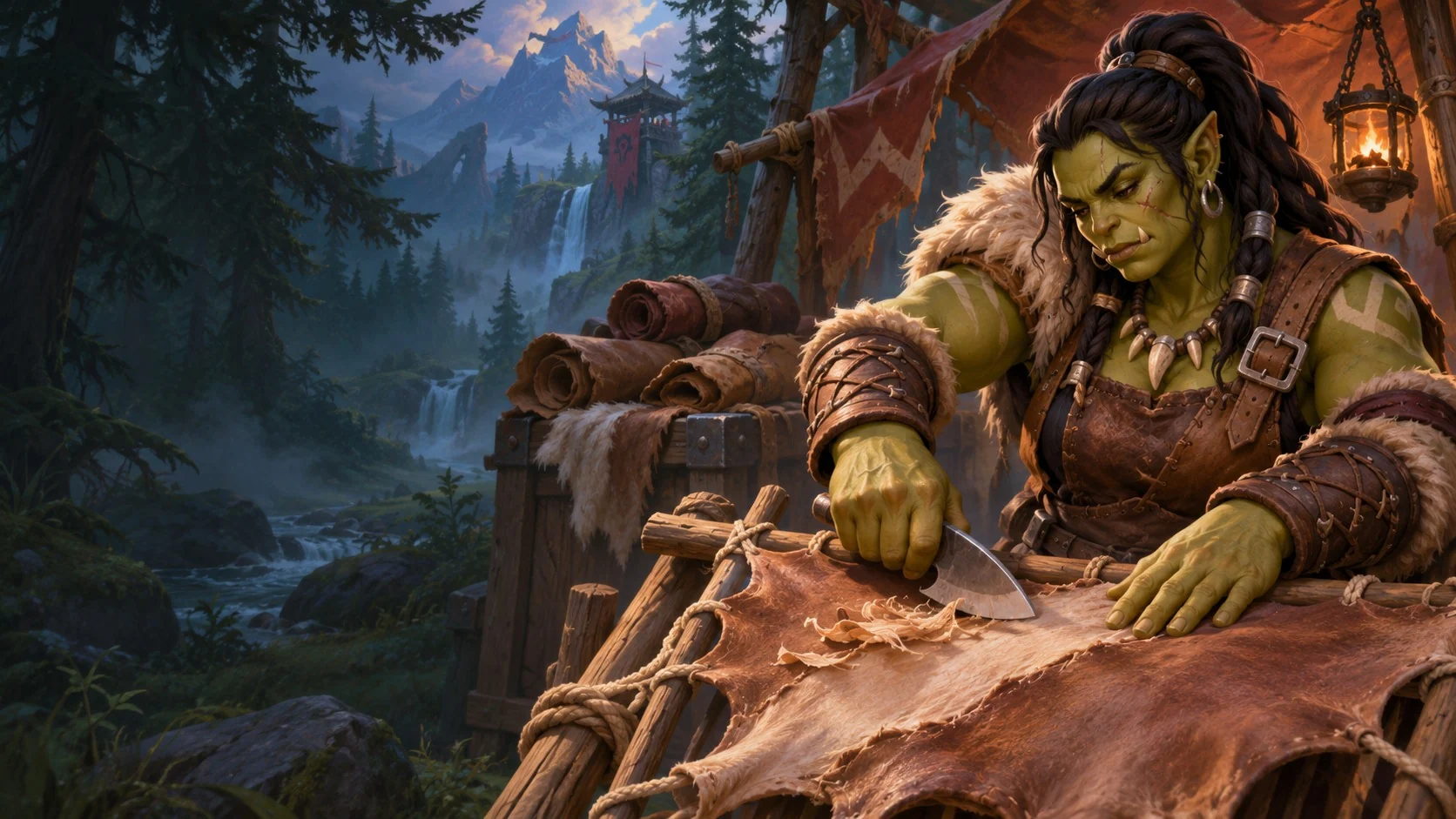
WoW Forever Skinning guide: leather, tools and leveling habits
Learn WoW Forever Skinning: looting and skinning beasts, leather tiers, bag planning, Leatherworking synergy and Camp Chair utility.

Skinning is a primary gathering profession in WoW Forever. This guide explains how to start, train the next rank and keep useful materials. Skinning can turn the beasts you already fight into a crafting supply. It becomes less convenient when your quest route mostly sends you after enemies that cannot be skinned. Choose it around the creatures you actually encounter, then keep the skill close enough to use their corpses.
On this page
- Skinning trainer locations and profession ranks
- How to skin a creature
- Leather is not the same as a hide
- Pair Skinning with Leatherworking
- Leveling Skinning without abandoning your quests
- Skinning for sales
- Camp Chair and group benefits
- Scarce materials and special leather
- Skinning tools: the knife in your bag and equipped bonuses
- Skinning FAQ
Materials to recognize


 Skinning trainer locations and profession ranks
Learn Skinning before leaving the starting areas if you want to gather from your first quests. The Forever trainer reference also lists Pelt Collecting for Beginners as a starting quest manual; check that you have a free primary profession slot before choosing it.
Apprentice Skinning caps at 75. You can learn Journeyman Skinning at skill 50, Expert at 125 and Artisan at 200, raising the caps to 150, 225 and 300. Return to a trainer before you hit the current cap. A long session of skinning at a full skill bar can produce materials without advancing the profession.
Starting-zone and capital trainers
Examples include Maris Granger in Stormwind City, Balthus Stoneflayer at Ironforge's Great Forge, and Eladriel in Darnassus. Horde players can check Thuwd in Orgrimmar, Mooranta in Thunder Bluff or Killian Hagey in Undercity. Helene Peltskinner is in Goldshire; Dranh is in Camp Taurajo. Confirm that the trainer offers the rank you need before traveling.
Apprentice, Journeyman, Expert and Artisan Skinning
Your next useful milestone depends on the beasts you are fighting. Learn Journeyman Skinning before the 75 cap blocks progress. Learn Expert Skinning before 150, and learn Artisan Skinning before 225. These are profession-rank upgrades, separate from a class trainer visit or a Leatherworking recipe purchase.
If you cannot learn a rank, read its listed requirement in your current client. Do not assume that a higher character level automatically raises your Skinning level. Check the profession window before buying gear or moving to a higher level zone to solve a training problem.
How to skin a creature
- Learn the profession and keep a
 Skinning Knife available.
- Defeat a suitable creature and collect all its normal loot.
- Check the corpse's skinnable label and skill requirement.
- Interact with the corpse to collect the Skinning materials.
A corpse can only be skinned once. These mechanics are described in Icy Veins' Forever Skinning reference.
If you cannot skin a kill, check the corpse label, remaining normal loot, required skill and tool before looking for another enemy. Not every failed interaction means your profession is broken.
Leather is not the same as a hide
Common leather, hides and special materials can come from different creatures. The checked reference follows the ordinary leather tiers from Light through Medium, Heavy, Thick and Rugged, with some creatures providing particular scales or hides.
| What you collect | What to decide next |
|---|---|
Leather scraps | Check whether converting them helps your planned craft |
Common leather | Reserve the tier used by your next recipe |
Hides | Keep separate from leather; curing may be needed |
Scales and special materials | Identify a recipe or buyer before discarding them |
The quality of a farming session depends on the material you need. A high-level beast is not automatically the answer to a low-tier leather shortage.
Pair Skinning with  Leatherworking
 is the direct supply partner. Before a quest session, look at one recipe stage and note which leather or hides it needs. Afterward, sort the materials into reserved inputs and surplus.
If your craft is running ahead of your gathering, decide whether to revisit an appropriate beast area or buy the missing stack. If gathering is ahead, there is no obligation to craft everything immediately. Selling surplus can be useful, especially when your current equipment does not need an upgrade.
Leveling Skinning without abandoning your quests
Check your skill before moving to a new quest area. Spending an hour on higher-level beasts does not help the profession when you cannot skin them. A short session on suitable creatures may let your skill catch up with the route you wanted to play.
Do not turn that into a requirement to abandon your quests whenever your profession falls behind. Set a small goal, such as the next recipe's supply, and stop when you have it. This keeps the gathering work connected to something you want to make.
Skinning for sales
A gathering profession can provide saleable materials, but that alone does not establish an income rate. Count how long you spend looting, skinning, traveling and clearing bags, then compare the sale value of the actual output. If nobody is buying a particular hide, its listed price is not money you have earned.
When playing in a group, agree how shared kills and materials will be handled before settling into a farming session. One usable corpse cannot provide a separate skin for every group member.
 Camp Chair and group benefits
Skinning's early Camp Chair grants critical-strike chance for attacks and spells and overlaps with Moonkin Aura. The benefit gives Skinning a social use beyond its leather supply. It still needs the camp conditions described in Blizzard's camping article.
Take Skinning if gathering from beasts fits your sessions. If your main interest is making leather equipment but you dislike the extra gathering step, compare buying leather with using that primary slot for another craft. ## Leveling Skinning: match the mob level to your skill
The Forever leveling reference describes gentler early requirements than the blanket Classic formula: beasts through level 10 need 1 Skinning; levels 11–20 rise in steps of ten. From level 20 onward, the listed requirement is five times mob level. A level 40 beast therefore needs 200, while level 41 needs 205. Check the corpse tooltip when a pack contains several levels.
Starting areas and the next quest zone
Start with the beasts along your ordinary quest route. Elwynn Forest is an Alliance example; choose an equally convenient starting zone for your own faction. The useful detail is whether your current targets are skinnable and within reach of your skill, not whether another player's leveling guide calls a distant route faster.
For a mixed pack, begin with the lower-level creatures you can skin. If every kill is above your current requirement, returning to a suitable area gives you a chance to catch up. Continuing to kill higher level mobs without being able to skin them will not solve the gap.
Hillsbrad Foothills, Alterac Mountains and later zones
When comparing routes through Hillsbrad Foothills, Alterac Mountains, Stranglethorn Vale or Thousand Needles, inspect the actual beasts and their levels before settling into a circuit. A zone name covers many different enemies. Pick the pack that supplies your needed material and fits your character's combat ability.
Un'Goro Crater is a later destination, not a necessary detour for a new skinner. Decide what recipe or sale you are supplying before traveling. If all you need is a small stack of early leather, moving to a dangerous later zone adds travel and combat without addressing that need.
Scarce materials and special leather
The Forever material overview lists Pristine Leather, Pristine Hide and Pristine Scale as scarce materials. It also identifies Fel Leather and Fel Hide for new endgame recipes, while noting that gathering locations are not yet fully documented. Keep that uncertainty separate from a tested farming route.
When an unfamiliar reagent drops, read its name and compare the exact recipe before selling. A Pristine Hide cannot be treated as ordinary leather merely because both came from skinning. Endgame recipes may combine several kinds of input; save a material only when it has a use for your plan, or investigate actual buyers.
Skinning tools: the knife in your bag and equipped bonuses
Your basic Skinning Knife is the required tool. A named bonus weapon has separate equipment requirements. The tool reference lists Keen Skinning Knife as a Horde quest reward with an equipped Skinning bonus. Check its level and weapon requirements before assuming a particular character can benefit.
An equipped skill bonus can help with a nearby requirement, but it does not train your next rank or create a guaranteed skill point. Compare the price of a bonus with simply skinning suitable beasts for the points you need. A small early purchase and a rare equipment hunt are different commitments.
Skinning FAQ
Can I skin beasts killed by other players?
After their ordinary loot has been collected, an eligible corpse can be skinned once. Be considerate in a group and agree who is collecting materials. There is one skinning opportunity per corpse, rather than a private duplicate for every player.
Does Skinning use one of my primary profession slots?
Yes. It is a primary profession, while Fishing, Cooking and First Aid are secondary professions. Choose the slot around how you play. Pairing Skinning with Leatherworking gives a direct supply chain; pairing it with another gathering craft is a different approach focused on collecting resources.
Should I keep every hide?
Check your current crafts before clearing bags. Hides can be needed for cured components, while common leather supplies a separate input. Reserve the next planned batch and compare the rest with real sale prices. Keeping everything indefinitely is not the same as having a useful supply.
Compare all professions and choose a pair · WoW Forever hub
Hero: original AI-generated illustration for Crit Pick, not gameplay or official artwork. Game icons: Blizzard Entertainment. Item and spell identities checked against Wowhead Forever; guide references retain their original sources. Icons are game assets, not gameplay screenshots.