
WoW Forever Protection Warrior build: a beginner’s shield tank guide
Learn how this WoW Forever Protection Warrior build plays, inspect its talent tree, and understand the uncertain effects.

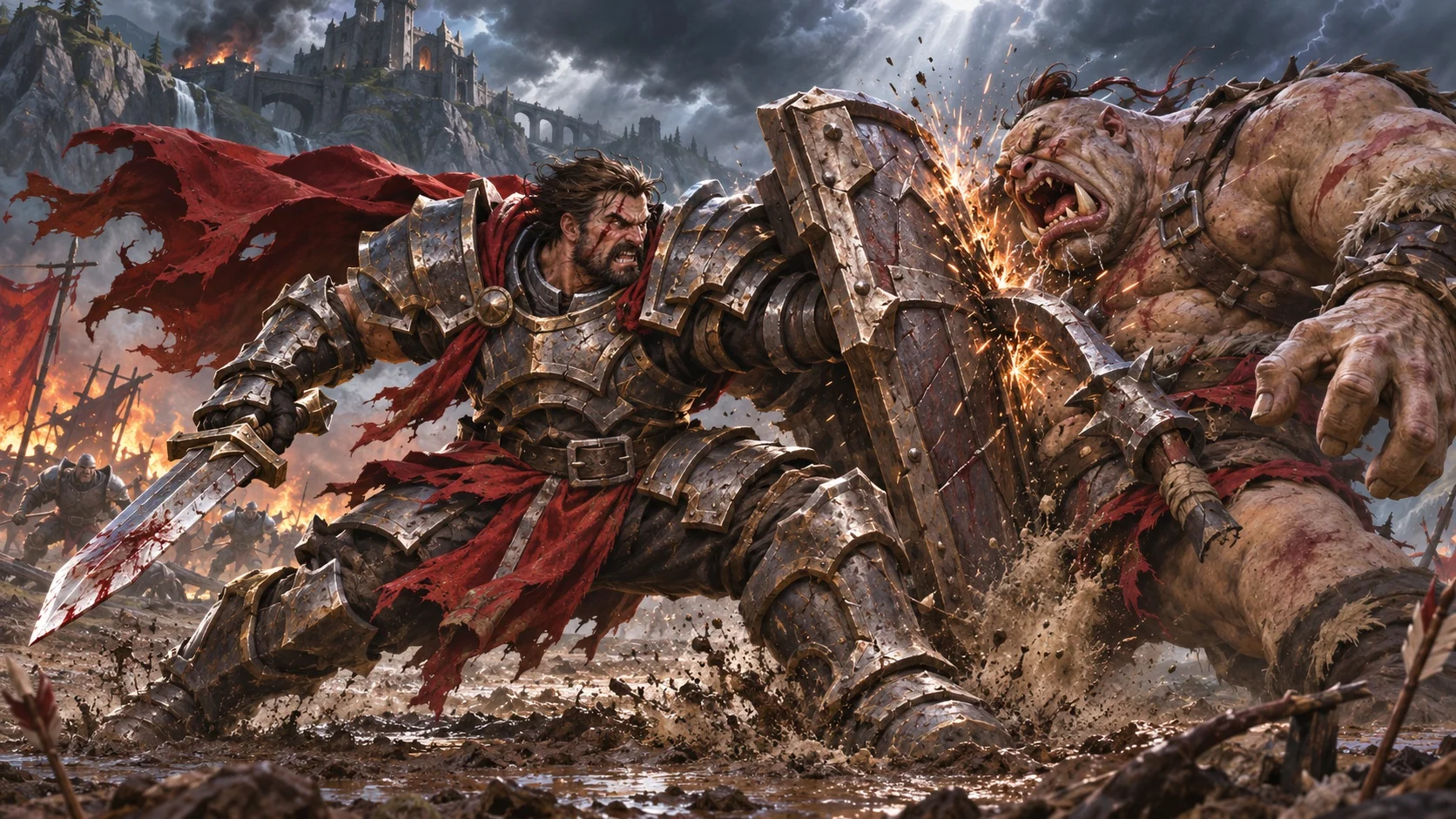
Original AI-generated class illustration for Crit Pick · not gameplay or official artwork.
This WoW Forever Protection Warrior build is a level-60 example with 37 points in Protection and 14 in Arms. It teaches a shield role built around Defensive Stance, Rage decisions and Shield Slam. The aim is to understand how you hold enemy attention and choose protection, rather than copy an unexplained list of tank buttons.
This guide is for players new to WoW or new to Warrior tanking who want to understand the shield tools before trying a complete allocation. A build is the set of talent improvements you choose. A tank is the character trying to keep enemies attacking them while surviving those attacks. I checked this allocation against the saved FOREVER talent rules, but have not tested it in game or established a best setup for a particular raid.
On this page
- What playing this Protection Warrior is like
- Protection Warrior talent calculator: try the build
- Why these Protection talents are here
- Protection Warrior rotation: holding threat with a shield
- Rage management and the limits of this example
- Shouts and defensive cooldowns: reading incoming damage
- Sources, versions and uncertainty
What playing this Protection Warrior is like
Your shield, stance and resource matter before you discuss an attack sequence. A Warrior in a different stance or without the required shield is not in the same situation as the example described here.
- Manage attention. Shield Slam generates very high threat. Threat is the attention your actions create with an enemy, which matters when the group needs that opponent to stay on you.
- Spend Rage deliberately. Several selected talents reduce costs or generate Rage under particular conditions. They do not make every attack free.
- Choose the right protection. Blocking, dodging, temporary Health and damage reduction do different jobs. A defensive icon is not a promise of complete immunity.
This style may suit you if you enjoy reacting to enemy behavior and protecting allies in close range. The guide does not claim a safe pull size, a defense cap or a damage/threat benchmark from the point allocation alone.
Protection Warrior talent calculator: try the build
This example uses 51 talent points: 37 Protection / 14 Arms. It assumes the standard level-60 point budget without extra Legacy talent-point modifiers. A talent rank is a point invested in an improvement; a spell rank is a recorded version of an ability. They are different things.
Click a talent to read its effect, then use the plus and minus controls to change your points. The planner checks recorded rank limits, tree-spending gates and prerequisite talents. You can start empty, reload this example or save your own allocation. The complete table remains readable without the planner.
51 /51 37 Protection / 14 Arms
The interactive planner is loading. The complete talent table below is already readable.
Full talent choices · readable without the planner
| Tree | Talent | Points |
|---|---|---|
| Protection | Shield Specialization | 5/5 |
| Protection | Improved Bloodrage | 2/2 |
| Protection | Anticipation | 5/5 |
| Protection | Improved Revenge | 3/3 |
| Protection | Master of Defense | 2/2 |
| Protection | Defiance | 3/3 |
| Protection | Last Stand | 1/1 |
| Protection | Concussion Blow | 1/1 |
| Protection | Focused Rage | 3/3 |
| Protection | Bastion | 5/5 |
| Protection | Shield Slam | 1/1 |
| Arms | Deflection | 5/5 |
| Arms | Improved Heroic Strike | 3/3 |
| Arms | Improved Tactical Mastery | 5/5 |
| Arms | Anger Management | 1/1 |
| Protection | Vanguard | 1/1 |
| Protection | Improved Thunder Clap | 3/3 |
| Protection | Improved Sunder Armor | 2/3 |
Why these Protection talents are here

Shield Slam and the selected shield role
Shield Slam uses a shield, deals damage and generates very high threat in the captured record. Its captured description gives a 50% chance to remove one Magic effect from the target. That is a possible removal effect, not a guaranteed spell interrupt or permission to remove every kind of effect. Treat the attack’s attention role and the possible removal effect as separate parts of its description.
Bastion improves damage while a shield is equipped. At the selected 5/5 rank, Shield Specialization adds 5% block chance and generates five Rage when you block. Master of Defense at 2/2 generates five Rage when you dodge or parry while a shield is equipped. These are your defensive events, not an enemy dodging or parrying your attack. These benefits have conditions; their presence in the point table does not remove the equipment requirement.

Defensive Stance, Vanguard and Charge
Defiance adds threat in Defensive Stance while a shield is equipped. That is why the stance is part of the build’s role, not just a label in a spell list.
Vanguard allows Charge in Defensive Stance. It changes the stance permission, but the captured Charge still cannot be used in combat. Do not import the modern idea of a general in-combat Charge into this guide.
At 5/5, Improved Tactical Mastery lets you retain up to an additional 15 Rage when changing stances. Additional means this talent adds to Tactical Mastery's retention; it does not state the whole retention limit is 15. It does not mean every Rage point is always preserved or that every stance switch loses all Rage. Anger Management generates one Rage every three seconds while you are in combat and reduces Rage loss out of combat by 30%. Reducing a loss is different from granting the same generation while you wait outside combat.

Keeping core tools affordable
Focused Rage at 3/3 reduces the Rage cost of offensive abilities by three. The selected 2/3 Improved Sunder Armor reduces that named ability's cost by two, not the three of its maximum rank. Improved Thunder Clap and Improved Heroic Strike have their own named cost reductions. These are flat resource amounts, not percentages. A named cost reduction is not a general instruction to spend Rage as soon as any button becomes available.
Heroic Strike is marked as a next-melee attack in the saved spell record. It is not simply an independent instant strike to insert into any gap. Improved Bloodrage increases the Rage generated by Bloodrage; the base ability still costs Health.

Protection, counterattacks and temporary Health
Anticipation adds Defense Skill. Deflection improves parry chance. Improved Revenge increases Revenge damage, but Revenge itself depends on its defensive trigger and stance. These are different changes, not one blanket damage-reduction value.
Last Stand temporarily grants 30% of your maximum Health for 20 seconds. That granted Health is lost when the effect expires; it is not permanent healing or a reduction to incoming damage. Concussion Blow is a stun tool with its own availability. This guide replaces the explorer’s Rend/Deep Wounds side path with Vanguard and cheaper shield-role tools so the explanation matches the selected points.
Protection Warrior rotation: holding threat with a shield
Begin with a manageable opponent and check the required shield and stance. These situations explain the abilities rather than give a fixed rotation or prove that one sequence holds every enemy permanently.

Approach before combat
With Vanguard selected, Charge can be used in Defensive Stance when its other conditions are met. Its out-of-combat restriction remains. Plan your approach instead of treating Charge as the answer to every target moving away during a fight.
Single-target pressure: the enemy is attacking you
Shield Slam gives a high-threat attack. Sunder Armor and Thunder Clap have separate debuff and area-related purposes, and their selected talents help with cost. Read the recorded target conditions; this guide does not promise that Thunder Clap affects every nearby enemy without a limit.

A defensive event opens Revenge
Revenge follows a block, dodge or parry and requires Defensive Stance in the saved record. Improved Revenge makes that counterattack more useful when it is available. It does not let you press Revenge freely before its triggering condition occurs.

An enemy turns toward an ally
Taunt requires Defensive Stance and has no effect if the enemy is already attacking you. Use it for the attention problem it describes. A temporary forced-attention effect such as Challenging Shout should not be described as permanent control over an entire group’s threat.

You need stronger protection or an interrupt
Shield Block requires Defensive Stance and a shield and increases block chance for a limited number of attacks in this reference. Last Stand supplies temporary Health, while Shield Wall has a separate protective effect. They are not interchangeable permanent protection.
Shield Bash interrupts and locks the relevant school in its base description. This example does not select Improved Shield Bash, so do not add a blanket silence to the base tool. Choose the response for the enemy’s action rather than treating every shield button as the same effect.
Rage management and the limits of this example
Why does my Rage change after a block or dodge?
Rage is the resource you spend on the named Warrior abilities. A qualifying block can trigger Shield Specialization, while your own dodge or parry with a shield can trigger Master of Defense. Look at what happened before assuming every attack you make grants those talent returns. Cost reductions, blocks and other conditional returns affect different parts of that resource problem. Reading those conditions is more useful than assuming a shield tank can always press every attack.
Does a valid build prove I am ready for a raid?
No. Use the spell-reference tab to inspect recorded ranks, and check full stance/equipment requirements on your character. The point table is not a level-by-level route or a gearing recommendation. It does not establish mitigation thresholds, a best-in-slot set or live-server behavior.
There are no Warrior entries in the original TEMP registry for this snapshot. That does not prove every aspect of the class is live-tested. I keep the source-version and untested-example explanation visible without inventing a Warrior question-mark case.
Shouts and defensive cooldowns: reading incoming damage
Battle Shout and Demoralizing Shout have different targets
Battle Shout increases nearby party or raid members' melee Attack Power. Demoralizing Shout reduces nearby enemies' melee Attack Power. One supports your group's attacks; the other weakens enemy melee attack strength.
When several physical attackers are involved, notice who each effect applies to. A shout's Attack Power change is different from Shield Block's limited protection against incoming attacks, and neither explains every kind of magical damage.
Sunder Armor, multiple enemies and AoE threat
Sunder Armor reduces the target's Armor and creates high threat. It can stack up to five times in the recorded description. Track the enemy's existing applications rather than treating each attack as an unrelated hit. The improved talent in this build reduces the cost of using that named ability.
AoE threat means holding the attention of multiple enemies. Thunder Clap damages nearby targets and increases the time between their attacks, with a recorded target limit. Those capabilities give you tools for a group of enemies; they do not guarantee every enemy will attack you throughout a pull.
Shield Block, Shield Wall or Last Stand?
These tools protect you in different ways:
- Shield Block: with the required shield and Defensive Stance, the captured effect increases block chance by 75% for up to seven seconds, but only blocks two attacks. The attack limit matters; this is not a guarantee that every incoming attack is blocked for seven seconds.
- Shield Wall: with its required shield and Defensive Stance, it reduces damage taken from all attacks by 60% for 12 seconds in this record. It reduces incoming damage instead of increasing your Health bar.
- Last Stand: grants temporary Health equal to 30% of maximum Health for 20 seconds, then that Health is lost. It does not promise that incoming attacks become weaker. Plan defensive cooldowns around incoming damage and your group's situation; a larger temporary Health bar is not the same effect as damage reduction.
Can Victory Rush heal me whenever my Health is low?
No. Victory Rush is an instant attack that heals for 10% of your maximum Health in the captured description. It can only be used within 20 seconds after you kill a non-trivial enemy. Those 20 seconds are the qualifying use window, not an independently established cooldown. It cannot be assumed available at any low-Health moment. A boss fight without that qualifying kill is a different situation from moving between enemies in the open world.
Does this use a Fury Prot allocation?
Fury Prot is a different talent approach from the 37 Protection / 14 Arms allocation shown here. This example is primarily focused on a shield and Defensive Stance. Battle Stance is a separate stance; changing stance changes which ability conditions you must check. Vanguard supplies the stated Defensive Stance exception for Charge, while Charge retains its out-of-combat condition.
Sources, versions and uncertainty
The talents use the saved World of Warcraft: Forever client reference 1.60.1.70755. Individual class spell and companion records retain their own earlier source-build context, including 70753, rather than being relabeled as the same capture. These are captured descriptions, not a live-server test. A new patch, changed rank cap or different server behavior requires a fresh check.
The original 64-case TEMP research set contains no Warrior cases. The full source registry remains unchanged, and the page does not create a fictional unresolved value to display an icon.
This guide uses a disclosed allocation variant tailored to the role explained here. The earlier nine-class explorer remains unchanged. Legally spending points proves only that the captured rules allow the choices, not that the build performs best.
The character illustration was prepared for Crit Pick using AI. It illustrates the class, not official gameplay. Ability icons come from the saved FOREVER reference sources.
Source note · Warrior effect values · 0 original TEMP cases
Only this class’s entries from the unchanged 64-case research registry are shown here. Unresolved values remain empty.