
LORE LIBRARY VOLUME 07
The Great Sundering: WoW Lore
The old continent breaks. Its survivors inherit a different world.
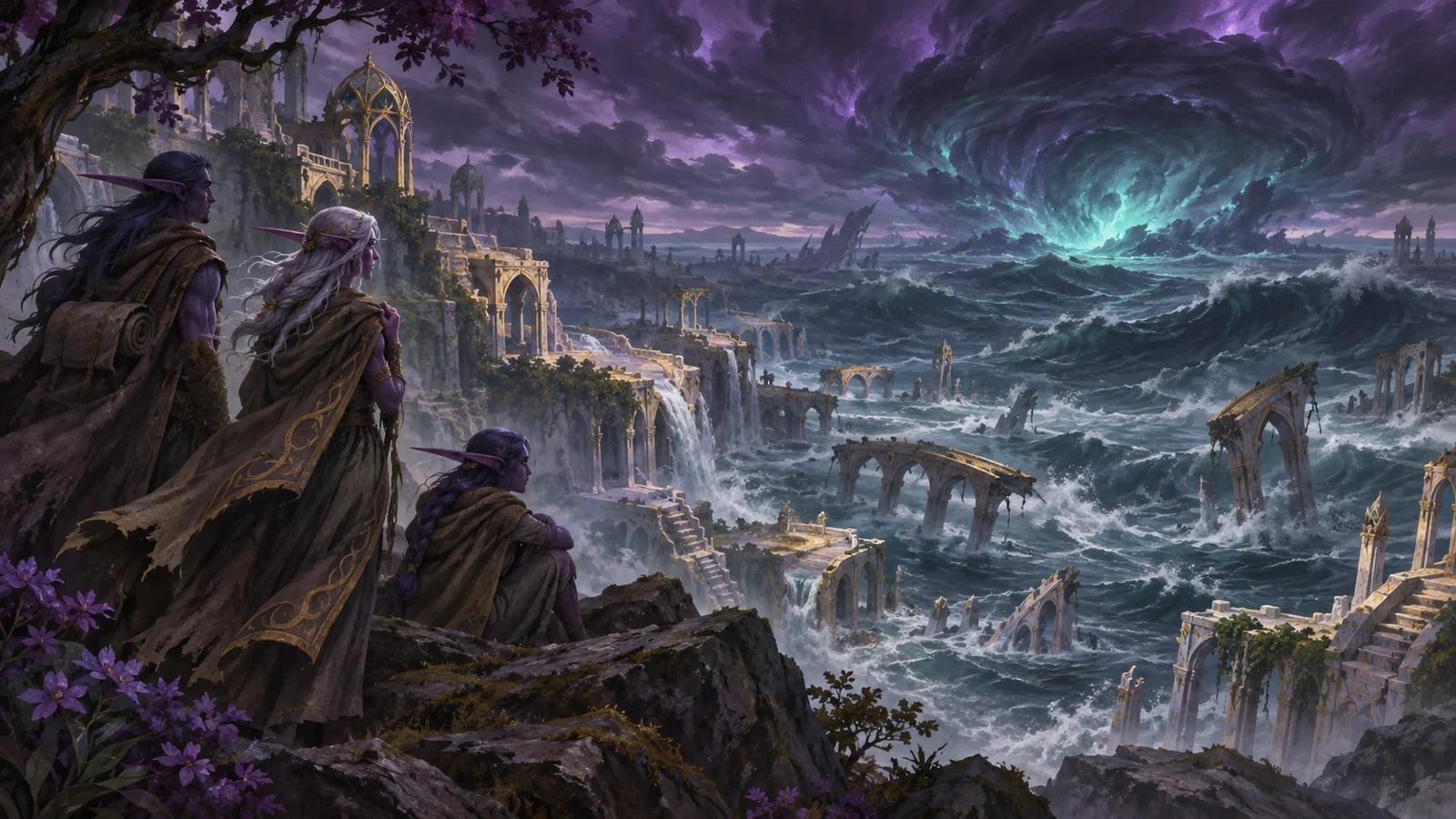
The Great Sundering was the disaster that broke ancient Kalimdor at the end of the War of the Ancients, roughly ten thousand years before the First War. The original Well of Eternity collapsed, the land split apart and the ocean flooded the ruined heart of the night elf empire. The Maelstrom marks the Well's former location. Queen Azshara and many of her Highborne survived beneath the sea as naga.
New to World of Warcraft lore, or following the WoW Forever timeline? This chapter explains why the old world broke, how its continents changed and what happened to the survivors. It connects familiar coastlines, drowned ruins and the naga to the same ancient disaster.
On this page
What caused the Great Sundering?
Azshara's palace Highborne had turned the Well of Eternity into a passage for the Burning Legion. They channeled its power into a portal connected to the Twisting Nether, trying to make it large enough for Sargeras himself. The resistance fought to close that passage before he could enter Azeroth. That struggle is covered in The War of the Ancients.
The gateway was bound to an enormous source of arcane magic. Disrupting it stopped the invasion, but the Well became unstable and collapsed. The resulting explosion and earthquakes shattered the surrounding land. The sea then poured into the space left behind. The defenders had cut off the Legion's route; they could not preserve the old continent in the process.
Blizzard's Well of Eternity dungeon preview connects the ancient portal, the coming Sundering and the creation of the Maelstrom. The lake's earlier history belongs to Azshara and the Well of Eternity.
Closing the portal to the Twisting Nether
Sargeras was prevented from completing his arrival. Neither he nor the Burning Legion was destroyed by the Sundering. The immediate victory was the closing of their way into Azeroth, which explains why later invasions remain possible.
Ancient Kalimdor splits into continents
Before the disaster, ancient Kalimdor was a vast landmass, far larger than the western continent carrying that name today. The Sundering left separated continents and islands. Northrend broke away in the north, as Blizzard's Wrath of the Lich King manual explains. The familiar world map preserves fragments of a much larger whole.
Blizzard's early history describes nearly 80% of that ancient landmass as destroyed. Cities, roads and territories were lost beneath a new sea, leaving separated lands where a much larger continent had stood. That figure describes the catastrophe in the lore; it is not a percentage of today's playable Kalimdor map.
Zin-Azshari, the imperial capital beside the Well, sank with the court's world. The Sundering therefore ended more than a military campaign. It destroyed the physical center of Azshara's empire and separated survivors from places that had once belonged to the same civilization. The Sundering of the World, preserved from Blizzard's early official history, recounts that transformation.
The Great Sea and the Maelstrom
The Maelstrom is the enduring storm and whirlpool at the former Well of Eternity. It occupies the center of the disaster, while the Great Sea covers the wider drowned region. The lake's destruction left a lasting disturbance in the surrounding ocean.
The distinction helps when reading later stories. The Maelstrom, the naga's underwater settlements and surviving night elf ruins share a connection to this catastrophe, but they are not all the same place. Vashj'ir, for example, was another Highborne city swallowed by the Great Sea. Blizzard's Vashj'ir history identifies it as a separate sunken city.
Azshara, N'Zoth and the birth of the naga
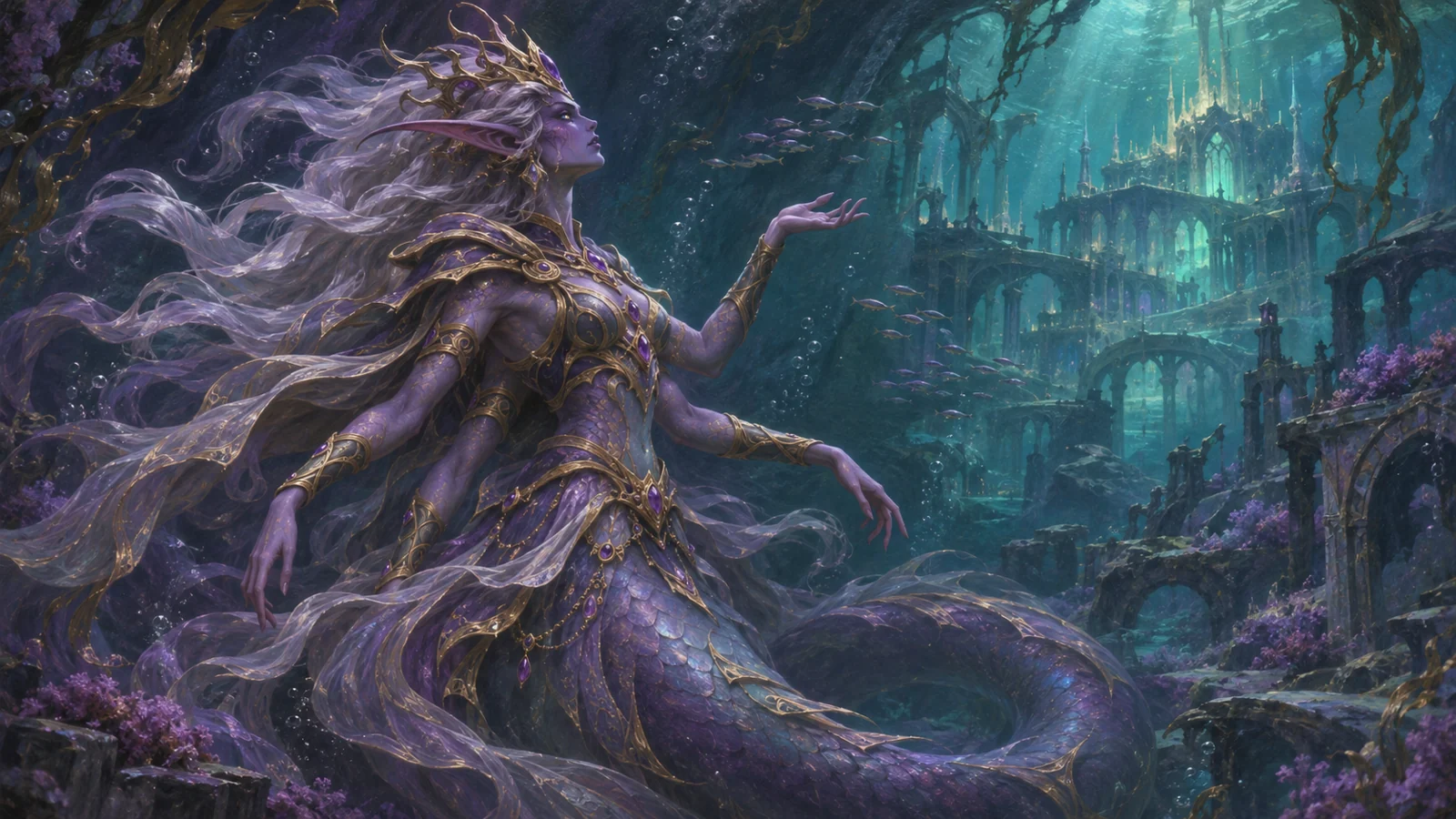
Azshara's bargain with Sargeras had promised a perfected world. Instead, she watched her capital disappear beneath the water. She and many of her Highborne escaped death through a transformation that gave them serpentine bodies suited to the depths. These were the naga, still led by their queen.
Blizzard's Warbringers: Azshara revisits the moment of her downfall. The cinematic makes the Old God N'Zoth central to her survival and the transformation of her people. Azshara seeks to retain her authority even after losing her empire on land; survival gives her a route to power beneath the sea.
The naga established Nazjatar as their underwater seat of power. Later Blizzard material identifies Azshara as its ruler and as N'Zoth's servant. The official Rise of Azshara timeline describes that later relationship. Those later campaigns reveal consequences of the ancient disaster rather than moving the Sundering into the era of the Horde and Alliance.
Highborne survivors took different paths
Azshara's surviving court does not represent every Highborne. Some had already rejected the Legion, while other groups endured the catastrophe elsewhere. Nor did every surviving night elf become a naga. The transformation explains one branch of their history, not the fate of the entire race.
Blizzard's preserved Highborne encyclopedia entry follows these different groups. Keeping them separate matters for later stories about exiles, isolated cities and the high elves.
Malfurion, Illidan and the surviving night elves
The night elf defenders fled the advancing waters and reached Mount Hyjal. Their victory had left them alive in a world whose center was gone. Malfurion Stormrage and his companions now faced the question of how to rebuild without repeating the Highborne's catastrophe.
Illidan had filled several vials with water from the original Well before it was destroyed. He carried some of its power into the aftermath and created a second Well at Hyjal. It was a new magical source, not the original lake surviving intact. Blizzard's Illidan encyclopedia account traces the escape and his decision.
The new Well, Illidan's imprisonment and the World Tree belong to the next volume, Nordrassil and the Long Vigil. Here, the important connection is the surviving water: the original Well was lost, but its power still shaped choices made after the disaster.
The Sundering beyond Azshara's empire
In Pandaria, the pandaren Emperor Shaohao undertook his own journey after the Great Waterspeaker warned him of the coming disaster. The Burdens of Shaohao tells that story from his people's perspective.
Pandaria survived behind concealing mists. Blizzard's original Mists of Pandaria announcement dates that isolation to the Sundering. The continent's later encounter with Alliance and Horde forces belongs to another era. Its survival also shows why Azshara's fall cannot describe every society's experience of the catastrophe.
Great Sundering, Shattering and the novel
The Great Sundering and Deathwing's Shattering in Cataclysm happened at different points in time. Both reshape Azeroth, but their causes are different. Blizzard's Shattering announcement describes Deathwing erupting from Deepholm after the Lich King's fall.
| Name | What it refers to |
|---|---|
| The Great Sundering | The collapse of the original Well of Eternity and the breaking of ancient Kalimdor at the end of the War of the Ancients. |
| The Shattering | Deathwing's later return and the upheavals associated with Cataclysm. |
| The Sundering | Also the title of Richard A. Knaak's third War of the Ancients novel; a book about this history rather than a second ancient catastrophe. |
The older history chapter and the expanded novel account differ in some scene details. This overview follows the shared chain of invasion, collapse and aftermath without treating every early description as a transcript of the novels. Later cinematics also make parts of Azshara's fate more explicit.
Return to the WoW Forever lore library to follow the reading order or sort the books by timeline.
YOUR READING JOURNEY
The world breaks. Its stories continue.
Load your account progress to keep your place.