
LORE LIBRARY VOLUME 06
The War of the Ancients
Azeroth faces the first great Legion invasion.
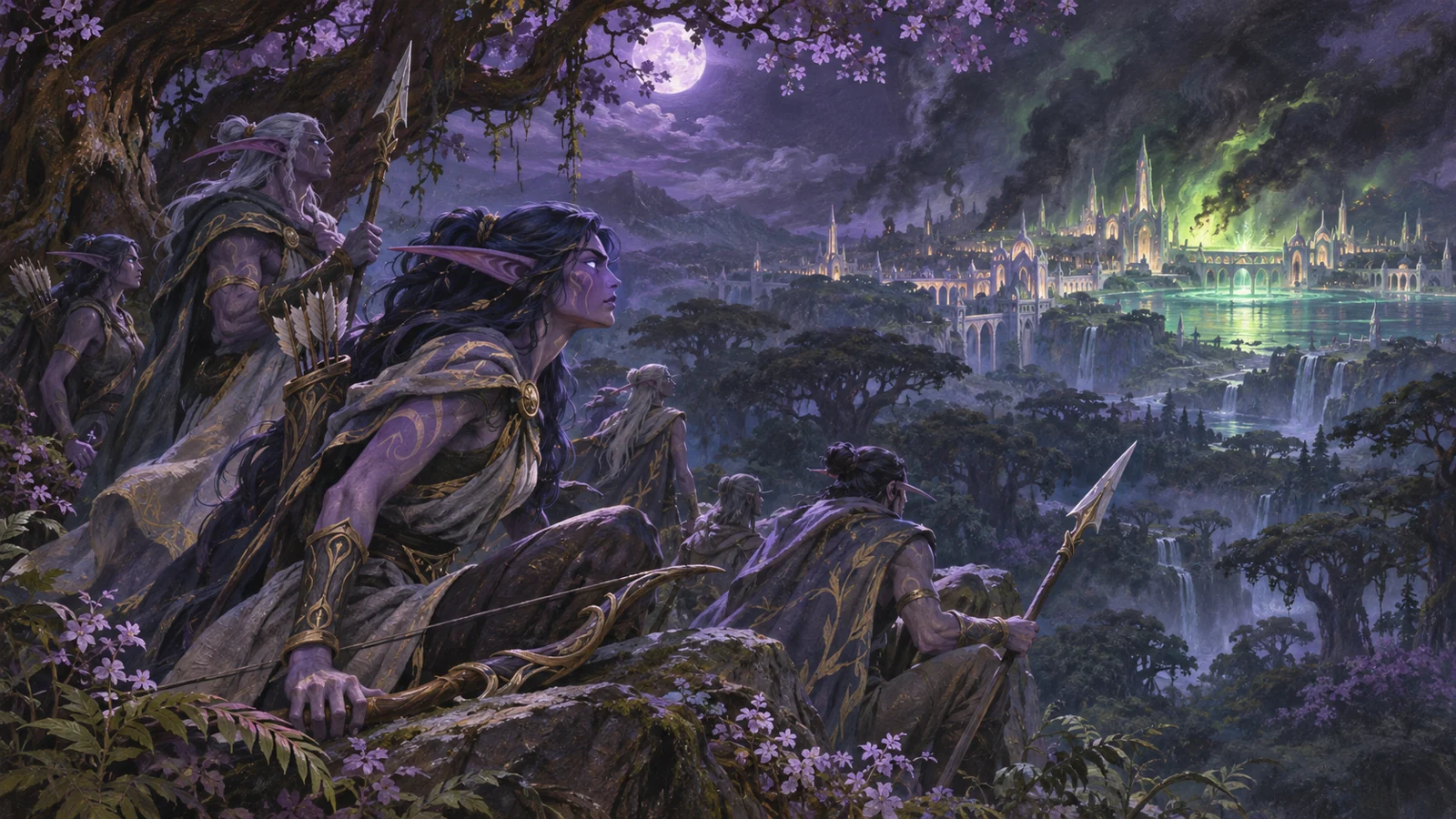
The War of the Ancients was the Burning Legion's first great invasion of Azeroth, roughly ten thousand years before the First War. Queen Azshara and her palace Highborne opened the way through the Well of Eternity. A resistance of night elves, dragons and ancient defenders fought to close that passage before Sargeras could enter. They stopped the invasion, but the Well's collapse brought the Great Sundering.
For readers new to Warcraft lore or following its timeline, this chapter covers the invasion's causes, its main defenders, the Dragon Soul and the war's ending. It connects Azshara's court with the shattered world that later generations inherit.
On this page
- What caused the War of the Ancients?
- The Burning Legion's invasion of Kalimdor
- Night elves and their allies in the War of the Ancients
- The Dragon Soul and Neltharion's betrayal
- Why did Illidan join the Legion during the War of the Ancients?
- How did the War of the Ancients end?
- War of the Ancients: history, novels and dungeon
What caused the War of the Ancients?
Sargeras had assembled the Burning Legion to destroy life across the cosmos. Its origin is covered in Sargeras and the Burning Legion. Here, the empire's greatest source of power became the invaders' route into the world. The Highborne learned to draw arcane energy from the Well of Eternity, a powerful source of arcane magic. Their increasingly reckless experiments drew the Legion's attention. Azshara accepted Sargeras's promise of a perfected world and allowed her favored spellcasters to prepare his arrival.
Zin-Azshari, the night elf capital beside the Well, became the center of that work. Keeping the portal open required the Highborne to channel their magic into it. Demons could already cross while the court labored toward a much greater prize: a gateway capable of admitting Sargeras himself. Blizzard's Well of Eternity preview describes that distinction.
Azshara's decision divided night elf society. The night elves defending their homes were fighting an invasion enabled by their queen. The Well's origin and the court's rise are covered in Azshara and the Well of Eternity.
Xavius and the first satyr
Azshara's chief counselor Xavius was the first palace Highborne contacted by Sargeras. After Malfurion killed him, Sargeras gave him another form: the first satyr. Xavius returned to spread demonic corruption among other night elves. His story makes the invasion's cost personal: members of the old court became agents of the force destroying their own civilization. Blizzard's Xavius encyclopedia entry traces that change.
The Burning Legion's invasion of Kalimdor
Ancient Kalimdor was the great continental landmass of this period, rather than just the western continent on a later map. The Legion's attack therefore threatened the heart of the night elf civilization.
The demon lord Archimonde and Mannoroth were among the invasion's leading commanders. Demons struck cities and countryside while night elf forces tried to hold them back. Infernals, doomguard and felhounds gave the assault several forms: destruction from above, advancing troops and creatures hunting through the land. Blizzard's in-game book The War of the Ancients preserves an early account of the attack.
The gateway linked Azeroth's physical world to the Twisting Nether. More demons could cross as the defenders fought the army already on Azeroth. Winning battles bought time; closing the portal was the way to cut off reinforcements.
Night elves and their allies in the War of the Ancients
Malfurion Stormrage, one of the resistance's leaders, had been learning druidism from Cenarius when he recognized the danger in the Highborne's use of the Well. His training gave him a different relationship with the world from the palace sorcerers' pursuit of arcane power. He sought help against a threat his people could not contain alone.
Tyrande Whisperwind served Elune and joined the struggle alongside Malfurion and his twin brother, Illidan. Her role included supporting the resistance and the effort to cut off the Legion's access. The brothers' feelings for her complicated their relationship, but the invasion was driven by Azshara's bargain and the Legion's ambitions.
The resistance's first army commander, Kur'talos Ravencrest, organized the night elves against the Legion, but Azshara ordered his assassination. His successor, Desdel Stareye, mistook a demonic feint for a retreat and led the defenders into an aerial ambush. Stareye died in the attack. Jarod Shadowsong took command when the surviving nobles could not agree on a response, giving the army effective leadership at a desperate moment. Blizzard's Jarod encyclopedia entry follows that succession.
Cenarius brings the ancient defenders together
Cenarius continued teaching Malfurion and persuaded other demigods to join the defense. They were powerful beings with their own concerns, so cooperation took work. He brought their offer of help to Jarod Shadowsong, expanding the resistance beyond the night elf host.
The alliance also included tauren and the proto-dwarven earthen. Blizzard's Lunar Festival history remembers their shared victory with the night elves. The resistance was no longer fighting as one people alone.
Among its Wild God allies, Ashamane, the great gray panther, answered Cenarius and died fighting the Legion while saving many lives. Blizzard's druid artifact history records her sacrifice. Blizzard's Cenarius encyclopedia entry recounts how the demigods agreed to join the defense.
The Dragon Soul and Neltharion's betrayal
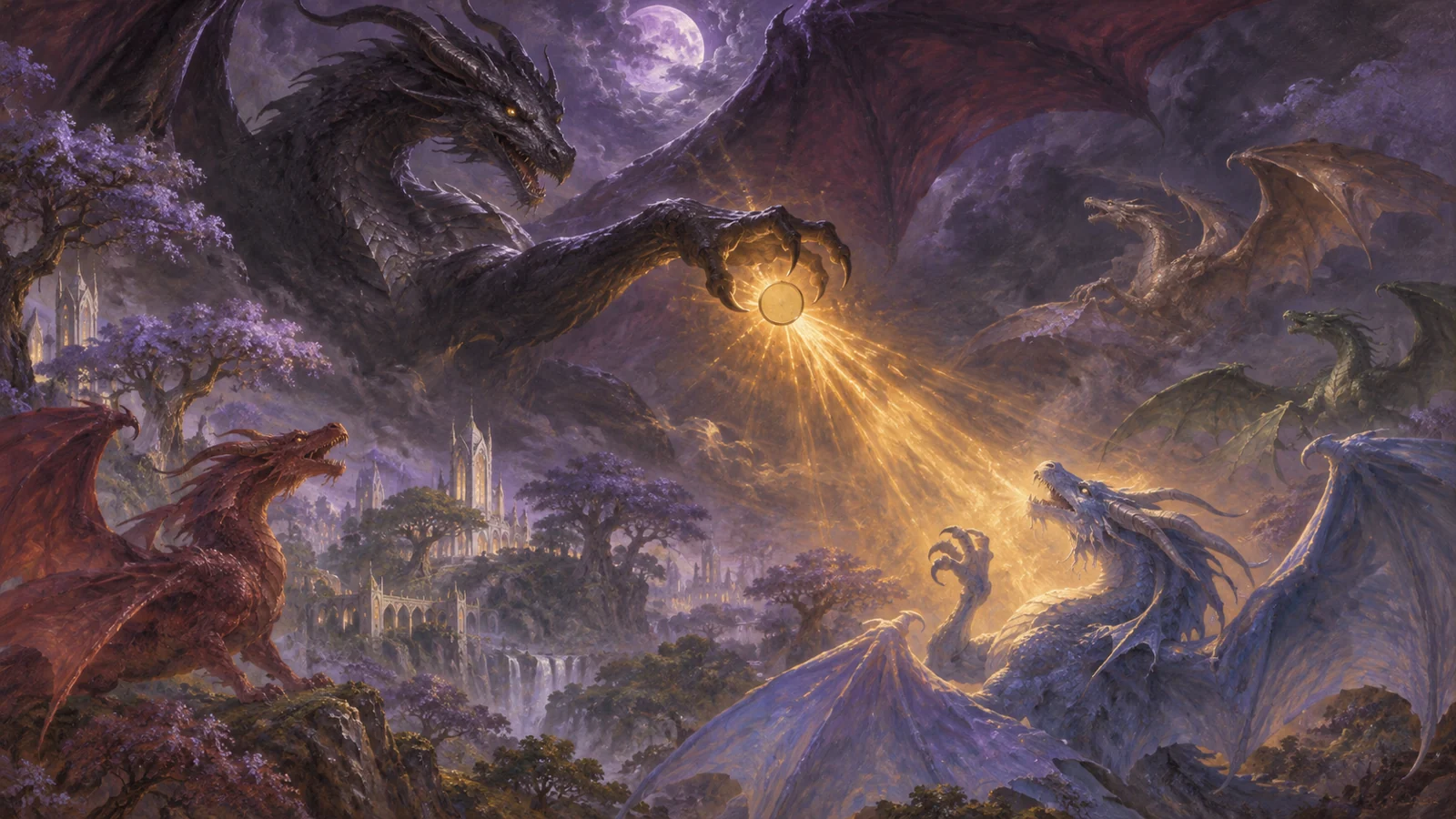
The Dragon Aspects and their dragonflights joined the defense against the Burning Legion. The black Dragon Aspect Neltharion, the Earth-Warder, proposed a weapon that could turn their combined power against the Legion. The other Dragon Aspects surrendered portions of their essence to empower a golden disk called the Dragon Soul.
The Old Gods had corrupted Neltharion, turning his charge to protect the world into a plan to enslave the other dragonflights. He withheld his own contribution. The weapon left his fellow Aspects vulnerable to him, and he used it against the dragons as well as the demons. The blue dragons were almost wiped out by the weapon, and Malygos withdrew into prolonged isolation.
The artifact is also known as the Demon Soul. It turned a plan for collective defense into a means of domination. The dragons' shared charge, introduced in Galakrond and the Dragon Aspects, could not protect them from a betrayal within their own ranks.
Blizzard's history of Neltharion's fall explains the Old Gods' influence. Charge of the Aspects revisits the empowering ritual and its consequences. The fallen Dragon Aspect became known as Deathwing; his later Cataclysm campaign belongs to a different age.
Why did Illidan join the Legion during the War of the Ancients?
Illidan Stormrage fought as an arcane spellcaster and took command of the surviving Moon Guard sorcerers. He also sought greater power, and his rivalry with Malfurion made their relationship increasingly bitter.
During the war, Illidan approached Sargeras and swore allegiance. The dark titan burned away his eyes, replacing ordinary vision with magical sight, and marked his body with tattoos that strengthened his magical powers. Illidan later returned to the defenders, saying that undermining the Legion had been his intention.
His actions helped stop Sargeras's arrival, but they also left his own people uncertain of his loyalty. That tension is more useful to understanding Illidan than treating every choice as either simple heroism or simple treason. Blizzard's encyclopedia account records both the apparent defection and his return.
Some palace Highborne also rejected the Legion. Dath'Remar Sunstrider led a group back to the night elf army before the portal was closed. Their break with Azshara matters when later stories distinguish surviving Highborne from those who remained committed to her plan.
How did the War of the Ancients end?
The decisive objective was the portal at the Well. While Archimonde attacked Jarod on the battlefield, Malfurion and Illidan combined their magic against the gateway. The demons were pulled back through the Well into the Twisting Nether, ending the invasion before Sargeras could enter Azeroth. Blizzard's Jarod account describes that reversal. Sargeras and the Legion still existed beyond the closed passage.
The victory came with a catastrophe. The Well collapsed, and the Great Sundering tore apart ancient Kalimdor. The Maelstrom and the destruction of the old empire are consequences of that ending. Azshara and many of her Highborne survived underwater as naga, as Blizzard's account of the sunken cities explains. Illidan had also collected vials of the Well's water before its destruction. The next volume, The Great Sundering, follows the disaster and the dangerous legacy carried by those surviving waters in more detail.
Three turning points help keep the sequence straight:
| Turning point | Why it matters |
|---|---|
| The Highborne open the way | Demons enter Azeroth while the court prepares a passage for Sargeras. |
| Neltharion turns the Dragon Soul on his allies | The defenders lose the unity and strength they expected from the dragonflights. |
| The portal is closed and the Well collapses | The invasion ends, followed by the catastrophe that reshapes the world. |
War of the Ancients: history, novels and dungeon
War of the Ancients also names Richard A. Knaak's trilogy: The Well of Eternity, The Demon Soul and The Sundering. Its story brings the dragon mage Krasus, the human wizard Rhonin and the orc warrior Broxigar into the distant past. The publisher's trilogy description explains that time-travel premise.
The novels' frame story begins after the Third War, with a rift sending these visitors into the past. The publisher's opening synopsis places it after the Battle of Mount Hyjal. These visitors are part of the expanded novel account. Their presence does not put the later Horde and Alliance into the original invasion as established factions. Earlier summaries are shorter and differ in some details; they should not be treated as complete scene-by-scene versions of the novels.
Nozdormu and the later return to the Well
The Well of Eternity dungeon is another later visit to this period through the Caverns of Time. Nozdormu opens a route through time so Cataclysm-era adventurers can retrieve the Dragon Soul to fight Deathwing in their own time. That dungeon's route and encounters are a playable view of the past, not a complete chronology of the ancient war or a claim about content currently available in Forever.
Return to the WoW Forever lore library to continue through the volumes or sort the collection by timeline.
YOUR READING JOURNEY
The invasion ends. The world breaks.
Load your account progress to keep your place.