
LORE LIBRARY VOLUME 02
Sargeras and the Burning Legion
A fallen titan. An army built to burn worlds.
The Burning Legion is the demon army founded by Sargeras, a fallen titan who turned against the universe he once protected. He freed demons he had imprisoned, united them under his command and made the destruction of worlds his mission.
If you are new to Warcraft lore or starting World of Warcraft: Forever, this guide explains the Burning Legion origins you need first: Sargeras’ betrayal, the demon army and its commanders. These connections help you understand the enemies and corruption behind Azeroth’s wars. Read on for a short timeline, the command structure and a comparison of Classic history with later additions.
On this page
- Sargeras before the Burning Legion
- Why did Sargeras turn against the titans?
- Burning Legion origins: from prison to army
- The Burning Legion’s command structure
- The Burning Crusade: corruption before invasion
- Where this story fits on the timeline
- The invasion of Azeroth: from origins to wars
- Reading the older story in Classic
- Sources and continuity notes
Sargeras before the Burning Legion
Sargeras began as the Pantheon’s champion. While the other titans brought order to worlds, he fought the demonic beings that threatened their work. The older story describes a warrior of molten bronze, powerful enough to defeat enemies that devastated mortal civilizations.
Glorious battles did not end the problem. Sargeras meditated on the corruption he encountered, while the Twisting Nether supplied more demons. His faith in the titans’ purpose wore down. The nathrezim, also called dreadlords, were especially disturbing opponents: they undermined societies through possession, distrust and manipulation.
The defender eventually concluded that the ordered universe itself was flawed. He abandoned the Pantheon and decided to destroy the creation he had once guarded. That reversal is the central event: Sargeras became the organizer of the threat he had spent ages fighting.
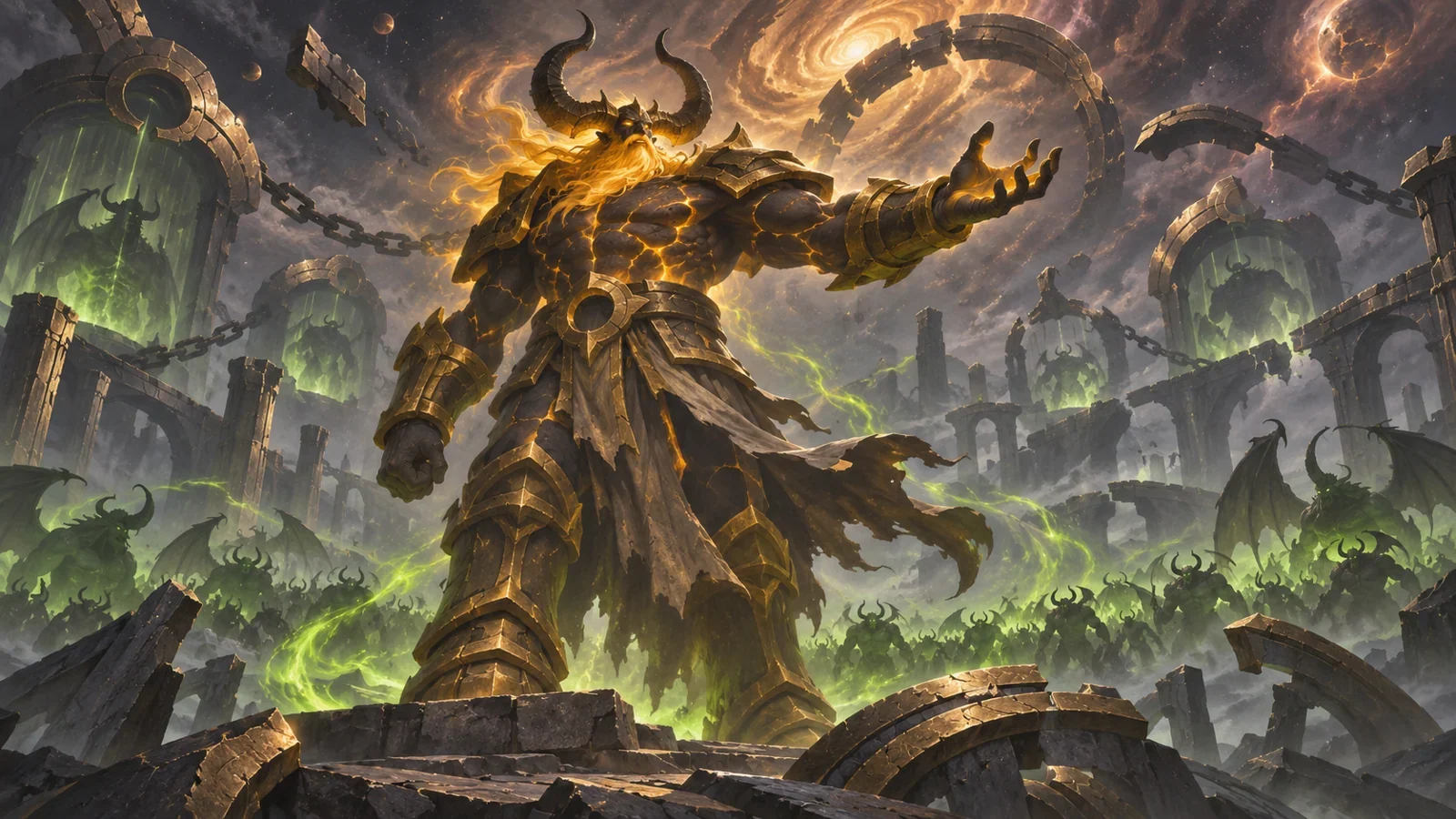
Why did Sargeras turn against the titans?
Warcraft has revised the explanation over time. The shared outcome is his betrayal; the reasons are not identical in every version.
| Account | What drives his fall |
|---|---|
| Classic-era telling | Demonic evil and corruption lead Sargeras into despair. He loses faith in the Pantheon’s vision of order and turns toward destruction. |
| Later Chronicle account | Sargeras learns that the void lords could corrupt a sleeping titan world-soul through the Old Gods. He decides that destroying worlds is preferable to allowing that outcome. |
A world-soul is a nascent titan within a planet. The later account makes Sargeras’ fear more specific: a corrupted titan could threaten creation on a cosmic scale. The Pantheon rejects his decision to destroy an infected world; The fallen titan hoped to deny the Void any victory. He considered even a lifeless universe preferable to a corrupted one.
The Old Gods and the Burning Legion therefore have different origins and goals. The Old Gods are connected to the Void. The Legion follows Sargeras’ destructive crusade. His fear of corruption does not turn his army into the Old Gods’ servants.
Burning Legion origins: from prison to army
Sargeras needed more than his own strength to destroy countless worlds. The fallen titan tore open his demon prisons and made the captives a fighting force. The Burning Legion grew through conquest, recruitment and the corruption of other races.
Later lore names the prison world Mardum, the Plane of Banishment. Sargeras created it after discovering that defeated demons could return through the Twisting Nether. Sargeras shattered Mardum, unleashing countless demons. The eruption of fel energy also transformed him into a monstrous demonic form. Those freed prisoners became the newly formed Burning Legion.
That is why a slain demon and a permanently destroyed demon are different things in later Warcraft lore. Regeneration explains the Legion’s reputation as an apparently infinite army. It does not mean every demon encountered in Azeroth belongs to the Burning Legion.
In the later Chronicle account, Sargeras then fights his fellow titans near Nihilam. The battle destroys the Pantheon’s physical bodies, although Norgannon preserves their spirits. The battle leaves the Legion victorious but exposes its undisciplined demons. Heavy losses help explain why Sargeras needs commanders to organize the Legion’s ranks.
The Burning Legion’s command structure
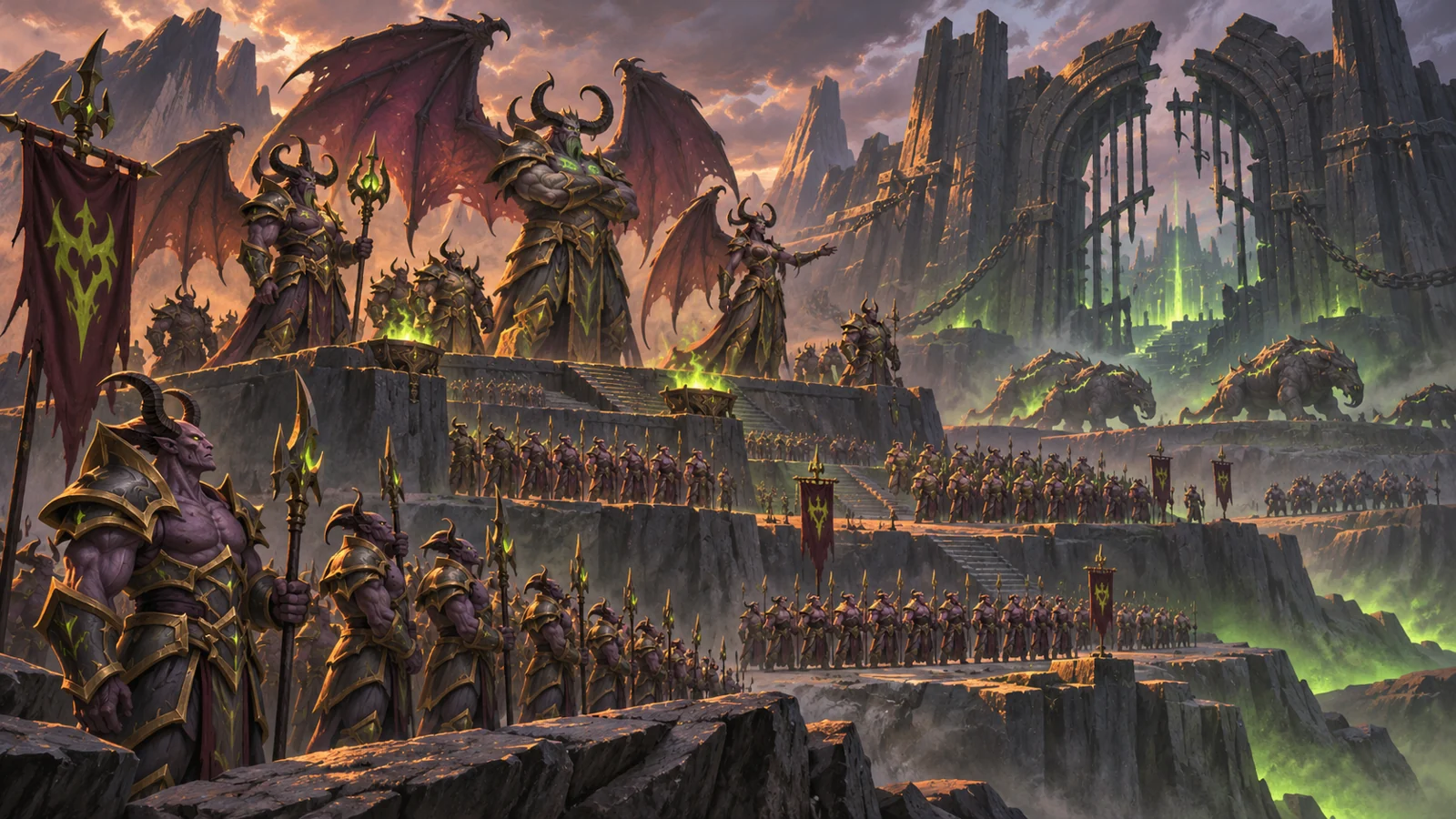
Sargeras recruited the eredar to help control his expanding army. Two became his principal lieutenants, with different responsibilities:
| Commander | Role in the Burning Legion |
|---|---|
| Sargeras, the Dark Titan | Founder and supreme leader; sets the crusade’s purpose. |
| Kil'jaeden the Deceiver | Corrupts and recruits others, using promises, schemes and agents to bring new servants into the Legion. |
| Archimonde the Defiler | Leads the Legion’s armies into battle and directs its military campaigns. |
| Tichondrius the Darkener | A leading dreadlord serving Kil'jaeden; represents the Legion’s use of deception and infiltration. |
| Mannoroth the Destructor | A pit lord general and feared enforcer serving Archimonde. |
The eredar’s history also changed. The earliest Warcraft III version treated demonic eredar as part of the evil that corrupted Sargeras. The revised account makes Sargeras the one who corrupts them. The fallen titan promised the eredar power. On Argus, Kil'jaeden and Archimonde accept; Velen rejects the offer and leads his followers away with the naaru’s help. Those refugees become the draenei. Argus later serves as a Legion homeworld and base of operations.
Velen is part of that later origin account, not a Legion commander. Keeping the versions separate avoids the circular claim that the eredar both created Sargeras’ fall and only became demons because he recruited them.
The Burning Crusade: corruption before invasion
The Burning Crusade is Sargeras’ campaign to destroy ordered creation, not merely the name of a World of Warcraft expansion. The Legion combines military force with promises of knowledge or demonic power. Legion agents can create willing collaborators before its armies arrive.
Fel magic is central to this process. Saturation with fel energy can transform creatures into demons. The army, often called simply the Legion, includes spellcasters, dreadlords, pit lords and lesser soldiers, alongside beasts and destructive constructs. Legion minions are not a single demon race. Nor do all such demons serve Sargeras.
Kil'jaeden’s schemes and Archimonde’s campaigns serve the same crusade. Mortal servants, undead minions and demons remain different kinds of followers; the Scourge is not another name for the Burning Legion.
Where this story fits on the timeline
This is ancient cosmic history, without a precise mortal calendar date attached here. In the older ordering text, Sargeras is already working against the titans while they shape Azeroth. Volume 02 explains a cause behind the world introduced in The Ordering of Azeroth; it is not simply the next event after it.
- Sargeras fights demons as the Pantheon’s champion.
- He rejects the titans’ purpose and chooses destruction.
- He releases imprisoned demons and forms the Burning Legion.
- Eredar commanders help expand and direct its armies.
The invasion of Azeroth: from origins to wars
The origins explain a recurring pattern: the Legion seeks allies or opens a portal before committing its forces. Three later conflicts show how that works. Each receives its own volume in the library.
The Well of Eternity and the first invasion
Around 10,000 years before the First War, Azshara and the Highborne aid Sargeras by opening the Well of Eternity to his demons. The Burning Legion attacked the night elves, whose allies resisted this first Legion invasion. The portal’s collapse ended the invasion and brought the Great Sundering.
The Dark Portal and the orcs
After its first defeat, the Burning Legion continued searching for a way to invade Azeroth. Kil'jaeden corrupts the orcs to serve that purpose. Their invasion through the Dark Portal becomes a campaign fought by mortal proxies, rather than simply another demon army.
The Lich King and the Third War
After the orcs fail, Kil'jaeden creates the Lich King. The Scourge weakens Azeroth for the Burning Legion’s invasion, led by the demon lord Archimonde during the Third War. Malfurion’s plan defeats Archimonde at Mount Hyjal before he can consume the World Tree’s power; Legion remnants survive.
Reading the older story in Classic
The relevant Classic in-game book is Sargeras and the Betrayal. Documented reading locations include Astranaar, the inns in Hammerfall and Ratchet, and the Reliquary in original Scholomance. These are Classic references; the corresponding reading objects have not been verified in Forever.
The Burning Legion continued its campaign after Mount Hyjal. The old Warcraft Encyclopedia describes surviving demons and Legion holdouts across Azeroth. This establishes the army’s continuing influence; it does not verify current Forever spawns or quest outcomes.
Later Retail events, including the Legion’s defeat on Argus, Sargeras’ imprisonment and his sword strike, are not assumed to have happened in Forever. Return to the lore library for the reading order, or read where Forever fits into Warcraft history.
Sources and continuity notes
- Sargeras and the Betrayal — transcribed Classic book, commanders and reading locations.
- Sargeras: character development — changes to his motives and the eredar’s origins.
- Burning Legion — formation and later cosmological context.
- Nihilam — the later Chronicle account of Sargeras’ battle against the Pantheon.
- Mardum, the Shattered Abyss — the later explanation of the demon prison.
- The Warcraft Encyclopedia: Burning Legion — preserved official reference text on membership and post-Hyjal activity.
- The Birth of the Lich King — Classic account of Kil'jaeden’s undead proxy army.
- Blizzard’s Warcraft III manual — the ancient invasion, orcish corruption and Third War.
- Nathrezim — dreadlords and Tichondrius’ role.
- Blizzard’s Argus history recap — the revised eredar, Velen and draenei origin.
- Blizzard’s Forever panel recap — Forever’s setting and continuity boundary.
Prepared 6 November 2026. Classic background and later additions are labelled separately. No later Retail ending is treated as a Forever outcome.
YOUR READING JOURNEY
The crusade begins.
Load your account progress to keep your place.