Aniimo best teams: the seven squads Pawprint itself recommends
Pawprint published its own Aniimo team recommendations: seven squads, four slots each, with roles, skills and where to catch them.

Where the official list actually lives
Every Aniimo tier list and team comp you can find the week before launch is built on beta footage. The rankings disagree with each other, the people who made them say so in their own posts, and the game they describe has already been rebalanced once since the last closed test. There is one list that is not guesswork, and almost nobody is linking it: Pawprint published its own team recommendations.
Seven squads, four slots each, with the role of every slot — DPS, BREAK, Support, REGEN or healer — the skills it should bring, where you actually get the creature, and a short rotation telling you which one to play first. They sit in the studio’s own support portal rather than on the marketing site, in a section called Adventure Guide, next to a core gameplay overview, a training guide and a guide to acquiring Prismana forms.
Where this comes from, plainly: we were not in the closed beta. What we did instead was go through the community — r/Aniimo and the guide channels of the official Discord — looking for team lists that were worth trusting. Most of what is there is beta impressions. What that search turned up, linked in a guide channel and almost nowhere else, was the studio’s own recommendation.
Two things are worth knowing before you use it. The articles carry no publication date, so treat them as the studio’s pre-launch position rather than a patch note. And the same page runs a chat assistant, which is an AI answering machine, not an editorial source — everything below comes from the written articles. The guide also uses the studio’s English element names, which is why you will read Light and Lightning here; the in-game index filter labels those same two elements holy and electric. Both spellings are official, they simply come from different surfaces.
Beginner team one: the safe first squad
The first recommendation is the one most players will land on without trying, because two of the three creatures are early-game open-world catches.
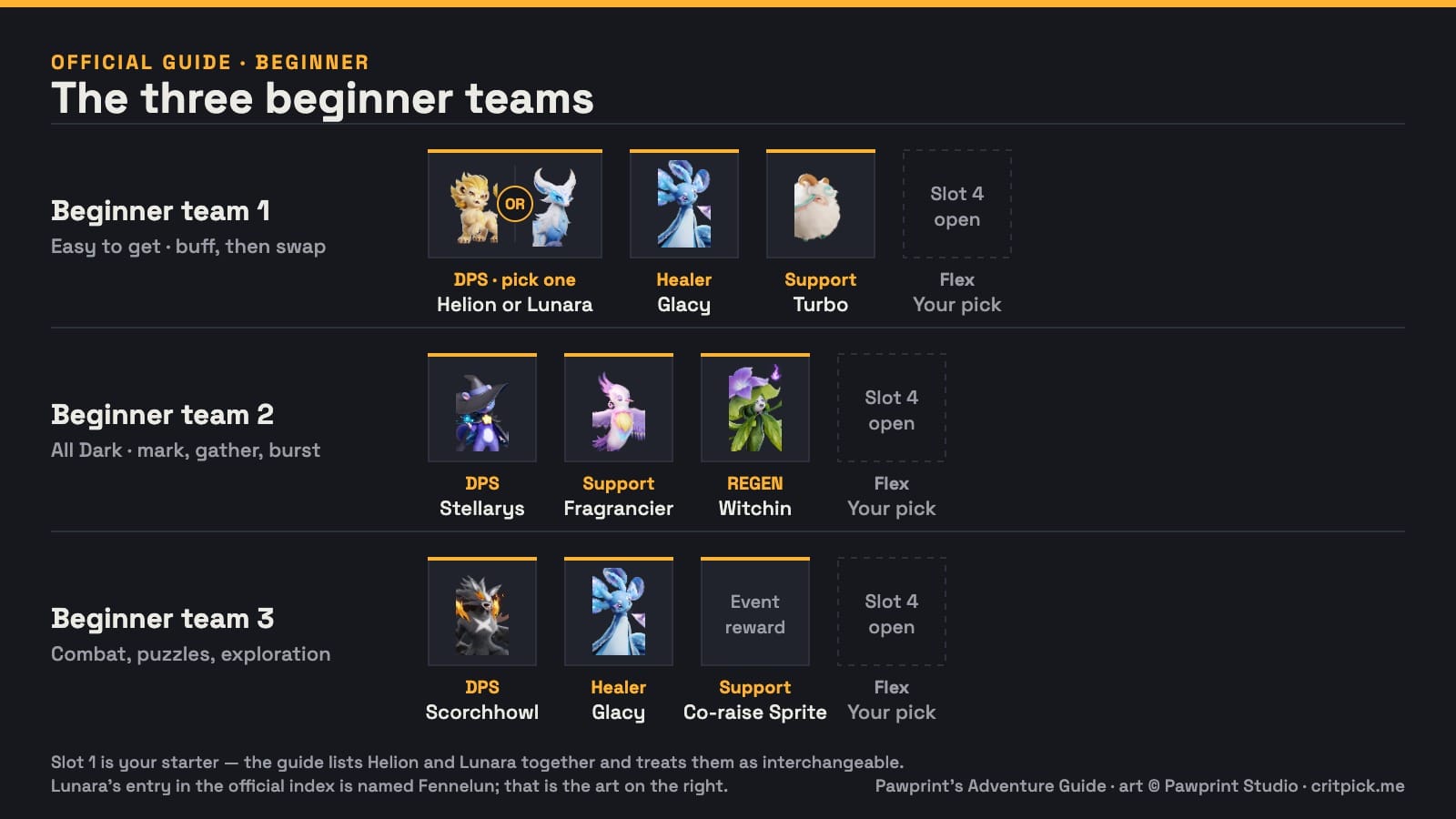
Slot one is your starter, Helion or Lunara, as the DPS. Both are Light, both are picked at the start, and the guide treats them as interchangeable here. Slot two is Glacy as the healer, the third stage of the Skippy evolution line, carrying Healing Water. Slot three is Turbo as support, evolved from Nimbi, carrying Nimbi Burst and Cloud Shield. Slot four is deliberately left open, to be filled by whatever the quest or puzzle in front of you needs.
Open with Nimbi Burst
Turbo stacks the damage buff
Swap to your starter
Helion or Lunara does the damage
Hold the line
Healing Water or Cloud Shield
That is the pattern the whole game runs on: buff first, then swap to the creature that hits. If you are still deciding between the two starters, we compared Helion and Lunara separately.
Beginner team two: all Dark, all damage
The second beginner team is the high-damage alternative, and it is mono-element: three Dark creatures, all catchable in the open world.
Stellarys is the DPS, evolved from Celestis, with Shadow Magic and Shooting Stars. Fragrancier, from the Dewy line, is the support, with Secret Fragrance Mark and Withering Bloom. Hexxin (formerly Witchin), from Hummin, fills the REGEN slot with Euphoric Sonic Blast and Black Hole Domain.
The rotation reads like a combo rather than a rotation. Mark the enemy with Fragrancier. When a wave of enemies is grouped, switch to Hexxin, pull them together with Black Hole Domain and restore energy with Euphoric Sonic Blast. Then bring in Stellarys, deploy her clone, and burst. If you have only ever fought one enemy at a time, that middle step is the part worth practising — gathering a wave before the burst is what turns a slow clear into a fast one.
Beginner team three: the one built for puzzles
The third team is labelled for combat, puzzles and exploration together, and it is the first sign that the open world asks for more than damage.
Scorchhowl leads, the third stage of the Emberpup line, with Fire Kick and Cinderblast. Glacy returns as the healer. The support slot goes to a Co-raise Sprite, which is an event reward rather than a catch, with Inspiration and Treat Feed, or Leaping Sparks if you need shield breaking.
Stack offensive buffs with Inspiration, then switch to Scorchhowl, whose charged Cinderblast is the main damage source. Dodging an attack with Fire Kick grants an extra damage buff on top, which makes this the first team where playing well is worth more than gearing well.
The advanced teams: mono-element and meaner
Both advanced teams drop the mixed-element approach entirely.
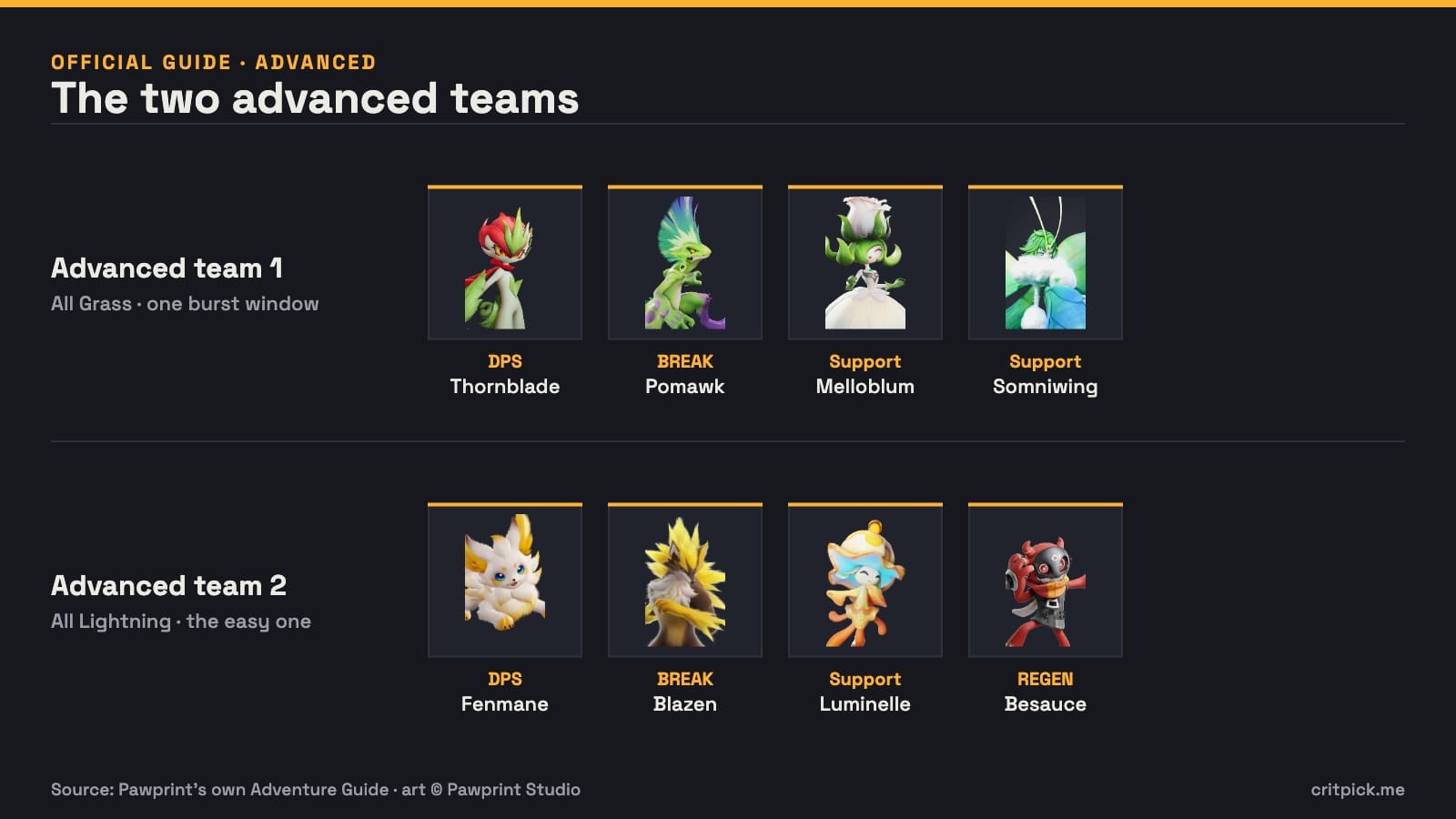
The first is all Grass and built around a single burst window. Thornblade deals damage, Pomawk breaks, Melloblum supports with Thorny Blessing and Healing Rose, and Somniwing adds a second support layer with Hypnotic Spores and Ethereal Light Wave. The guide asks you to keep Ethereal Light Wave running for as much of the fight as you can, break with Pomawk, and slip Melloblum’s Thorny Blessing in immediately before the Break State opens, so Thornblade lands its damage into the window.
The second is all Lightning and explicitly the easier one to play. Fenmane deals damage, Blazen breaks, Luminelle supports, and Besauce covers REGEN. Fenmane needs stacked buffs to transform, so the order matters: as Blazen is about to break the enemy, switch to Luminelle for Lightning Surge, then to Fenmane to stack Thunderbond and hit the peak.
Three of those four are open-world catches. Somniwing comes from Elite Training and Besauce from the Shop Exchange, which is the first point where the recommended teams stop being purely about catching things.
The endgame teams: burst, and a water shell
The two endgame squads are where the acquisition routes get specific.
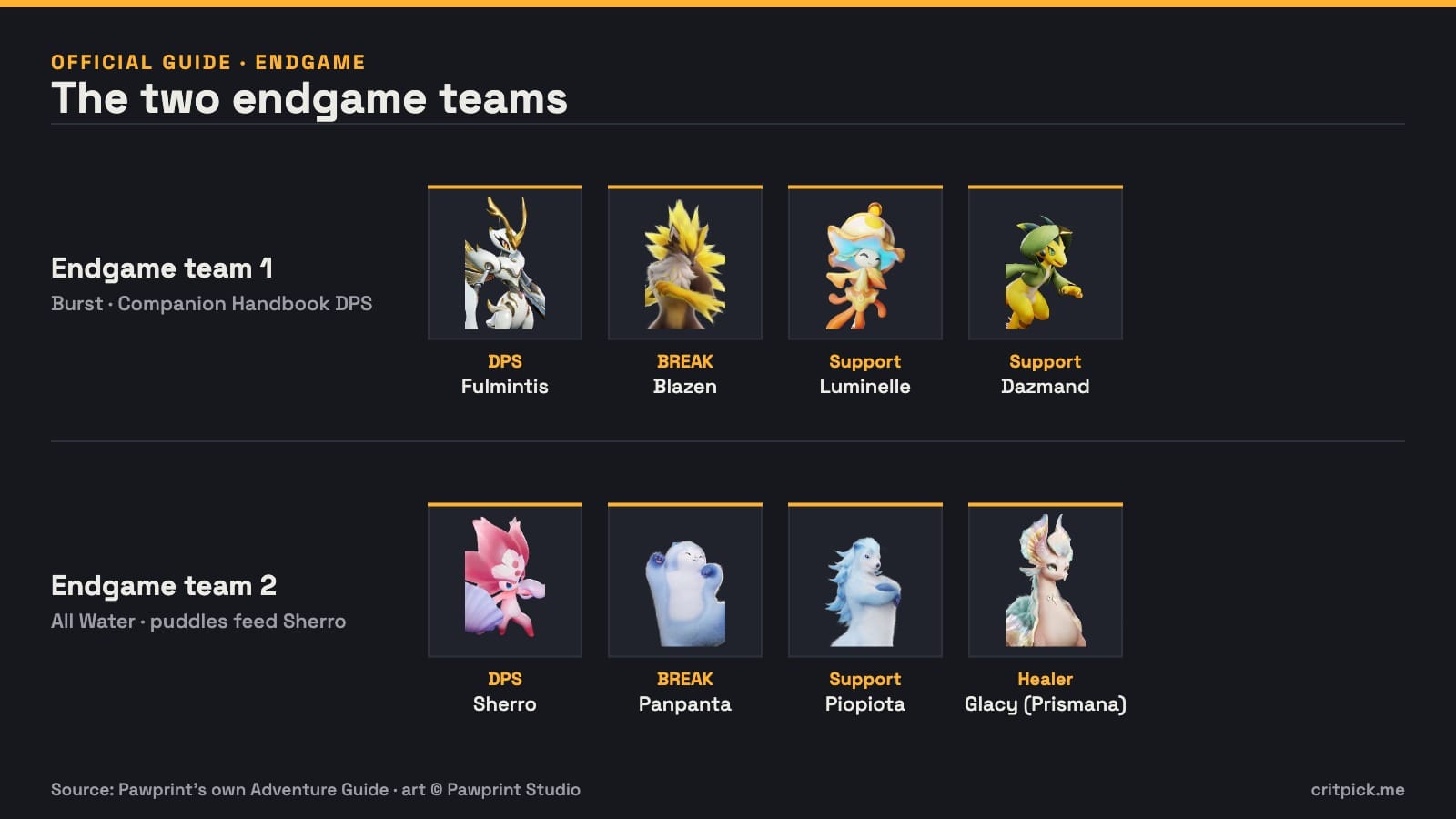
The burst team is Lightning again, with Fulmintis as the damage dealer, and Fulmintis comes from the Companion Handbook. Blazen and Luminelle keep their jobs, and Dazmand joins as a second support from an event unlock. Break with Blazen, stack with Lightning Surge and Thunder Sweep, then burst with Fulmintis.
The balanced team is Water, and it is the most mechanical of the seven. Sherro is the damage dealer, Panpanta breaks, Piopiota supports, and the healer slot goes to Glacy’s Prismana form, which appears during Prismana weather in Driftwise Meadow — one of the six free Prismana is claimed the same way. The catch: Panpanta and Piopiota are not only there to break and support. They have to keep water puddles on the field, because that is what triggers Sherro’s passive.
What the seven teams tell you about Aniimo’s combat
Read together, the seven recommendations say more about the game than any of them says on its own.
There are five jobs, not four, and the in-game Aniilog labels them: DPS, BREAK, Support, REGEN and Heal. REGEN is treated as its own role with its own slot, not as a healing variant. Every team follows the same shape — break or buff first, then swap to the creature that converts that window into damage. Swapping is the mechanic; a team that never swaps is playing one quarter of its kit. That matches what the roles in the official index already suggested, which we went through in our Aniimo tips.
Slot four is open in all three beginner teams. The studio is telling you to keep a flexible seat for quests and puzzles rather than to optimise a fixed four. And the deeper you go, the more mono-element the teams become: beginner teams mix elements, advanced and endgame teams do not. Whether that is a real damage bonus or simply easier buff chaining, the guide does not say.
What the list does not tell you
It is a recommendation, not a ranking. The guide never calls any creature the best, never compares two, and never publishes a single stat. If you came for numbers, they are not here.
It also predates your save file. The articles are undated and describe a pre-launch build, so a balance pass can move any of it.
Four of the recommended creatures — Fulmintis, Somniwing, Besauce and Dazmand, plus the Co-raise Sprite — are not open-world catches at all, and their acquisition routes depend on events and shops that only exist once the servers are up. What it is worth: it is the only team list in circulation that comes from the people who balanced the game, and it names the acquisition route for every slot. Use it as the shape of a team rather than as a shopping list, and fill slot four yourself. Everything else we have on the game is on our Aniimo tracker.
And to be straight about our side of it: we have not played it either. This post is the studio’s written guide plus what the community posted before launch, nothing else. From day one we play it and check every line against our own save — what moves, we correct here.
FAQ
Where can I find Aniimo’s official team recommendations?
They are in Pawprint’s support portal under Adventure Guide, alongside a core gameplay guide, a training guide and a Prismana guide. The portal is linked from the official Discord rather than promoted on the front page, which is why most guides have missed it. The articles carry no date.
What is the best beginner team in Aniimo?
The studio’s own first recommendation is your starter as damage, Glacy as healer and Turbo as support, with slot four left open. Two of the three are early open-world catches, and the rotation is simple: buff with Nimbi Burst, then swap to the starter. It is a recommendation, not a ranking.
Does it matter whether I picked Helion or Lunara?
Not for this team. The guide lists them together in the same slot and treats them as interchangeable damage dealers, both Light element, both chosen at the start. The differences show up in their skills and their transformation, not in whether the recommended squad works around them.
Is this an official Aniimo tier list?
No, and that distinction matters. A tier list ranks individual creatures against each other. This guide recommends seven complete teams with roles, skills and rotations, and never rates one creature above another. Every ranked Aniimo tier list you can currently find is community-made and built on beta data.
How do I get Fulmintis, Somniwing, Besauce and Dazmand?
The guide names a route for each: Fulmintis through the Companion Handbook, Somniwing through Elite Training, Besauce through the Shop Exchange, Dazmand through an event unlock. What it does not say is how long any of those take at launch, so treat the endgame teams as a destination rather than a week-one plan.
Why does the guide say Light and Lightning when the index says holy and electric?
Both are official, from different surfaces. The written guides use Light and Lightning; the filter bar in the studio’s own creature index uses holy and electric. Nobody has reconciled the two, so a guide that quotes one is not contradicting a guide that quotes the other. Expect both spellings to stay in circulation.
Should my endgame team be all one element?
The studio’s two endgame recommendations are mono-element, and so are both advanced teams, while all three beginner teams mix. That is a clear pattern, but the guide never explains it — no damage bonus is documented. Treat it as the studio’s preference for chaining buffs within one element, not as a proven rule.