
Dawn of War 4 Necrons: Power Matrix and resurrection
How Dawn of War 4’s Necrons expand the Power Matrix, earn Dominion, resurrect units and use teleportation. Confirmed mechanics and pre-release limits.
On this page
- Dawn of War IV Necron economy: Power Matrix and Dominion
- Resurrection Galleries: replacing fallen Necron units
- Necron teleportation: Tomb Pylons and the Monolith
- Necron units: Scarabs, Deathmarks and Doomstalkers
- Who are the Necrons, and why return to Kronus?
- Thothmek and Ahmnok: two campaign commanders
- Dawn of War IV changes: check the build date
- Cover and resilience: different defensive rules
- Is this the faction to watch?
- Dawn of War IV release date and official sources
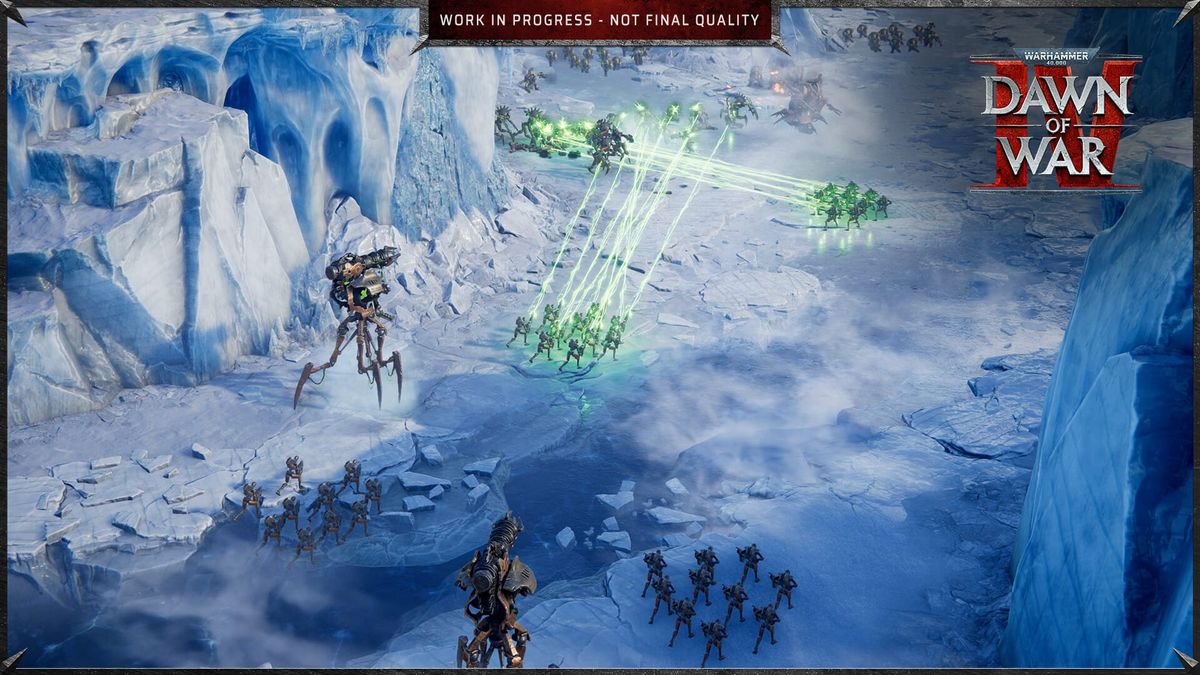
Dawn of War IV’s Necrons are ancient android warriors built around a slow, methodical advance. Their troops are generally slower than the other factions’ units, but exceptionally durable. They hold territory and wear enemies down through recovery and free resurrection. Expanding the Power Matrix strengthens their economy and army, while teleportation helps their slower troops reach a new frontline.
Choosing your army in Warhammer 40,000: Dawn of War IV? This guide explains the Necron economy, confirmed units and teleportation, so you can judge whether an infrastructure-led advance suits you. Checked 24 October 2026; the Power Matrix has already changed during development, so early demonstrations are not final balance data.
Dawn of War IV Necron economy: Power Matrix and Dominion
The Tomb Citadel is your production centre. Buildings spread the Power Matrix, many structures require it for placement, and expansion generates the Dominion resource. Friendly units on the Matrix receive additional resilience and faster recovery outside combat. You are deciding where your next building will let the army operate, as well as what that building produces. Official Necron deep dive.
A strong position still has to serve the match objective. Domination rewards strategic positions; Maelstrom contests objectives that appear around the map. That is why the movement options below matter even for an army built around its own territory. Developer multiplayer AMA.
Resurrection Galleries: replacing fallen Necron units
Resurrection Galleries are assigned a preferred unit type and can replace fallen units of that type for free. Keeping the infrastructure alive therefore matters as much as the next exchange of fire. A gallery is configured for a selected type; it is not a promise that every casualty anywhere immediately reappears.
This changes what you need to defend. An opponent attacking your resurrection infrastructure threatens the army you can field next, even if your current frontline survives. Consider where the replacement unit must arrive and how it will reach the next objective.
Necron teleportation: Tomb Pylons and the Monolith
These are three different ways to move an otherwise slow army:
- Canoptek Spyders construct Tomb Pylons away from base. A pylon creates a new patch of Matrix and a destination for troops entering the Tomb Citadel.
- Translocation Science is a stratagem that teleports up to five units to another visible part of the map.
- The Monolith’s Eternity Gate provides an exit for reserves waiting at your Citadel.
The first establishes a destination, the second moves a selected group, and the third brings reserves through a mobile war machine. Plan the destination before committing your slowest troops to a long walk. A distant objective can matter more than the ground your army currently makes difficult to attack.
Necron units: Scarabs, Deathmarks and Doomstalkers
The Necron roster combines specialised infantry with heavy war machines. These confirmed roles buy time for the advance:
- Scarabs tie up enemy ranged units in melee combat.
- Deathmarks snipe enemy commanders and elite infantry.
- Doomstalkers bring heavier firepower with Doomsday Blasters.
Scarabs are an exception to the army’s generally slow movement. Sending them into hostile shooters can prevent those enemies from using their strongest ranged weapons, buying the rest of your force time to approach. Deathmarks do a different job: threaten priority infantry from a distance instead of joining that melee.
The developer AMA also names the Monolith’s Particle Whip as an answer to clustered units. That makes target choice relevant even for a resilient army. The largest concentration of enemies and the most important single target may call for different tools.
Who are the Necrons, and why return to Kronus?
The Necrons began as the mortal Necrontyr. Their bargain with the C’tan star gods promised immortality, but biotransference replaced their flesh with living metal and cost them their souls. After breaking with the C’tan, they entered a sleep lasting millions of years. Now their dynasties awaken from tomb worlds to reclaim their former domains. Official Warhammer background.
Dawn of War IV brings that history to Kronus, a dormant tomb world emitting a mysterious signal. That is the setup for the faction’s campaign, rather than a new multiplayer rule.
Thothmek and Ahmnok: two campaign commanders
The Chronomancer Thothmek manipulates time to support his forces and disrupt enemies. Ahmnok takes a direct approach with massive claws. Their abilities give the two leaders different jobs in combat.
Outside the campaigns, commanders are generic faction units selected before a match. By default you produce them later from headquarters for a cost. Custom settings can start with a commander or disable them. Those rules matter when interpreting an early demonstration.

Dawn of War IV changes: check the build date
The September Orks versus Necrons Battlefield Report specifically advertises Power Matrix changes following community feedback. It is a useful warning against copying an exact early-game plan from the July demonstration. We are not carrying old resource rates, build timings or a tier ranking into this guide as if they were launch facts.
Cover and resilience: different defensive rules
The multiplayer AMA confirms that Necrons do not use cover. A barricade that protects another faction’s shooters therefore does not provide the same benefit here. Build your plan around the army’s own resilience, recovery and territory instead.
That is also why the location of a fight matters. Staying on your Matrix protects its advantages; moving elsewhere may be necessary to win the objective. The interesting decision is when to hold your strong ground and when to spend your mobility tools to leave it.
Is this the faction to watch?
If you enjoy planning an advance around infrastructure and deciding when to redeploy, the announced design gives you plenty to examine. A reliable claim about how forgiving it feels needs hands-on testing. Compare the Adeptus Mechanicus network, read the source limits in our preview roundup, or return to the Dawn of War 4 hub.
Dawn of War IV release date and official sources
Dawn of War IV is being developed by KING Art Games and published by Deep Silver for PC on 3 December 2026. The Necrons are one of four launch factions, alongside Space Marines, Orks and Adeptus Mechanicus. The game’s four campaigns support solo and co-operative play.
- Official Necron faction deep dive: economy, resurrection, movement and commanders. Its old September release reference has been superseded.
- Developer multiplayer AMA: cover, match objectives, the Particle Whip and commander rules.
- October game overview: current release date, factions and campaign co-op.