Dark Heresy investigation system: clues, journal and judgement
How Dark Heresy turns clues into conclusions: the Detective Journal, servo-skulls, companion advice and the choice of whom to accuse.

The Dark Heresy investigation system puts you in charge of collecting evidence and deciding whom to blame. As an acolyte of the Inquisition, you inspect crime scenes, question witnesses and connect clues in a Detective Journal. Then you report to your Inquisitor. That report can follow the truth, get it wrong, or deliberately put the blame on someone else.
Owlcat Games gives you room to act before every loose end is tied up. There is a limit, though: according to senior narrative designer Veronika Larionova, you need an incriminating entry in the journal before you can accuse a suspect. You cannot simply point at any random person and declare the case closed.
Development status: this explains announced systems and published beta information, checked on 24 October 2026. It is not a case walkthrough or our hands-on review. The full game still has no verified release date.
How the Dark Heresy investigation system works
Owlcat's original explanation divides the investigation process into four areas. Read these as the tasks you perform, rather than four compulsory screens that every case must follow.
- 1. Find cluesExamine objects, tracks and testimony. A lead may be incomplete or misleading.
- 2. Use special toolsInvestigate what ordinary observation cannot reveal with your servo-skulls and companions’ specialist skills.
- 3. Draw conclusionsConnect information in the journal and weigh competing interpretations.
- 4. Pass judgementReport your actions and conclusions to the Inquisitor, including the person you accuse.
Evidence gathering gives you material to test a theory. Owlcat's examples include a bloodied bolter, a burned account book, an unknown substance and symbols on a wall. Witness statements matter alongside physical evidence. Look beyond objects, too: Owlcat describes following footprints, examining the terrain and reconstructing events. A clue gives you something to investigate; it does not settle who acted or why.
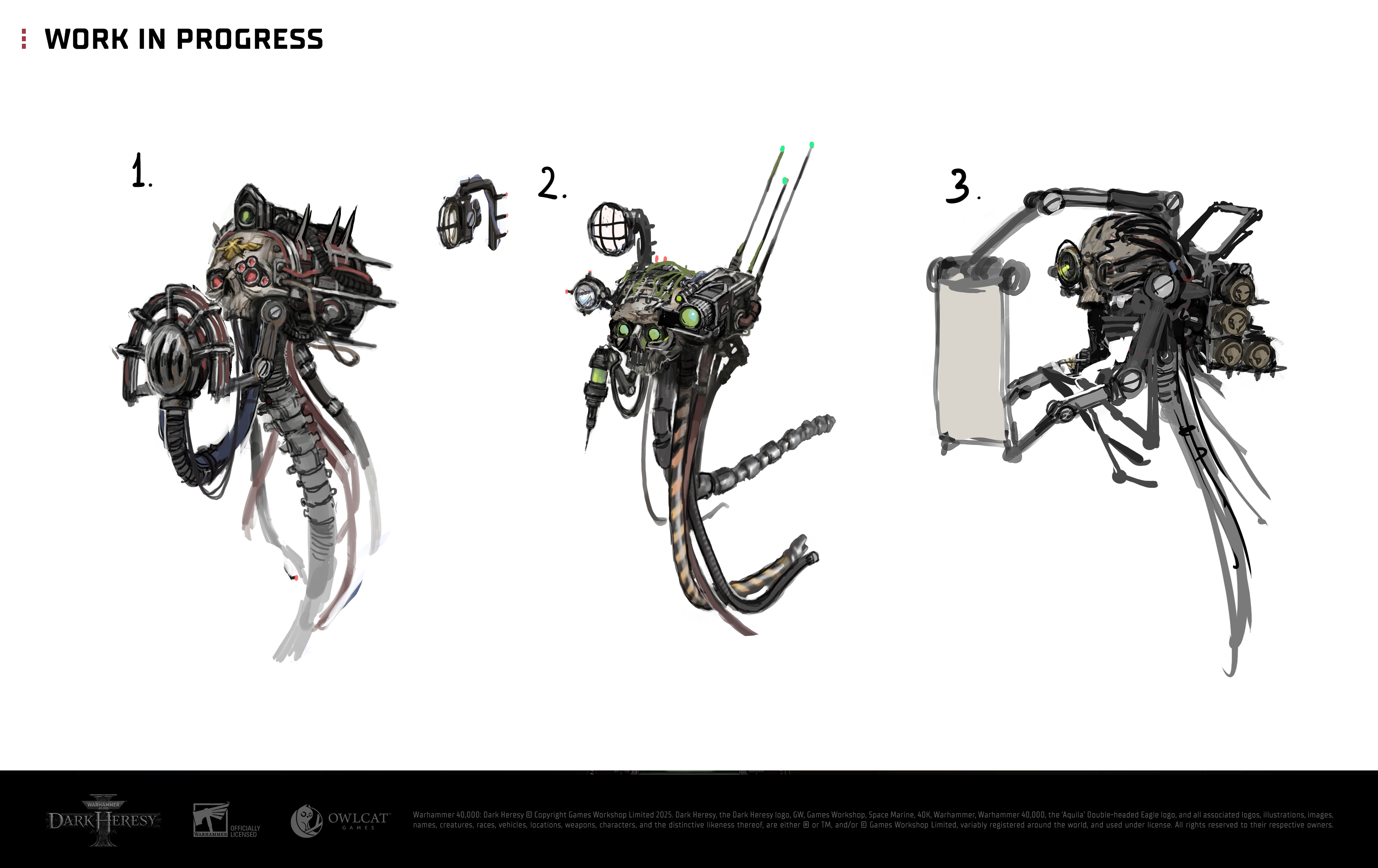
Use special tools: servo-skulls and the Servo-Ossuarium
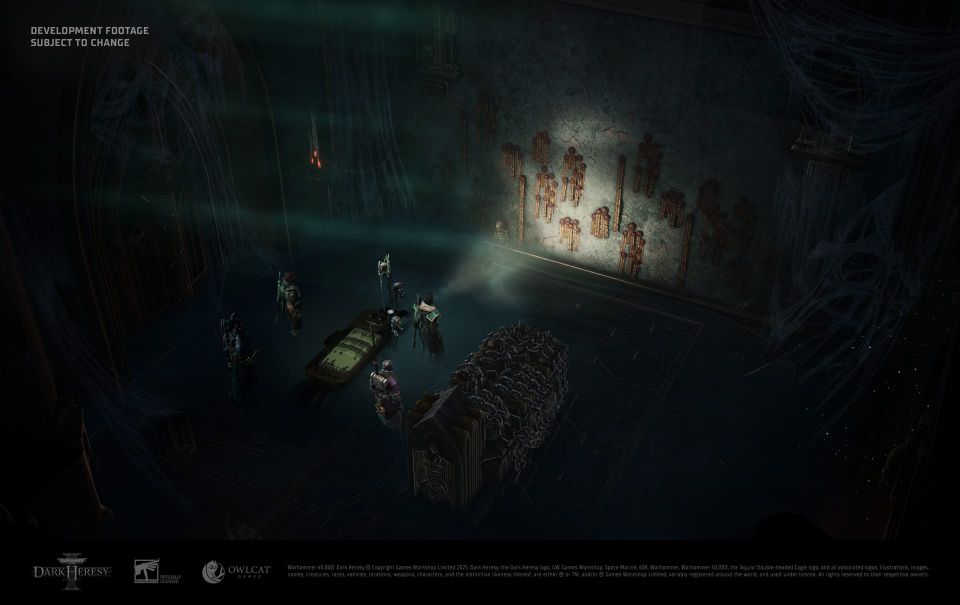
The Servo-Ossuarium combines several servo-skulls in one rare device. Larionova describes following traces, intercepting signals and using the device to analyse evidence. Owlcat's earlier breakdown also names lighting, Auspex scanning, speech synthesis, image recording, analysing substances and Psykana detection among the different skulls' functions.
These tools let you examine a scene beyond the visible objects on the floor. The October overview shows a signal display, a green scan and projected figures in a scene. Those are demonstrations of the tools, not proof that every investigation has the same scanning puzzle.
Other Inquisitors can provide additional devices. Final resource costs, exact checks and restrictions on repeated analyses have not been established in the sources used here.
Draw conclusions in the Detective Journal
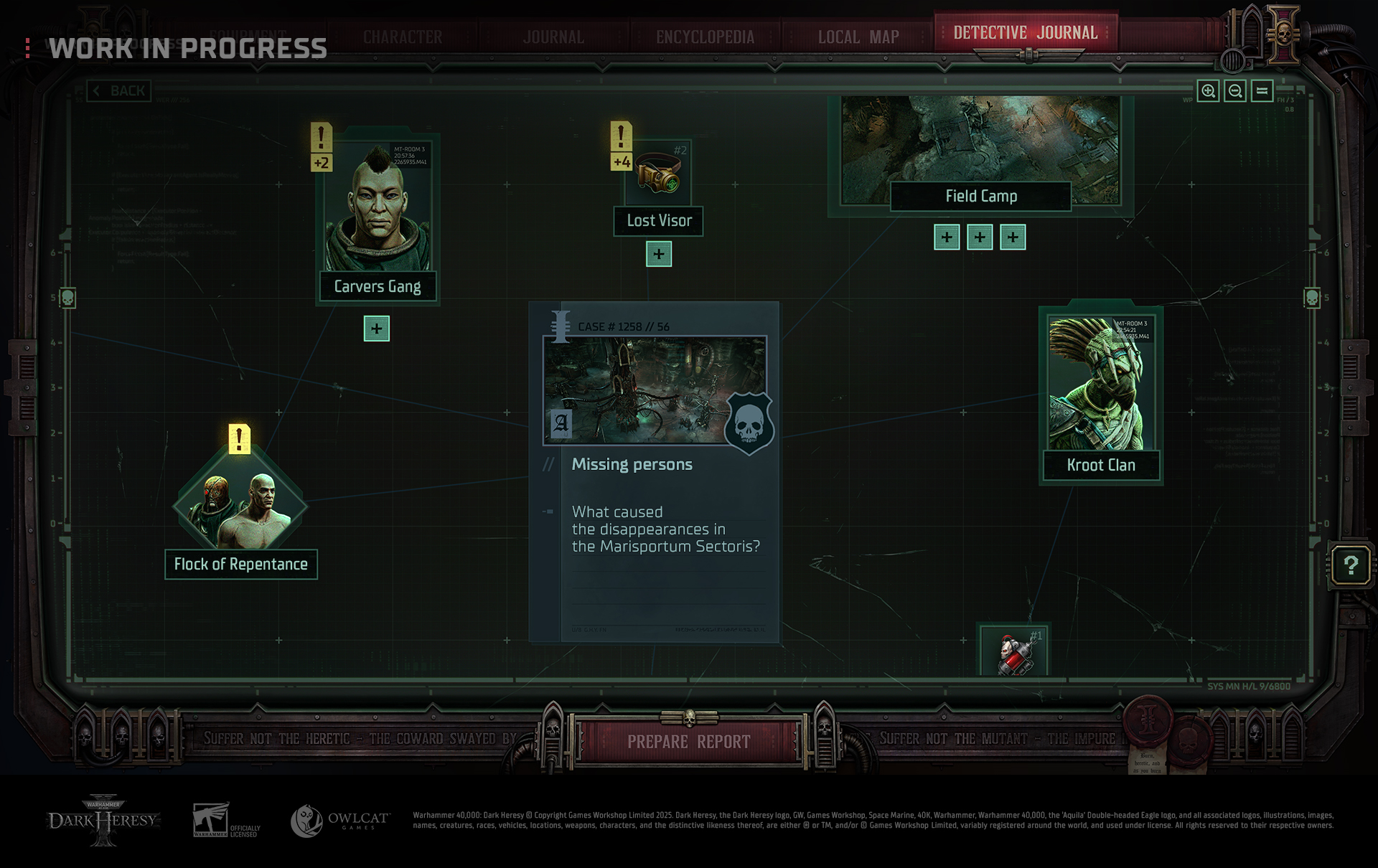
The special Detective Journal keeps active cases in separate tabs. Each case file has its own workspace for collected clues, people and conclusions. You can review evidence for one case without mixing it with another. The important work is deciding which connections hold up.
The same clue can allow more than one interpretation. Owlcat also describes contradictions in the evidence and testimony. A contradiction is something to examine against the rest of the case; finding one does not automatically tell you the ultimate guilty party.
If a theory looks thin, the announced options include reviewing evidence, following another lead and asking companions for their assessment. Larionova says some cases need a chain of deductions; in others, a lucky suspicion can land on the truth. More collecting is useful when it changes your understanding, rather than simply making the journal busier.
Pass judgement: accusations and false reports
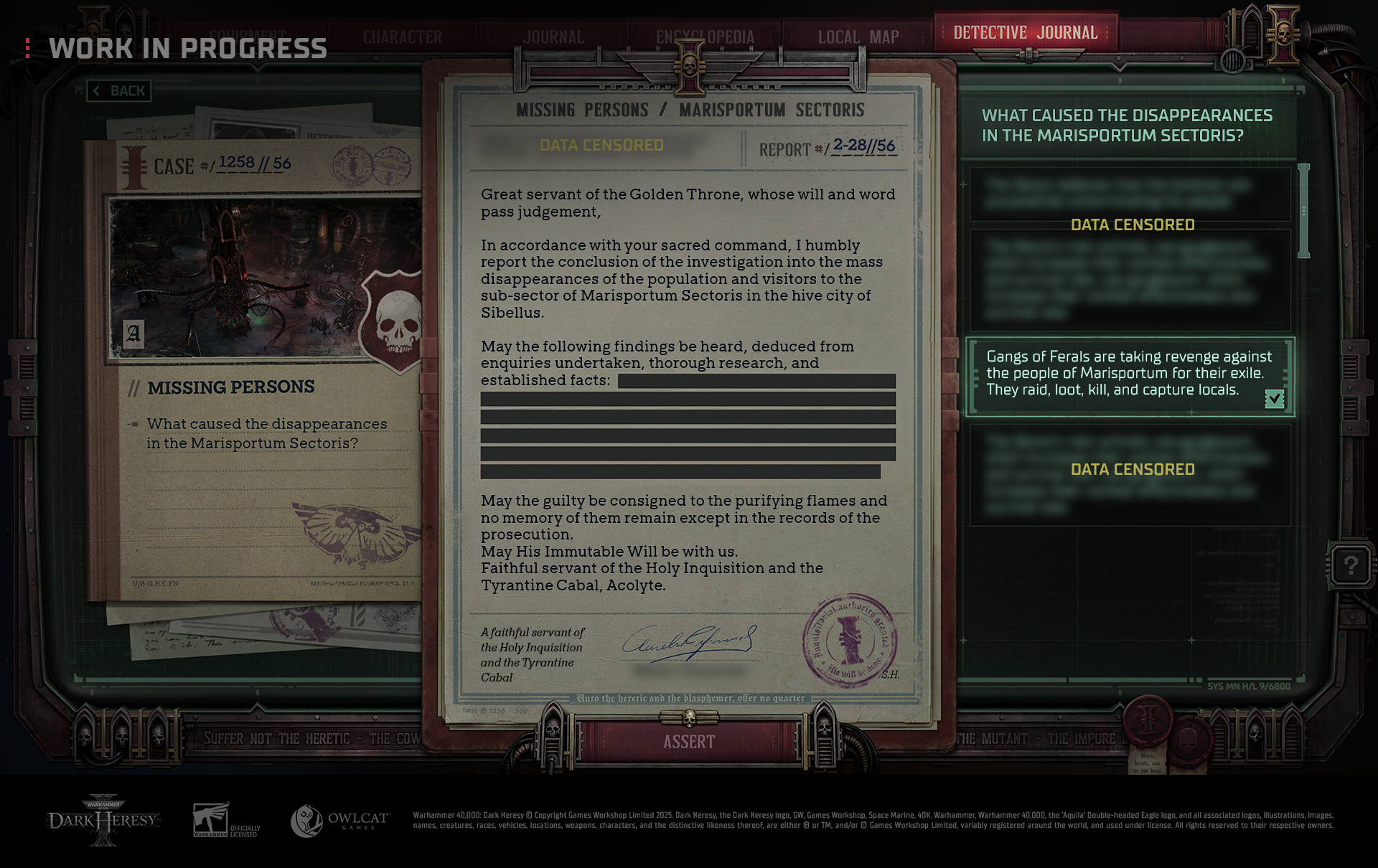
Once the journal contains evidence against a suspect, you can accuse them. Further investigation can strengthen that accusation, change it or exonerate the person. Your formal report covers the investigation findings, your actions and mistakes, and the person you accuse.
Incorrect conclusions can reach the Inquisitor through a mistaken report or deliberate falsification. Owlcat explicitly allows you to lay blame out of personal animosity. Larionova says decisions can affect story branches, rewards, NPC attitudes and additional endings. You can deliberately accuse an innocent person to further your own goals. Those are possible consequences, not a promise that every dishonest report pays off.
The available explanations do not establish a universal punishment for a wrong conclusion. They also do not say that false accusations are harmless. Your authority lets you act on an incomplete case; it does not remove the consequences.
Companion expertise and your final decision
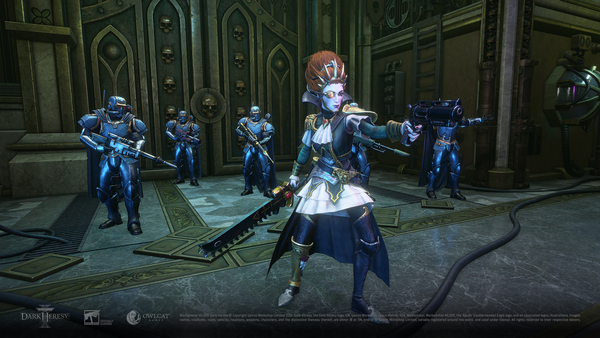
Epione contributes medical knowledge, Haymar survival expertise and Laarthyr insight into xenos behaviour. Companions can help during conversations or suggest a different approach when a line of inquiry stalls. Their responses are personal assessments, not a guaranteed correct answer.
Larionova is explicit that nobody in the retinue solves the mystery independently. You decide how much weight to give their advice. For the named specialists and the rest of the confirmed roster, see our Dark Heresy companion overview.
What beta impressions can tell us so far
In his June closed-beta preview, Windows Central's Alexander Cope describes investigating disappearances and a murder conspiracy, and praises the tangled stories. Individual beta players have also reported uncertainty about whether they had found enough connections. Those accounts raise a practical question about the system: how clearly does it distinguish an unfinished theory from a conclusion you are ready to stand behind?
They do not settle the quality of the finished Warhammer 40,000: Dark Heresy. The original developer breakdown dates to 2 December 2025; the 6 October 2026 overview and interview add newer explanations. We will update this page as the rules become clearer. Release, platforms and broader news stay in the main Dark Heresy hub.
Sources and official footage
Checked 24 October 2026. Developer statements describe planned or beta features; the cited preview is someone else's early experience.