
Dawn of War 4 Space Marines: Chapters and tactics
How Dawn of War 4’s Space Marines work: Blood Ravens, Dark Angels, orbital reserves, confirmed units and the difference between campaign and multiplayer.
On this page
- Dawn of War IV Space Marines gameplay: adaptable squads
- Blood Ravens and Dark Angels on Kronus
- Four campaign commanders, different jobs
- Confirmed Space Marine units and vehicles
- Choosing the right weapons and support
- Drop Pods and the Thunderhawk Relay
- Base-building: dropping structures from orbit
- Orbital Strike and Thunderhawk Bombing Run
- Cover, retreat and field reinforcement
- Campaign and competitive multiplayer: different commanders
- Chapter Painter: customise your Space Marines
- The Last Stand: three-player survival
- Combat Director and what the trailers show
- How the four factions differ
- Warhammer 40,000: Dawn of War IV release date
- Official Dawn of War IV sources
Dawn of War 4’s Space Marines put a small, expensive army under your command. You develop its equipment, protect surviving squads and use orbital reserves to reinforce a fight without marching across the map. The Blood Ravens and Dark Angels also have different campaign roles: reconnaissance and precision for one Chapter, heavier assaults for the other.
If you are choosing which army to play, this guide explains the Space Marine faction’s units, commanders, orbital deployment and squad preservation. It shows what each tool lets you do and where its limitations matter. Checked 24 October 2026 against official reveals; launch-build testing is still pending.
Dawn of War IV Space Marines gameplay: adaptable squads
You command squads, capture territory and build your base while the battle continues. Space Marines combine steady expansion with shock assaults. Their equipment and upgrades let you adapt an expensive squad to a particular job; keeping that squad alive protects the resources already spent on it.
The early game asks you to spread that small army across resource points. Later, orbital reserves and air transport help you put more units where they are needed. You still need something left to defend the ground you took.
Blood Ravens and Dark Angels on Kronus
The Blood Ravens return to Kronus looking for recruits, with fewer resources than a full-strength deployment. Their campaign favours smaller missions, scouting and operations behind enemy lines. The Dark Angels have access to heavier equipment and more direct assaults.
These are the two authored campaign Chapters. The Painter’s custom Chapters are a separate option outside the campaign.
Four campaign commanders, different jobs
- Captain Cyrus leads the Blood Ravens with stealth, ranged attacks and a supporting air strike.
- Chief Librarian Jonah Orion uses psychic attacks and shields allies.
- Chaplain Ezrael rides a Raider-pattern bike, inspires nearby allies and targets priority enemies.
- Company Master Astoran wears Terminator armour. His loadouts include an assault cannon, or a thunder hammer and storm shield for close combat. He advances more slowly as a heavily protected frontline fighter.
These named characters belong to the campaigns. Skirmish uses generic commanders, explained below.
Confirmed Space Marine units and vehicles
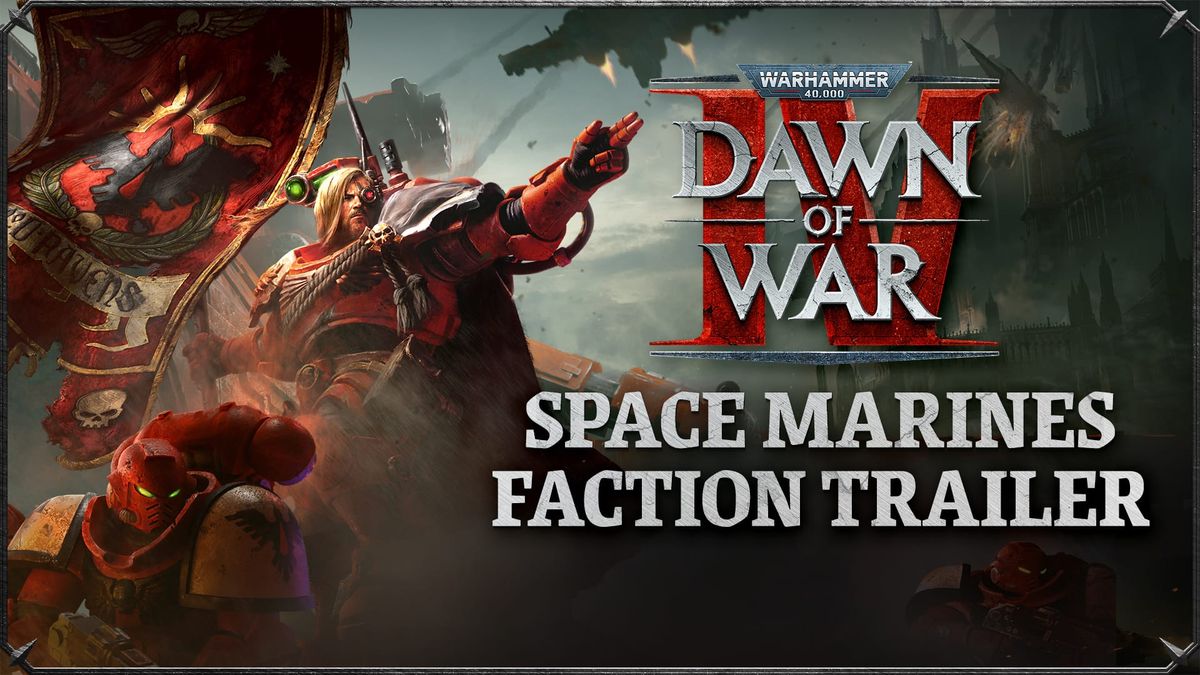
The official Dawn of War IV Space Marines trailer identifies these units and roles:
- Intercessor Squads: core infantry with bolt rifles.
- Assault Intercessors: chainsword-equipped melee troops, with Jump Pack upgrades for rapid attacks.
- Infiltrators: scouting and capturing points under stealth.
- Eliminators: long-range snipers for removing priority targets.
- Outrider Squads: fast raiding units.
- Bladeguard Veterans: frontline defenders with storm shields.
- Eradicators: melta-rifle specialists against vehicles, fortifications and elite targets.
- Terminator Squads: heavily armoured infantry.
- Invictor Tactical Warsuits: flexible assault support.
- Redemptor Dreadnoughts: heavy weapons against infantry and armour.
- Gladiator tanks and Repulsor Executioners: firepower for fortified positions.
Choosing the right weapons and support
Eradicators give you an answer to enemy vehicles; Assault Intercessors bring melee pressure. Choosing weapons means identifying what is stopping your advance, then protecting the squad carrying the answer.
Deep Silver gives a practical example: Infiltrators capture resource points while Eliminators cover approaching infantry from farther back. That lets one squad work while another protects it.
Veterancy adds another reason to keep developed squads alive. Exact upgrade costs and effective openings remain untested.

Drop Pods and the Thunderhawk Relay
Drop Pods deliver units that you have prepared in an orbital reserve. The Thunderhawk Relay instead accepts troops already on the ground and redeploys them elsewhere. One supplies reinforcements; the other moves an existing force.
If the enemy commits to one flank, you can send reserves there or open another front. The Relay can move surviving Space Marines across the map, preserving your existing force for the next engagement.
Base-building: dropping structures from orbit
The developer multiplayer AMA confirms that Space Marine buildings can be deployed within vision. Greater distance from headquarters increases deployment time, and opponents can see where the structure will arrive. Upgrading buildings unlocks additional units and research.
First establish vision, then hold the landing area until construction finishes. The official gameplay trailer also shows Hammerfall Bunkers and Tarantula Turrets fortifying capture points. A forward stronghold extends your reach, but its visible arrival gives opponents time to contest it.
Orbital Strike and Thunderhawk Bombing Run
Space Marines have both attacks among their stratagems. The Thunderhawk Bombing Run sweeps an area with aircraft fire; Orbital Strike attacks a large area from space. Both are offensive tools, distinct from moving units through the Relay.
Use the distinction when planning support: transport moves your army; these stratagems attack the enemy. Damage and cooldowns still need launch testing.
Cover, retreat and field reinforcement
The multiplayer AMA explains three different ways to preserve a squad:
- Cover reduces ranged damage. Melee pressure and suitable wargear can remove that advantage.
- Retreat pulls the squad toward the nearest production structure with reduced incoming damage, temporarily taking control away. The order can be cancelled after its indicator turns yellow.
- Field reinforcement spends resources to sustain units away from base. Keeping many squads on automatic reinforcement can exhaust your economy.
For Space Marines, the choice is whether holding this position justifies the reinforcement cost. Retreat early enough and a veteran squad can return for the next battle.

Campaign and competitive multiplayer: different commanders
If you play the single-player or co-operative campaigns, the named characters above belong to those stories. In Skirmish and multiplayer, the announced commanders are generic faction units selected before a match. By default you produce them later for a cost; custom settings can make them starting units or disable them.
So Cyrus’s story abilities do not establish a competitive multiplayer build order.
Chapter Painter: customise your Space Marines
The Painter supports official schemes and your own designs outside the campaign. Deep Silver’s October overview shows customisation of armour and equipment, including colours, decals and wargear. Painting your favourite Chapter is separate from selecting one of the two authored campaign stories.
The Last Stand: three-player survival
The Last Stand is the separate three-player survival mode, where you and two allies face waves of enemies. In Dawn of War IV, you choose from five heroes and assemble companion units around them. That gives you a smaller force to develop than the full army and base described above.
Combat Director and what the trailers show
Dawn of War IV expands the original Dawn of War’s choreographed Sync Kills through its Combat Director. It coordinates personalised combat animations across the battlefield. The result explains the trailer’s close-up spectacle; animations alone do not establish damage values.
How the four factions differ
Of the four factions, Space Marines put particular emphasis on protecting adaptable, expensive squads. Orks build pressure through numbers and forward construction. Necrons combine territory with resurrection; Adeptus Mechanicus forces depend on a connected network. Choose the army whose decisions appeal to you; balance between them remains untested.
Warhammer 40,000: Dawn of War IV release date
Warhammer 40,000: Dawn of War IV launches on PC on 3 December 2026. KING Art Games is developing the game; Deep Silver publishes it. The screenshots above show a pre-release build.
Compare the faction guides for Orks, Necrons and Adeptus Mechanicus. Our preview roundup separates press impressions from confirmed systems. The Dawn of War IV hub covers release news and editions.
Official Dawn of War IV sources
- Official Space Marines faction trailer: unit roles and weapons from 0:53–2:39; fortifications from 4:29.
- Space Marines faction deep dive, Deep Silver: unit pairing, commanders, reserves, stratagems and Painter.
- Space Marines announcement, PLAION, 8 October: Chapter roles, Cyrus and Astoran, expansion and shock assaults.
- Developer multiplayer AMA: buildings, vision, deployment time, unit preservation and generic commanders.
- Official game overview, 21 October: modes, campaign co-op and customisation.
- Warhammer Community’s October overview: The Last Stand heroes and companion units.
- What KING Art is building: core gameplay, Combat Director and game modes.