Arknights PC review: 10 hours on the official client
Arknights finally has an official PC client. Ten hours in: a sharp tower defense game, a base you check twice a day, and a gacha that is milder than most. 6/10.

I am a tower defense person. Arknights is a very good tower defense game with a gacha strapped to it, and for six years the only way in was a phone — which is why I never got in. The PC client removed the one thing standing between me and a genre I already love.
Ten hours in, it is the thing I open when I am too fried to play anything that needs reflexes. The six is not for the game underneath. It is for everything the phone left behind: the timers, the pulls, the two-sessions-a-day rhythm.
I have played a lot of tower defense. Bloons, Kingdom Rush, Defender’s Quest, Dungeon of the Endless if you squint, and a decade of trying to find the next one. So when people kept telling me Arknights was one of the best in the genre, I believed them. I just could not play it, because it lived on a phone, and I do not play games on a phone.
To be clear about what this is: Arknights itself launched in China on 1 May 2019 and on the Global server on 16 January 2020. Nothing about the game is new. What is new is that on 13 August 2026 Yostar shipped an official Windows client, and the excuse ran out. This is a first-impressions review from ten hours on that client — enough to judge how it feels, not how it balances, and nowhere near enough to judge the late game. I will update it if I keep going, and I probably will.
Why it took a PC client to get me in
This is the part where I admit the problem was never the game. Arknights has been out since 2019, it has the reputation, it has the art, and people whose taste I trust have been telling me to play it for years. I installed it on a phone at least three times. I never got past the first week.
Phone games and I do not get along. It is not a principled stance, it is ergonomics: I do not want to hold a screen at arm’s length and cover a third of the board with my own hand. Tower defense in particular wants you to see the whole map at once and to place things precisely, and a thumb is not a precise instrument. Every session felt like doing a crossword through a letterbox. A long session also meant a warm phone and a dying battery, which is its own quiet argument. That is a hardware problem, not a design problem, and I want to be clear about which one I was actually complaining about all those years.
The Arknights PC client fixes exactly that and nothing else, which turns out to be enough. It is a real Windows program — you pull an installer from the official site and run it through its own launcher, not through Steam, and not through an emulator. Mouse and keyboard work. The board sits on a monitor at a sane size. Progress syncs with the mobile account both ways, so nothing you did on a phone is stranded.
What it is not is a reimagining, and that is fine by me. This is the mobile game rendered bigger and it does not pretend otherwise: menus are built for portrait-shaped thinking, some panels are generous slabs of empty space at 1440p, and the shop screens look exactly like what they are. I do not hold that against it. A port is a port. I did not want a remake, I wanted to stop squinting, and on that narrow promise the client delivers completely.
The client itself: 1440p, mouse and keyboard, and a Fedora detour
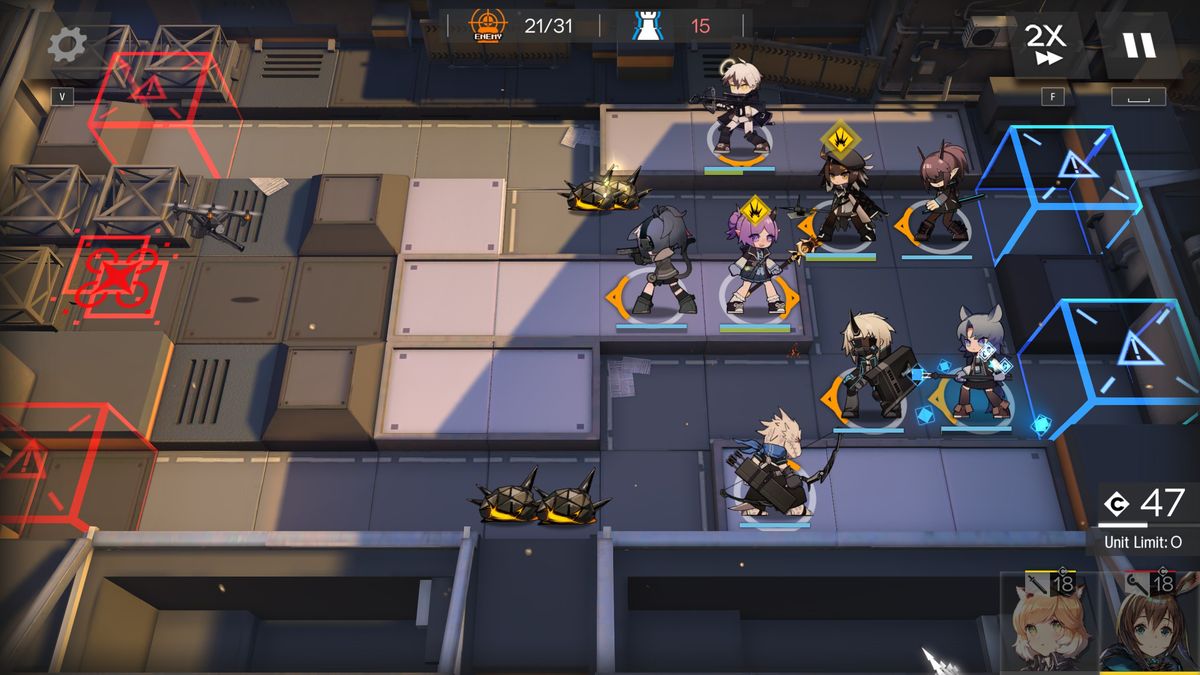
Since the client is the reason this review exists, it deserves more than one line. It runs at proper desktop resolutions — every screenshot on this page is native 2560×1440 straight out of the game, no upscaling, no letterboxing. Mouse and keyboard are supported natively, which for a tower defense game means you place operators by clicking where you want them instead of dragging a finger and hoping.
The three keys that matter are bound out of the box, and they are the right three: F speeds the battle up, space pauses it, E fires a skill. That sounds trivial written down and it is the single biggest difference between playing this game and operating it. On a phone, speeding up and firing a skill are taps in opposite corners of a screen your hand is already covering, so a stage that wants three skills timed in sequence turns into a dexterity problem that has nothing to do with the tactics. Here they sit under two fingers that never move, and the puzzle goes back to being a puzzle.
One thing worth knowing before you install: the dedicated client is not the only official route onto Windows any more. Arknights is also listed on Google Play Games for PC, Google’s own way of running Android titles on Windows without an emulator. It has its own requirements — Windows 10 version 2004 or later, an SSD with 10 GB free, Intel UHD Graphics 630 or comparable, four physical CPU cores and 8 GB of RAM — and those numbers are worth keeping straight, because they belong to Google Play Games, not to Yostar’s client. If you want the build Yostar actually supports, take the installer from the official Arknights website.
The more interesting note is where I ran it. I do not game on Windows — my machine is on Fedora, and the Arknights PC client is a Windows installer with its own launcher, which is exactly the shape of thing that usually turns into an evening of troubleshooting. It did not. Through Proton it runs genuinely well: stable in combat, no stutter where it matters, and the only hitch I noticed across ten hours was the occasional loading screen hiccuping for a moment before settling. For an official client that has been out for less than a week and was never aimed at Linux, that is a better result than I expected.
The tower defense underneath is the good part
Strip the gacha off and what is left is a compact, legible tactics puzzle, and as someone who plays this genre on purpose I can say it holds up against the best of them. You get a squad of up to twelve operators, a deployment budget that ticks up over time, and a map with lanes, chokepoints and two kinds of tile: ground, where melee units stand and physically block enemies, and high ground, where ranged units shoot from and cannot be attacked by most things.
The block mechanic is what makes it its own thing rather than another Kingdom Rush. A melee operator stops a set number of enemies dead in their tracks; while they are held, your ranged units get to work. Your towers are people, they can die, and the wall is made of the same budget as the damage. Every stage is a question about where you spend your blocks and how long your healer can keep the blocker upright. Get it right and the map solves itself in a satisfying, clockwork way. Get it wrong and you watch a leaker walk calmly into your base while you are still paying for a unit you placed two seconds too late.
What I did not expect is how much it respects your time in the moment. You can slow the deployment down, speed the whole thing up to 2x, and pause to think. Failing a stage costs you the sanity you spent and nothing else. Clearing one with three stars unlocks auto-deploy, so the next time you need that stage’s drops you press a button and go make tea. That is a small design decision that does an enormous amount of work for the exact player I am on a weeknight.
The friction is that the difficulty is not gentle about class knowledge. Arknights expects you to know that a Defender and a Guard are not interchangeable, that some enemies ignore blocking, and that arts damage and physical damage want different answers. The game tells you this, more or less, in tooltips you will read once and forget. Ten hours in I still occasionally lose a stage because I brought the wrong shape of squad, not because I played badly — which, for a genre veteran, is a novel and slightly humbling failure state.
Your towers are people, they can die, and the wall comes out of the same budget as the damage.
Ten hours on the PC clientOperators: where your material and your months go
Pulling an operator is the start of the work, not the end of it, and this is the system that explains everything else in the game. Every unit runs up a ladder, and each rung wants materials you can only farm from stages, which is what sanity is really for.
Levels
Battle records, capped by rank
Elite 1
Raises the cap, unlocks skill two
Elite 2
Rare materials plus a voucher
Mastery
Skill 7, then M1–M3
Modules
Gear that rewrites a trait
The two promotions are the big gates. Elite 1 raises the level cap and hands the operator their second skill; Elite 2 raises it again and costs rare materials plus a promotion voucher, and only 4-star operators and above can get there at all. Once a unit is at Elite 2 with a skill at level 7, you can put them through Mastery training, one skill at a time, for stronger effects. Modules come later still — equipment that improves or outright replaces an operator’s defining trait, unlocked at Elite 2 plus a level threshold that depends on rarity.
Alongside that sit two quieter tracks: trust, which rises simply from using an operator and hands out small permanent stat bumps, and potential, which rises when you pull a duplicate and can be improved up to six times. Duplicates are therefore not wasted, which is a kinder design than it sounds and takes some of the sting out of a bad ten-pull.
What this means in practice is that Arknights is a game about a few operators, not many. Taking one unit to Elite 2 with a mastered skill costs more than levelling five to Elite 1, and after ten hours I have exactly one operator I would call finished. That is the shape of the long game, and it is also why the game can afford to be generous with pity: the pull is cheap, the investment is the expensive part.
The base is a second game running while you are away
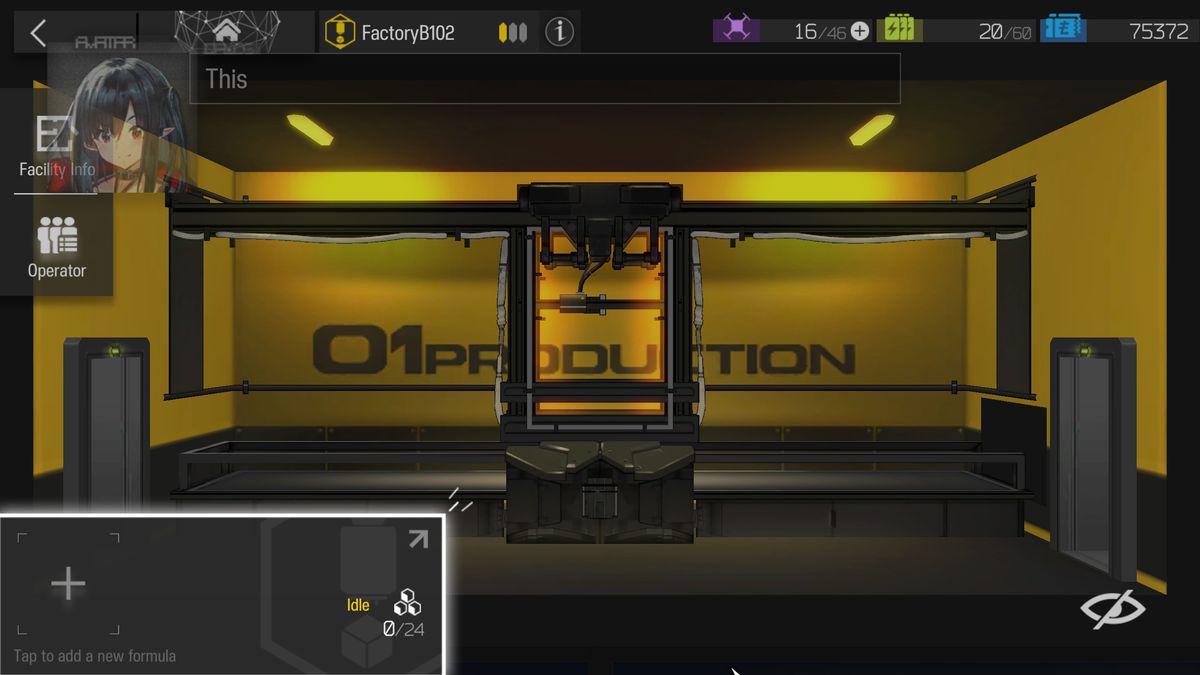
The part nobody warned me about is the base. Arknights calls it the Rhodes Island Infrastructure Complex, everyone else calls it RIIC, and it is a full idle-management layer bolted underneath the tower defense — a grid of rooms you build, staff with operators, and upgrade, which produces resources whether the game is open or not.
The loop is straightforward once you see it. Power plants generate the electricity every other room needs, and produce the drones you spend to hurry things along. Factories turn that power into the things you actually want: the game’s currency, the experience records that feed step one of the ladder above, and promotion materials. Trading posts convert factory output into cash. Dormitories are where operators rest, because a tired operator works worse, which means the base has its own little morale economy on top of the resource one.
Power
Runs the grid, makes drones
Factories
Records, cash, materials
Trading posts
Turn output into money
Dormitories
Morale, or nothing runs
I like it more than I expected to. It is not deep, exactly — the community has settled on a couple of standard room layouts and you can look one up in thirty seconds — but it gives the game a reason to be opened twice a day that is not the daily-mission guilt trip, and rearranging who works where is a pleasant five-minute puzzle in its own right. There is also a control centre, a reception desk that handles clues and friend visits, and a workshop for crafting, so the base menu is genuinely a menu you spend time in.
It is also the clearest tell that this was designed for a phone. The base is a thing you check in short bursts, several times a day, from wherever you are. On PC it is a thing you alt-tab to. That is not worse, but it is a rhythm the game inherited from a device.
Sanity, timers, and the rest of the phone furniture
Here is where the coat starts showing. Arknights runs on an energy system called sanity: every stage costs some, it refills on a real-world clock, and when it is empty you are done for now unless you spend. It regenerates at one point every six minutes — ten an hour — and the cap tops out at 135 as your account level rises. That is a full bar in about thirteen and a half hours, which in practice means you get a session in the evening and a session before work, and that is the game’s intended shape.
13 Aug 2026
PC client launch
1 / 6 min
Sanity regen, cap 135
2%
Base 6-star rate
30 GB
Install size on PC
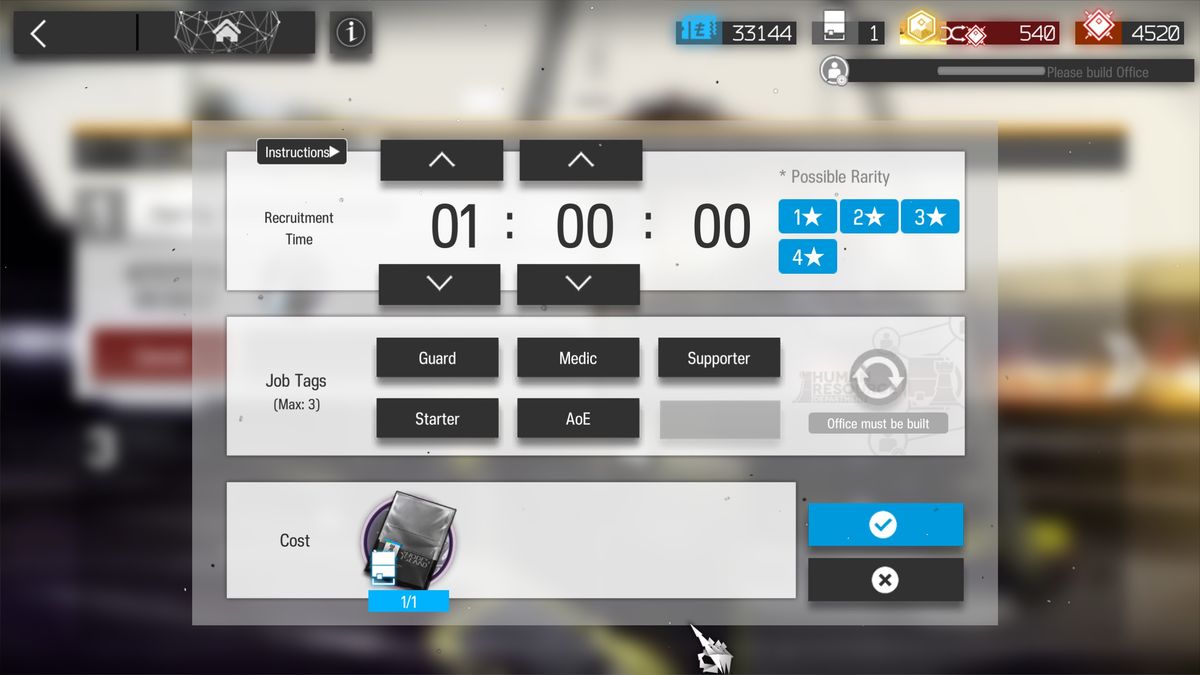
Alongside it sits recruitment, which is the other timer. You post a job, pick from a handful of tags describing what you want, and then wait — a real hour for a quick hire, up to nine for the slot that can produce something rare. Nine hours is not a mechanic, it is a calendar entry. It is also, to be fair, a completely free source of operators that runs in parallel with everything else and asks nothing but that you come back.
None of this is unusual for the genre and all of it is friction. What saves it, for me, is that the friction never turns into a wall you can pay past to beat someone else, because there is nobody else. The campaign, the events and the roguelike mode are all played alone. Sanity limits how fast you progress; it does not limit how well you do.
Integrated Strategies is the mode everybody points at
Every conversation about Arknights arrives here eventually, and I have to be upfront: I have not played it. Integrated Strategies unlocks after you clear stage 3-8 of the main story, and ten sanity-gated hours does not get a fresh account that far. What follows is what the mode is, not what I think of it.
It is a roguelike run built out of the tower defense. You start each run with nothing and build a squad from scratch using recruitment permits the mode itself hands you, then move through a branching map of operations and events, picking up collectibles — relics, effectively, some of which carry a downside — and levelling a Command Level that exists only inside that run and resets when it ends. Hard difficulty unlocks once you have cleared a normal run.
The reason I am flagging a mode I have not touched is that it is the single strongest argument for this game to a tower defense player specifically. A roguelike layer on top of a deployment-budget TD, where the draft is the difficulty and your roster is irrelevant, is precisely the thing the genre has been short of. If Arknights ends up sticking for me past ten hours, this is why, and it is the first thing I will write about when I get there.
The story, the voices, and an actual record label
I came for the tower defense and did not expect the writing to slow me down, but it does, and I mean that as a compliment with a caveat attached. Arknights is set on Terra, a world where a mineable mineral called Originium powers everything and also gives people a terminal illness, which means the infected are simultaneously the workforce, the weapon and the underclass. Rhodes Island, the outfit you run, is a pharmaceutical company that is also a paramilitary. That is a sharper premise than a mobile tower defense game needed.
The delivery is where the phone shows again. Story is visual-novel text over static art, it arrives in long slabs between stages, and there is a lot of it: the main story has run past chapter fifteen and into a third act, with side stories and event stories stacked underneath. Ten hours in I am still in the early chapters and I have already skimmed some of it. Whether that is a flaw depends entirely on whether you read games.
The music is not a footnote. Hypergryph releases everything under its own label, Monster Siren Records — which exists both as a real imprint and as an in-universe record company — and it pulls in outside composers including Go Shiina and Kevin Penkin. It is a genuinely good soundtrack, it is on streaming services, and it is doing far more work in the moment-to-moment than a game like this owes you. There are also three seasons of anime, which I mention mostly so you know they exist and that they are not required reading.
How pay to win is Arknights, actually?
Short answer: it is a gacha, and it is one of the mild ones. The long answer is worth having, because “pay to win” means two different things and Arknights fails one test and passes the other.
The pull rates are public and they are not generous in absolute terms: a 6-star operator drops at 2%, a 5-star at 8%, and the remaining 90% of pulls are 4- and 3-stars. One pull costs 600 of the premium currency. What softens it is the safety net. A 5-star or better is guaranteed somewhere in your first ten pulls. If fifty pulls go by without a 6-star, every pull after that adds two percentage points to the rate until it hits 100% at pull 99 — so a 6-star is guaranteed within 99 pulls, and the effective rate across the whole system works out around 2.9%, roughly one in thirty-three.
Getting a specific operator is the expensive part. Even on a banner built around one, the rate-up only splits half the 6-star pulls your way on standard banners, so the operator you actually wanted can stay out of reach while you collect three you did not ask for. Limited banners add a token you earn per pull and can eventually trade for the featured unit — a hard ceiling, but a high one, in the hundreds of pulls.
Now the part that matters. Arknights has no competitive mode. Nobody’s roster ever shows up on your screen as an opponent; the campaign, side stories and the roguelike are all single-player, and there is no ranked ladder where a wallet outranks you. Money buys you speed and it buys you options — a 6-star makes a hard stage easier, and sanity refills let you grind faster. It does not buy you a win condition, because there is nothing to win against anyone else.
The community line, which matches what I saw in ten hours, is that low-rarity operators stay viable and no single unit is required to clear anything. That is the design decision the whole monetisation rests on, and it is why Arknights gets called one of the fairer gachas rather than one of the predatory ones. The monthly card, at $4.99, is the standard low-friction purchase: six premium currency units and a daily trickle of pull currency for thirty days. It is not nothing over a year, and I want to be clear that “mild gacha” is still gacha — the pull screen is still a slot machine with better art.
Six years of operators, and the powercreep question
A game this old has a powercreep conversation, and I am not going to pretend ten hours qualifies me to settle it. What I can point at is the structural evidence, which cuts both ways. Against powercreep: the game’s own documentation holds that no operator is a strict requirement at any point, and higher rarity makes stages easier rather than possible. For it: the developers themselves treat old units as a distinct category — the cost of buying a 6-star with limited-banner tokens was reduced for operators released four years ago or more, which is not a change you make about a roster that has aged evenly.
My honest position is that I do not know yet, and I would rather say so than borrow someone else’s verdict. If you are starting today, the practical takeaway is the same either way: build the operators you like, because the game is not asking you to beat anybody.
Who it’s for
This is not a game I would hand to everyone, and the reason is not the quality. It is the shape of it: a slow-burning, timer-gated, read-the-tooltip game that rewards showing up more than it rewards sitting down for six hours.
Give it a go
The evening-brain slot, filled properly.
- You play tower defense on purpose and have run out of the good ones. This is one of the good ones.
- You want something for the hours when you are too tired for anything with reflexes in it.
- You bounced off Arknights on a phone. This is the fix, and your old account carries over.
- You want a gacha that lets you build the squad you like instead of the squad the meta rents you.
Probably not
The timers are the whole design, not a setting.
- Energy systems and daily check-ins make you tired on sight.
- You want to binge a game on a Saturday. Sanity disagrees, in writing.
- You need a game to be finished and finite. This one is an ongoing service, six years deep.
- You skip story text and want the mode everyone raves about now — Integrated Strategies is days away, not minutes.
For me it lands in a slot almost nothing else fills: the game I open at half past nine when I am done thinking, that still asks me to think a little, and that does not punish me for closing it. Six out of ten is not a shrug — it is a very good tower defense game reviewed honestly alongside the business model it is wearing, by someone ten hours in who is still playing.
Questions
Is Arknights on PC now?
Yes, since 13 August 2026. Yostar released a dedicated Windows client that you download as an installer from the official Arknights site and run through its own launcher. It is not a Steam release, so you will not find it in your library. Officially it is Windows only — there is no Mac client and no Linux client.
Does the Arknights PC client work on Linux?
Unofficially, yes. There is no Linux build and Yostar supports Windows only, but the client runs through Proton on Fedora: stable in combat across ten hours, with the occasional loading screen hitching for a moment. That is one machine in the week after launch, not a guarantee — a future patch could change it without warning, and you would have no support to fall back on.
Do I still need an emulator to play Arknights on PC?
No, and that is the whole point of the release. Before August 2026 the only way onto a desktop was BlueStacks, LDPlayer or similar, with the performance and account-safety questions that come with them. The official client is a native Windows program with real mouse and keyboard support, and Google Play Games for PC is a second official, non-emulator route. Between them there is no longer any need for a third-party APK.
Does my mobile Arknights account carry over to PC?
Completely. Cross-platform progression is full two-way sync: operators, resources, base, story progress and everything else live on the account rather than the device, so you can clear a stage on PC and check your base on a phone an hour later. Log in with the same Yostar or linked account and nothing needs migrating. You cannot be logged in on two devices at once.
Is Arknights pay to win?
Not in the sense that matters, because there is no competitive mode. Everything is single-player, so no one else’s spending ever lands on your screen. Money buys speed and options — more pulls, more sanity, a rare operator sooner — and higher-rarity operators do make hard stages easier. What it does not buy is a way to beat you, because there is no you to beat.
Is Arknights F2P friendly?
Reasonably, by gacha standards. The 6-star rate is 2%, but a 5-star or better is guaranteed in your first ten pulls and pity forces a 6-star by pull 99, and low-rarity operators stay genuinely usable rather than becoming shelf decoration. The honest catch is time: free play is gated by sanity, so a free account progresses on the game’s clock, not yours.
Is Arknights good if I only like tower defense?
That is exactly the case for it. The deployment budget, the block mechanic and the ground-versus-high-ground split make a real tactics puzzle, and Integrated Strategies puts a roguelike draft on top of it. The catch is that the tower defense is wrapped in systems that are not tower defense — a base, an energy meter and a gacha — and you do not get to opt out of them.
Is Arknights beginner friendly?
The systems are, the tooltips are not. Deployment, blocking and high ground are easy to grasp in ten minutes, and failing a stage costs only the sanity you spent. What catches people is class knowledge — knowing which operator answers which enemy — which the game explains once and then assumes. Expect to lose stages to squad composition rather than to skill for a while.
Is Arknights worth playing in 2026?
If the tower defense appeals and the gacha does not put you off, yes — and the PC client is the best reason yet to try. Six years of story, events and modes are sitting there and none of it is behind a paywall. The reservation is the same as it was in 2019: it is a live service with timers, and it wants a slot in your week rather than a weekend.