Guild Wars 2 getting started: how to begin without getting overwhelmed
Guild Wars 2 looks like a decade-deep wall of expansions, professions, and acronyms. It mostly isn't. The base game is free and complete — here's the short path in: a race for the look, a class for the feel, the core loop, and one direction to point at when you hit level 80.

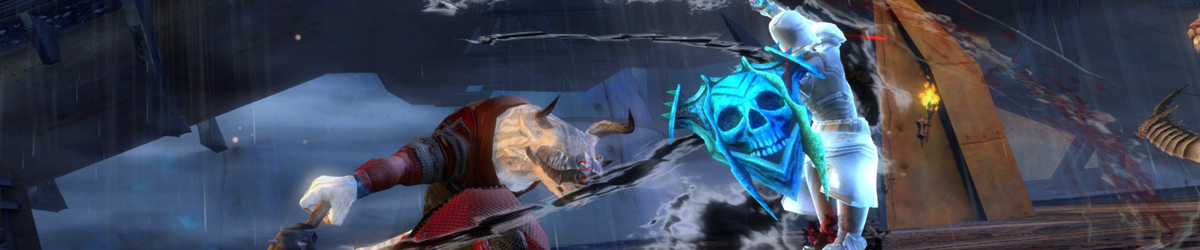
Getting started in Guild Wars 2 looks like a wall — whether you're brand new or returning after years away. A decade of expansions, nine professions, half a dozen game modes, an interface dense with panels and icons, and a fanbase that talks in acronyms. Ignore most of it. The base game is free and complete enough to learn everything that matters, and the only day-one choices that count are small — a race for the look, a class for the feel — before you go learn how the game actually plays.
This guide is the whole on-ramp for new and returning players: why you can't fall behind, who to roll, how combat and gear feel, the core loop, and which direction to point yourself at level 80. Most "GW2 getting started" advice is either a wiki read cover to cover or a two-hour video; this is the version you can finish before the download does. It's a lot, so jump around with the list below. If you haven't decided whether to play at all yet, start with whether Guild Wars 2 is worth it in 2026 and come back.
Start free
no card needed
Pick a race
the look
Pick a class
the feel
Learn the combat
and the loop
Pick a direction
PvE · PvP · WvW
Start Guild Wars 2 for free
The core game is free with no trial timer. Grab it from the official site or link a Steam account, and it takes you the full way to the level 80 cap with every profession except Revenant, which is an expansion class. Free-to-play accounts are real accounts — buying an expansion later upgrades the same characters, nothing resets — so the free game — the full core story included — is absolutely worth a few evenings before you spend a penny. And when you do buy in it stays a one-off: Guild Wars 2 has no monthly fee, before or after an expansion.
Free
to start
5
playable races
8
base professions
80
level cap
One real setting: your region
Before your first character there is one account-level choice: America or Europe. Older advice still talks about picking a server or a world, and that is out of date — the world selection panel was replaced by a plain region picker in January 2025, and the worlds that remain are a World vs World matchmaking detail rather than somewhere you live. Inside a region the megaserver drops you onto a map with everyone else automatically, so there is no busy server to get into and no quiet one to avoid.
Pick the region you are physically closer to and take the lower latency, unless friends are already on the other one. The trading post, mail, guilds and your friends list all reach across the divide; the single thing that does not is standing in the same map together, which is the whole point of having friends there. Switching later costs 500 gems and blocks another switch for a week, and it is free only while the account still has no characters — so it is worth thirty seconds of thought now and nothing at all later.
Why none of that is urgent is the next thing to understand.
Horizontal progression: why you can't fall behind
This is the one idea that makes the whole back catalogue stop being scary, so it goes first — and for a new player it's extremely important to grasp early. Most MMOs, like a lot of other games, are vertical: each patch raises the cap and the gear ceiling, so a break leaves your character obsolete. GW2 is horizontal. Character levels stop at 80, where they've been since launch, and the power ceiling on gear has barely shifted in over a decade.
You can't fall behind in a game with no vertical treadmill — so stop trying to catch up, and start playing the part in front of you.
The mindset that turns ten years of content from a backlog into a buffetExotic, the trading post and ascended gear
Gearing proves it. The top tiers sit close together: exotic is cheap on the trading post and within a few percent of max, ascended gear is the true best-in-slot at only a small step above exotic, and legendary weapons and armour have the exact same stats as ascended. Two players of equal skill — one in full exotic, one in full legendary — perform the same. Legendary is convenience and flash, not power.
| Tier | Power | What it's really for |
|---|---|---|
| Exotic | ~99% of max | Cheap off the trading post — what you gear up in the moment you hit 80. |
| Ascended | Best in slot | A small bump over exotic; only the hardest content (high-tier fractals) needs it. |
| Legendary | Same as ascended | Convenience and flash: swap stats out of combat, a showy skin, shared account-wide. |
Because the numbers don't inflate — exactly this, no power creep — nothing decays into trivia. The game also scales your character down to a lower zone's level, so a starter map never turns into a faceroll. Every zone still rewards gear that matters, and every endgame fight ever added is still endgame — a raid boss from years ago is still a current max-level boss. Rare skins stay prestigious too, since you can't simply outgear old content and faceroll it for the drop. It also makes GW2 alt-friendly: gold, crafting materials, and currencies sit in one account-wide wallet, unlocked skins are shared across every character, and you can pass gear between characters of the same armour weight — so trying a second class costs almost nothing.
With the pressure off, the only real day-one choices are cosmetic — starting with your race.
Character creation: pick a race for the vibe
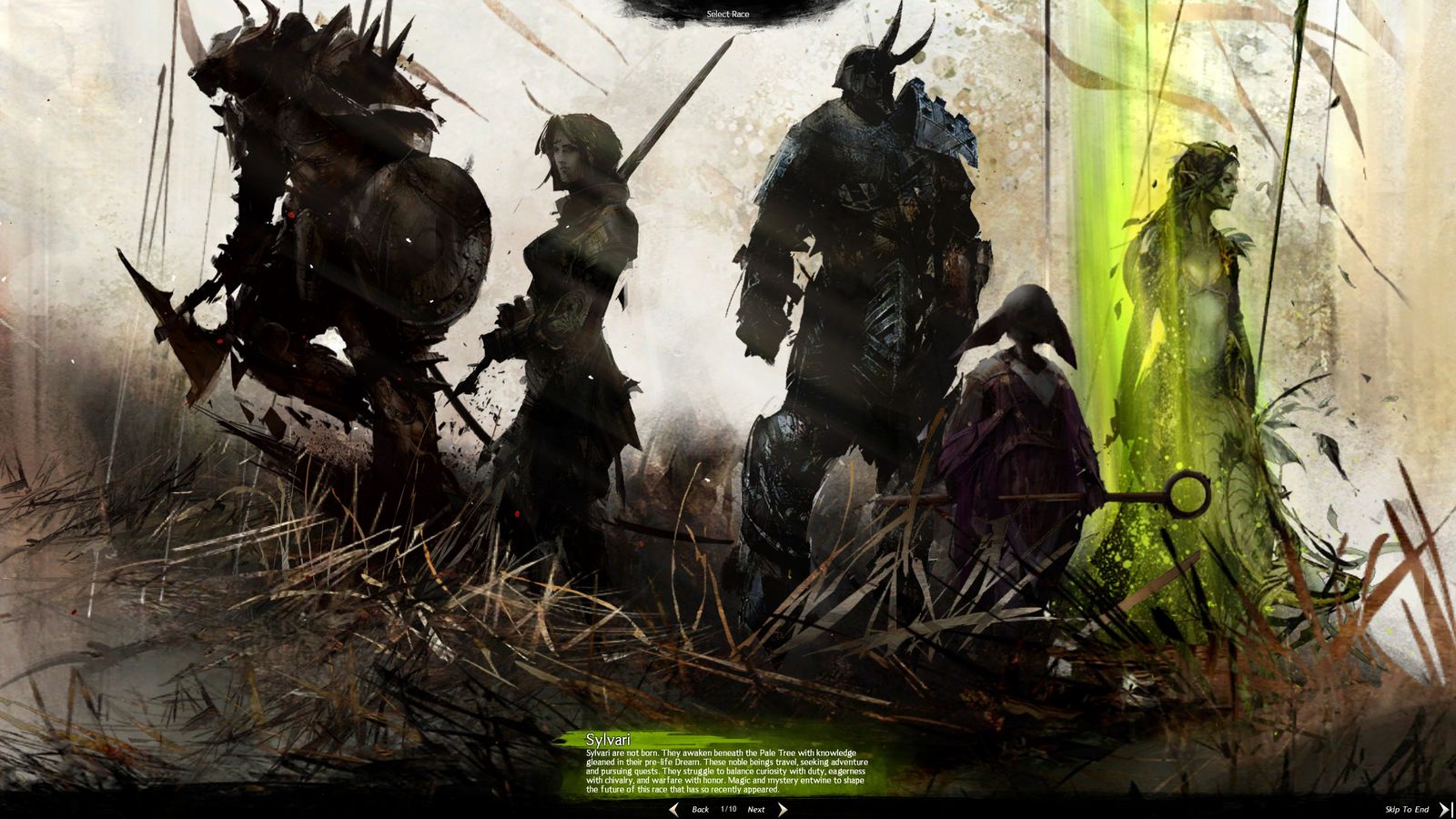
Character creation opens with five races, and new players treat it like a build decision. It isn't. Race changes your look, your home city, and the opening hours of your personal story — and very little else. Racial skills exist but are weak enough to ignore, and the studio actively removes any case where a race grants a real edge in a fight, so this is a roleplay and aesthetics choice, full stop.
- Human — classic high fantasy and the most familiar starting point. Safe if you want grounded.
- Charr — war-forged, industrial felines; a military opener with the most attitude.
- Norn — towering northern hunters who shapeshift into spirit forms. Big people, big snow.
- Asura — tiny magitech geniuses with enormous egos. The comedy pick, and a great camera height.
- Sylvari — plant-people born from a dream; the strangest lore and the prettiest armour fits.
Even size is cosmetic: hitboxes are identical, so the tiny Asura isn't any harder to hit. Each race starts in a different zone with a different story intro, then everyone funnels into the same world. Choose on taste.
With the look settled, the choice that actually changes how you play is your profession.
Pick a class by feel
The base game has eight core professions — the ninth, Revenant, needs one of the three Elder Dragon Saga expansions (Heart of Thorns, Path of Fire or End of Dragons), so set it aside for now. Each profession has its own class page here if you want the long version. This is the choice that shapes how the game plays in your hands, but it still isn't a tier-list decision on day one. You don't need a meta build to start; a simple core build clears all of the leveling content. Pick on feel:
- Warrior, Guardian — durable, simple to pilot, hard to kill while you learn. The standard "first character" answer.
- Ranger, Necromancer — forgiving, with a pet or a second health bar doing some of the work for you.
- Engineer, Elementalist — the most buttons and the most reward for pressing them well. Pick these if fiddly is fun.
- Thief, Mesmer — high-skill, high-ceiling, less obvious early. Rewarding once it clicks.
The thing that actually freezes people here isn't the class list — it's the advice. Ask "what do I play to be a ranged direct damage dealer" and you'll get answered in specs, trait lines, and weapons you don't have yet, which is a level-80 conversation dressed up as a starter one. Early on, equip whatever weapon looks fun and move on; each weapon type brings different skills, so trying different weapons is how you find your feel. The "best weapon" question belongs to a role and an elite spec that are a long way off.
Whatever you land on plays by the same rules underneath — which is where combat comes in.
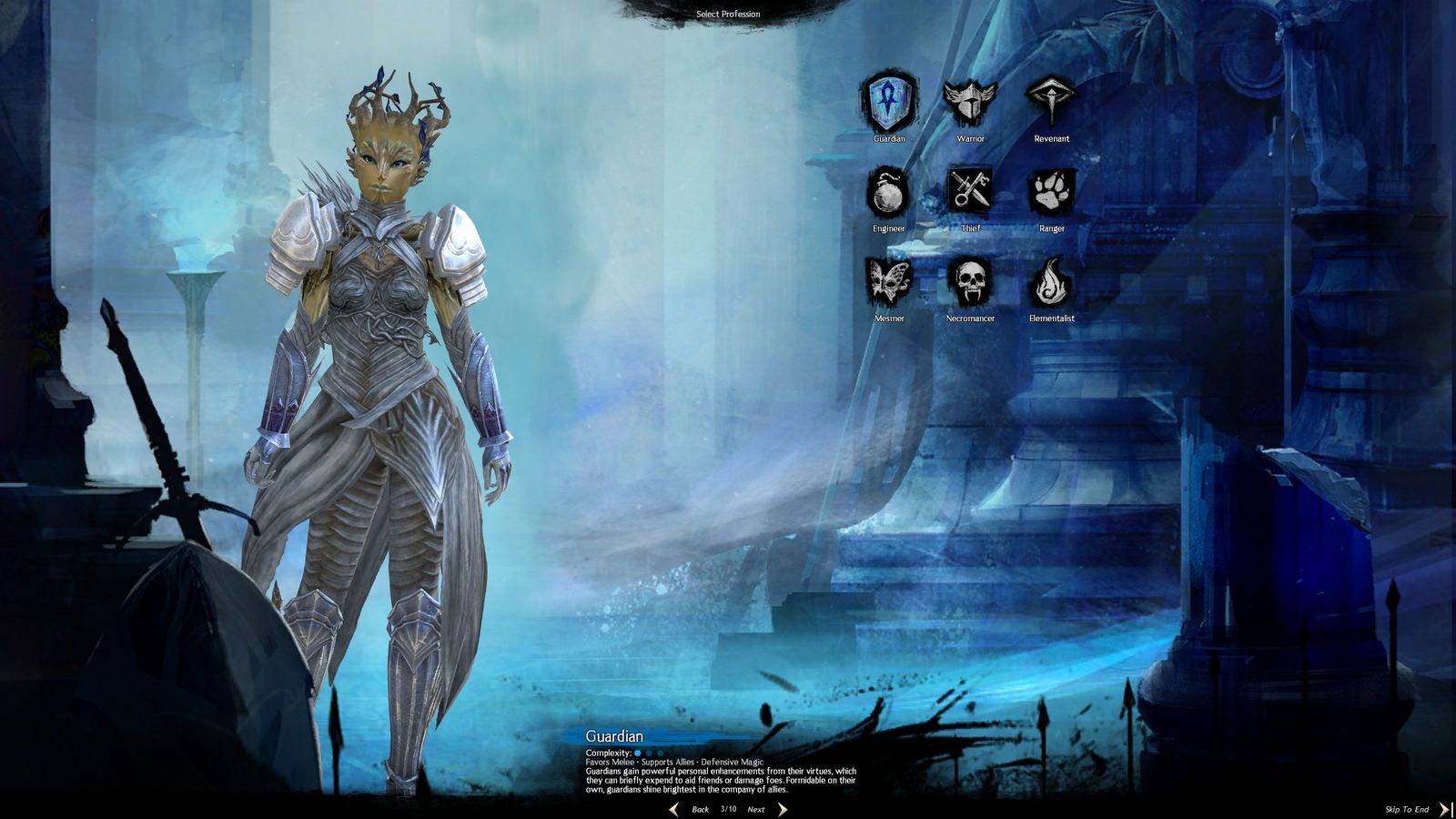
Combat and armour: skills, dodging and crowd control
This is the part that hooks people, and it's the biggest break from other games. GW2 combat is active and reads closer to an action game — no mana bar, you move while you attack, and survival is about positioning, not standing still. The pieces:
- Your weapon is your kit. The weapon type you hold sets your weapon skills (slots 1–5) — a main-hand weapon and an off hand, or a single two-hander. Your healing skill (6), three utility skills (7–9), and an elite skill (0) fill out the rest of the skill bar. These are your core skills; an elite spec adds new abilities much later. Equip different weapons and half your bar changes with them.
- Weapon swap. It unlocks at level 10, and from there most classes carry two weapon sets and flip between them in combat — each set is a different weapon type, so each brings its own skills. The rhythm is: spend one set's skills, swap, spend the other's. Elementalist and Engineer are the exceptions and can only change weapons out of combat; they swap between attunements and kits instead, which is much of why they are the two busiest professions to play.
- Dodge, don't tank. You avoid the big telegraphed hits with a dodge roll on an endurance bar. Learn this before any rotation — it's the whole defensive game.
- No holy trinity. Every profession has its own healing skill and can deal damage and support, so you never queue for a tank or a dedicated healer. A soft healer / support / damage split shows up at endgame, but that's a later concern.
- Boons and conditions. Boons are positive buffs — about a dozen of them — that you put on yourself and on allies standing near you, and a big multiplier; full boons can roughly double your output. They and the bad effects landed on you — conditions like burning and bleeding — show up as several icons above your skill bar. Power drives direct damage; condition damage and condition duration drive damage over time.
- Combo fields and finishers. Drop a combo field — fire, water, lightning — then fire a finisher skill through it for a bonus effect like might or healing. Free value when a group stacks them.
- The defiance bar (break bar). Tough enemies have a defiance bar — a bar that turns blue while it's active and soaks crowd control; hit it with stuns, knockdowns, or fears to break it and open a big damage window.
- Downed, not dead. At zero health you go "downed" with a few last-ditch skills; finish a nearby enemy or land hits to "rally" back up, or an ally can revive you. Death stings less here.
On armour: your profession fixes your armour weight — light (Elementalist, Mesmer, Necromancer), medium (Engineer, Ranger, Thief), or heavy (Guardian, Warrior, Revenant). It's mostly a look, and it's why the account-wide wardrobe is handy — you can hand armour down to another character of the same weight. Stats come from the gear's prefix, not its weight, so a "tanky" or "glass" build is a choice you make, not a class you're stuck with.
That's how fights feel. Where you'll actually spend your levels is the core loop.
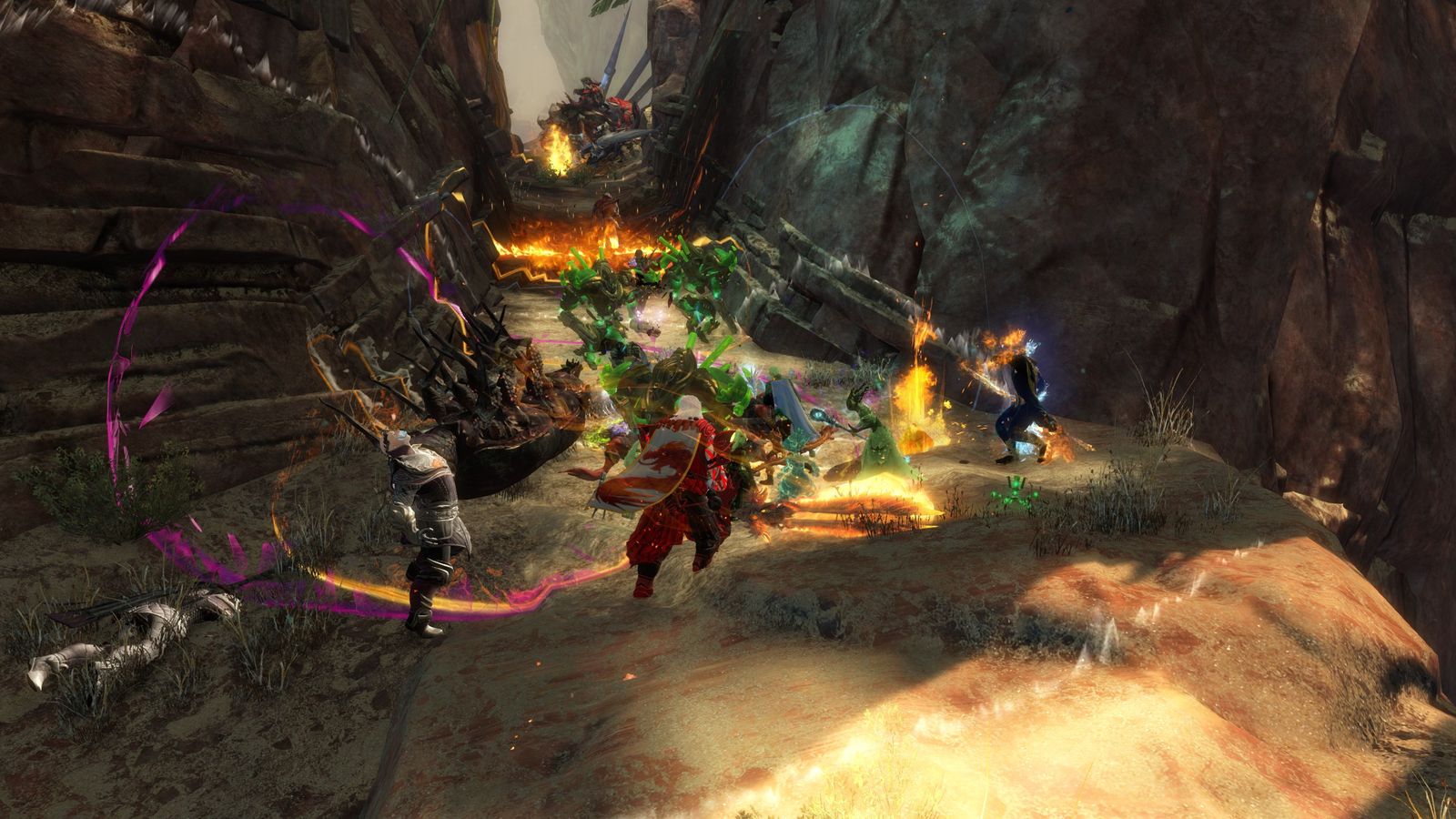
The core loop: open world, events and world bosses
The base game runs on one rhythm — explore a map, the world reacts, you get rewarded, you move on. There's no quest log to grind down. You walk into an area and things happen:
- Events and hearts. Dynamic events are the game's take on side quests — they spin up around you with no quest list to chase, and they show on the map and compass in orange, with red marking the heavier group fights. Renown hearts are the yellow hearts dotted around a zone: a standing task list for the region that fills in as you help out. You never need a party for either. Every player who pitches in is rewarded on their own contribution, and the loot is calculated for each of you as though you were the only one there — which is why other players showing up at your event is good news rather than competition. Clearing both levels you on its own.
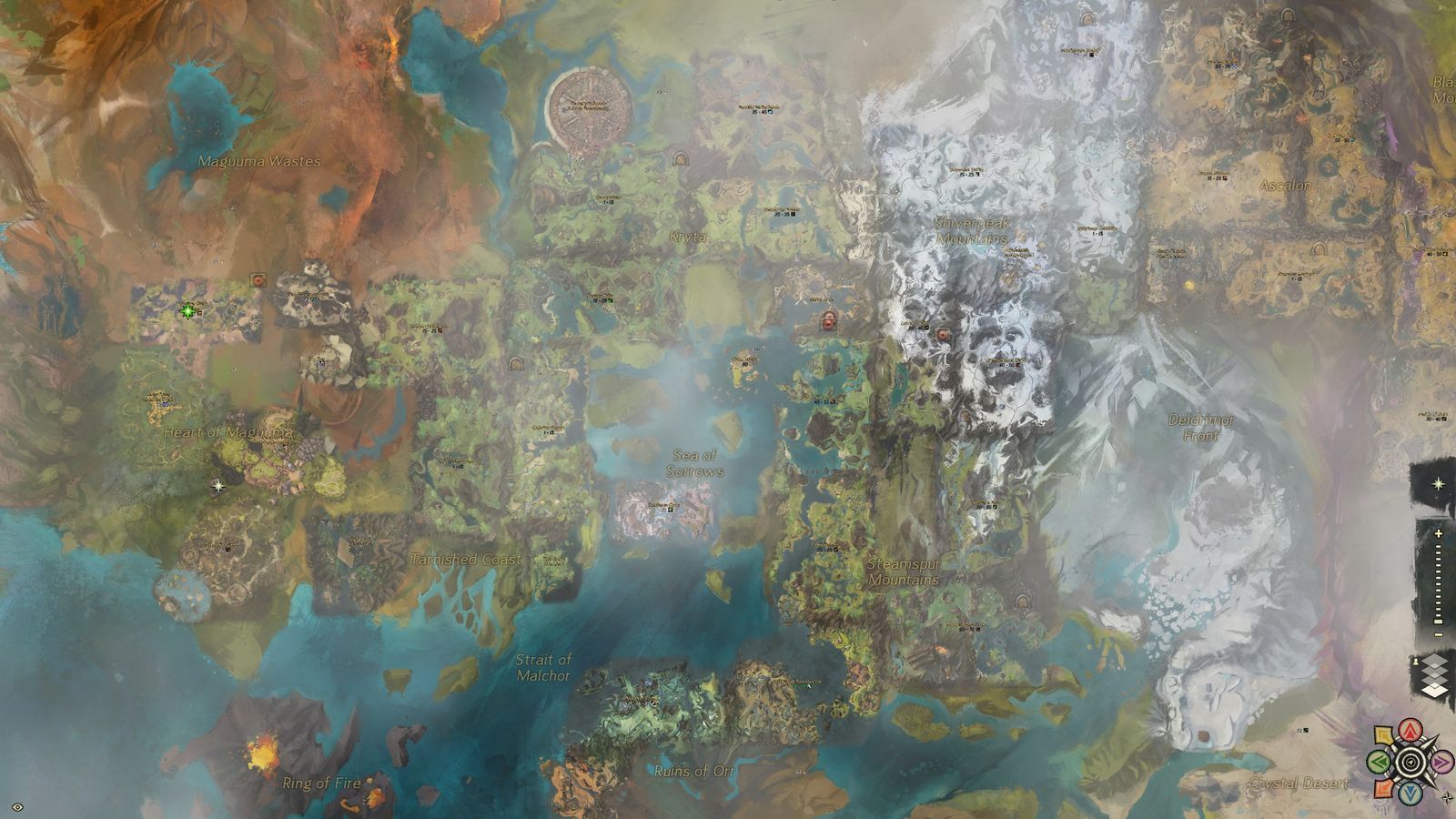
- Map completion. Vistas, points of interest, hero point challenges, and all the waypoints you unlock for fast travel. Finishing a map pays out real rewards, including transmutation charges — the thing you spend to change how your gear looks, plus a stream of drops you break down with salvage kits. Finish every map in core Tyria on one character and you also collect two Gifts of Exploration, a required ingredient for first-generation legendary weapons — which is why you will find veterans quietly filling in starter maps years later.
- Hero points. You invest points to unlock traits across three trait lines and to unlock utility skills, your elite skill, and other new abilities. Some come from character levels; the rest from hero point challenges in the world. Bank enough hero points and you can also unlock elite specs from expansion content later.
- Meta events. In many zones a chain of events builds to a big map-wide boss with a pile of loot — the heartbeat of open-world PvE.
- World bosses. Scheduled open fights anyone nearby can join; the easy ones live in starter zones, the tougher ones in level-80 maps. They run on a fixed rotation, so a world boss timer is the difference between catching three in an evening and riding across an empty field.
The personal story and story mode
The personal story is your main story — a core story that branches by race and early choices, played in story mode instances. It runs eight chapters and paces itself against your level: the first opens at 10, and a new one unlocks every ten levels from there to 80, which is the closest the base game comes to a main quest telling you where to go next. Between expansions, Living World seasons add episodic story content; the first, Living World Season 1, is free for every account and replayable in story mode. Achievement rewards stack up the whole way, the Character Adventure Guide in your hero panel keeps a per-character checklist of what you have not tried yet, and typing /wiki in chat pulls up the official wiki page for anything you're unsure about.
It helps to treat levels 1 to 80 as one long tutorial rather than a barrier. Every system the endgame quietly assumes — dodging, boons, weapon swapping, event etiquette — gets handed to you somewhere on the way up, and experience points come from all of it: events, story, exploring a new area, gathering, even crafting. That's what you're really learning at low level. Builds and rotations come later; movement, dodging, and reading boons-versus-conditions come first. Let events and map completion carry your XP, and the cap arrives on its own — at which point the whole game opens at once.
The habits nobody tells you about
None of this is in the tutorial, all of it saves an evening, and most of it is the kind of thing a guildmate mentions offhand three weeks in. Five things worth learning before the game teaches them to you the slow way.
- Inventory is the real final boss. Guild Wars 2 drops loot constantly, and a full bag stops a good session dead. Your inventory has a Deposit All Materials button that sends every crafting material straight into account-wide storage from anywhere in the world — no bank trip, no keybind, just press it whenever the bag fills up. Then buy bigger bags off the trading post as soon as you can afford them. It is the best early gold purchase in the game and nobody tells you.
- The group finder hides under Y. Instanced content is organised through the Contacts and LFG panel, and plenty of players never find it. It can look barren at quiet hours, which reads as this content is dead when it usually means it is four in the afternoon — check again around evening reset and the same listings fill up.
- Join guilds early, and more than one. An account can belong to six at a time while representing one, so a raid guild, a WvW guild and a social guild coexist happily. The community's reputation for being welcoming is largely earned, and a guild is the shortest route past every question a guide like this one does not answer.
- Do not think about gear before 80. While leveling, equip whatever the tooltip flags as an upgrade and carry on. Nothing in the core game demands optimised stats, and anything you agonise over gets replaced two levels later. The gearing decision starts at 80 with a cheap set of exotics and not a minute earlier, at which point our builds library has open-world setups per profession ready to copy.
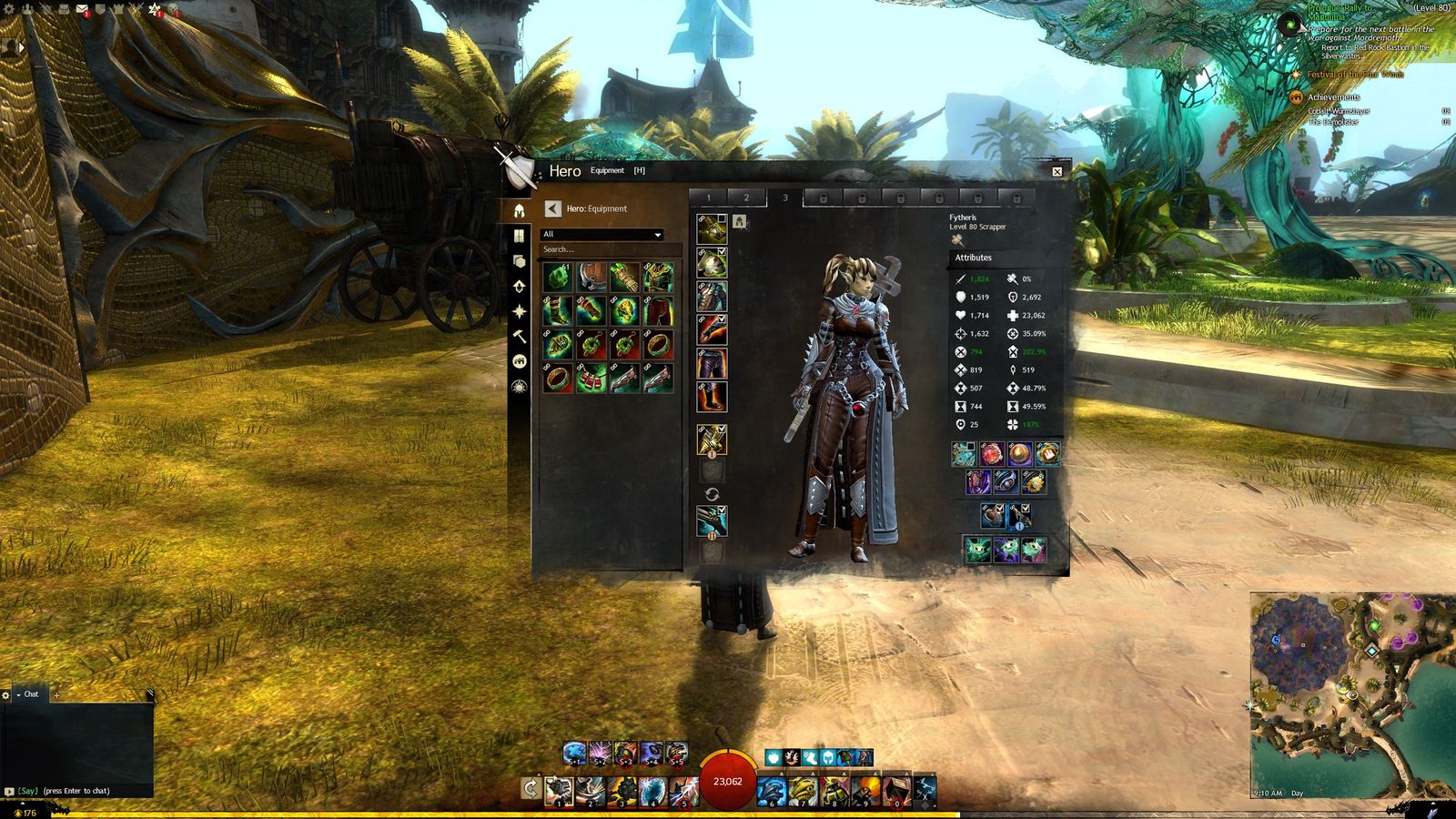
- Use the hero panel as a to-do list. Press H, open Achievements, and find the Character Adventure Guide. It tracks what this particular character has and has not done, which is as close as the game comes to admitting that go and explore is not much of an instruction.
None of that is advanced. It is the set of things that are obvious to everyone already playing and invisible to everyone who isn't, and the community will happily tell you all five if you ask in map chat — which is itself the most useful habit on the list. Fix them in your first evening and the game stops feeling like it is hiding the interesting parts from you.
With the friction handled, the question at the cap is direction.
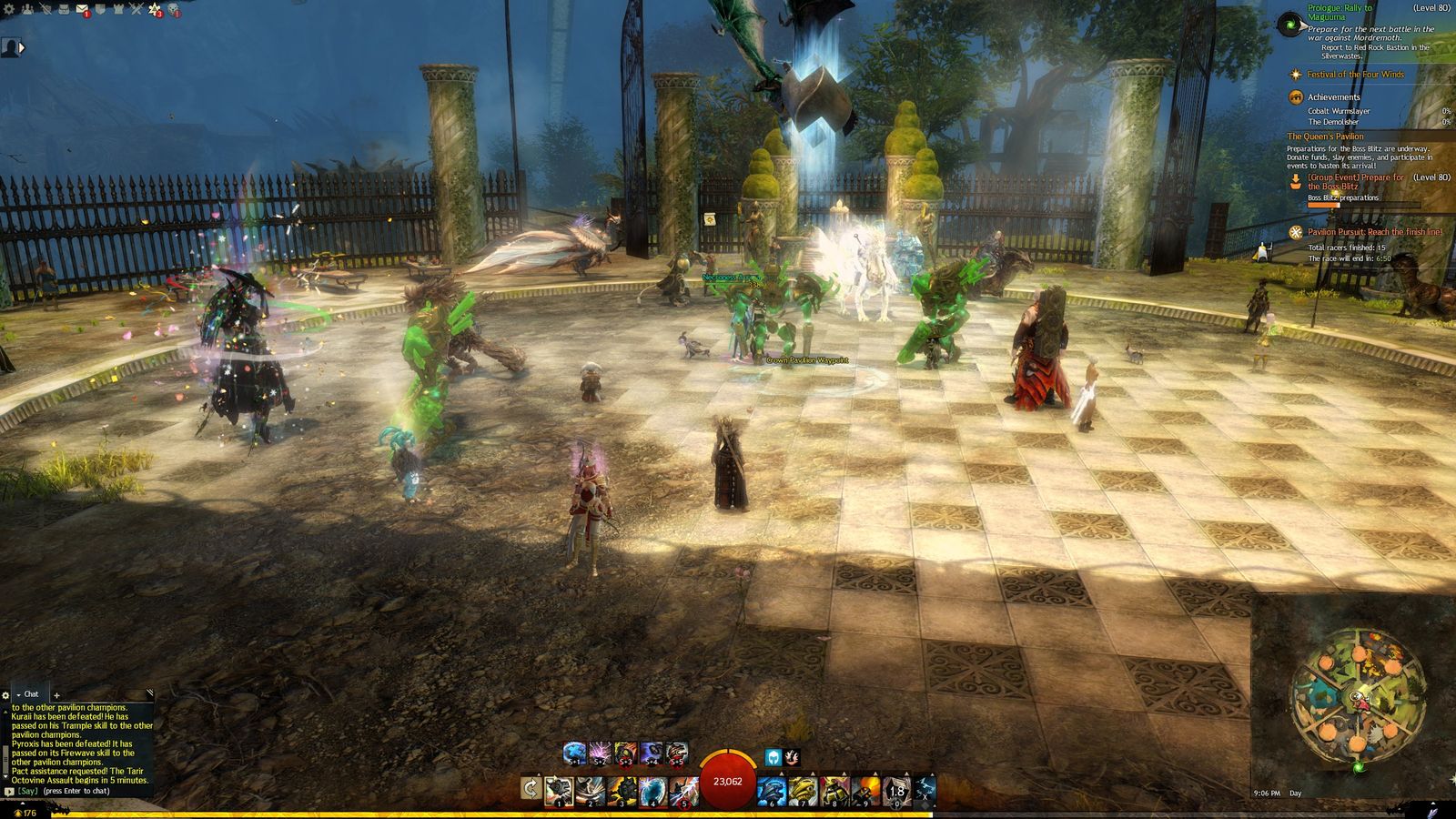
At 80, pick a direction — not every mode
Level 80 opens everything at once, which is the second wave of overwhelm. You don't have to commit to a single activity, though — pick a direction. Most players settle into one of three camps: PvE, PvP, or WvW. They share gear and currency, so drifting between them is never wasted; the point is to stop sampling and lean somewhere.
| Activity | Camp | Notes |
|---|---|---|
| Open world | PvE | Events, meta events, world bosses, map completion. The default home — relaxed and always busy. |
| Fractals | PvE | Short, scaling instanced content. The friendly step into harder grouped play. |
| Raids | PvE | 10-player instanced bosses and the deep end of PvE. The old strike missions were folded in here as raid encounters in February 2026. |
| Dungeons | PvE | The original 5-player instanced content. Mostly abandoned now — groups are scarce, safe to skip. |
| Structured PvP | PvP | 5v5 conquest, everyone equalised at 80. Pure skill, no grind. |
| WvW | WvW | Massive server-vs-server war, scaled to 80. Chaotic and social, runs around the clock. |
Open world is the easiest place to keep learning. Fractals are the friendly door into instanced content: they run on scales 1 to 100 across four tiers, and from scale 20 upward enemies apply agony, which is the one and only reason a new player ever needs to think about ascended gear and the infusions you slot into it. Raids are the deep PvE endgame — and the single-boss fights the game used to call strike missions were merged into raids as raid encounters in February 2026, so any guide still splitting the two into separate modes is out of date. Dungeons are the exception — the original five-player runs still exist and still pay out, but the community has long moved on, so groups are hard to find and a new player can skip them with nothing lost. PvP and WvW both scale you to 80 on an even field: in the PvP lobby an amulet hands everyone the same gear options, so it's pure skill and you can jump in long before the cap — the level-3 reward hands you the key, and inside a match every skill and trait is unlocked no matter what your character has actually learned. No meta build required. And it's worth joining a guild early; guilds and their guild halls add account-wide perks and a daily resource stop, and most modes feed the same achievement rewards. An account can sit in six guilds at once while representing one at a time, so a raid guild, a WvW guild and a purely social one cost nothing to hold together while you work out which one you actually turn up for.
All of that is the base game. The expansions are a later conversation.
Expansions, Living World and the gem store — later
You don't need them to start, and you shouldn't think about them until the base loop has sold you. When it has, expansion content is the next conversation: it adds elite specializations, player housing, guild halls, and the ninth profession — plus the mastery system, the account-wide progression that takes over from leveling once you're 80. Masteries are permanent upgrades you train with experience instead of more levels — mounts and their movement tricks, gliding, auto-loot, and more. Between expansions, Living World seasons add more story content. That's real upside, and a separate guide. For your first stretch, the free base game is plenty.
What an elite spec actually does
Described abstractly it sounds like nothing: a third trait line with some new skills. Concretely, a core Necromancer fights at range and drops into Death Shroud, a second health bar with ranged attacks. Buy Heart of Thorns, train the Reaper, and that same shroud becomes Reaper's Shroud — melee skills, a greatsword, and a profession that now wants to stand in the middle of the fight. Same character, different game. Every expansion adds one specialisation per profession, and the newest, Visions of Eternity, added all nine at once.
Two different checkouts
This trips people up constantly, because the two halves of the catalogue are bought in completely different places. Expansions are ordinary purchases — the official store, Steam or Epic — and cannot be bought with gems at all. Living World episodes are the reverse: they unlock from the in-game gem store at 200 gems each, and since gems can be traded for gold you earned in game, a patient player can unlock a whole season without spending money.
Season 1 is permanently free for every account and needs nothing at all. The others carry prerequisites that are not obvious from the store page: Season 3 requires Heart of Thorns, and both Season 4 and the Icebrood Saga require Path of Fire. End of Dragons has no season attached to it. If you are buying in order to follow the story in order, check what a season needs before you buy the season.
In order, the six are Heart of Thorns, Path of Fire, End of Dragons, Secrets of the Obscure, Janthir Wilds and Visions of Eternity, which arrived in October 2025. Where the series goes from here is its own question now that Guild Wars 3 has been announced.
Hold the whole catalogue loosely, though — the real trap isn't the content, it's how you approach it.
The traps that make it feel huge
The game isn't overwhelming. The way new players approach it is. The split below is the whole guide in two cards — the left side is the path, the right is the spiral.
Start here
- Pick a race for the look, a class for the feel
- Let events and map completion level you
- Learn to dodge before you learn a rotation
- At 80, grab cheap exotics and pick a direction
Skip the spiral
- Choosing a race or class for its stats
- Reading a tier list and chasing the "best weapon"
- Forcing yourself to try every mode at once
- Grinding ascended or legendary before you need it
None of the right-hand list is forbidden — tier lists, legendaries, and expansions are real parts of the game. They're just the wrong first move. Do them once you've earned the context to care, and the game stays the size of whatever you're currently doing.
FAQ
Is Guild Wars 2 free to play?
Yes. The core game is free with no trial timer and takes you to the level 80 cap. You can grab it from the official site or a Steam account. Expansions are a one-time purchase with no subscription. Free-to-play accounts have a few anti-bot limits — restricted chat and trading, fewer slots — that any expansion removes.
Does race matter in Guild Wars 2?
Not for power. Race changes your look, your home city, and the opening hours of your personal story. Racial skills are weak enough to ignore, hitboxes are identical regardless of size, and the studio removes any case where a race gives a real edge — so at character creation, pick on aesthetics and the starting story.
Which class should a beginner pick?
Pick on feel, not on tier lists — leveling content is clearable on any of the core professions. Warrior and Guardian are the most forgiving while you learn; Engineer and Elementalist reward players who like more buttons. Use whatever weapon looks fun early on, run a simple core build, and respec for free out of combat, so nothing is permanent.
How does combat work?
It's active: no mana bar, you move while you attack, and your weapon type sets your weapon skills on the skill bar. There's no holy trinity — every class can damage, heal, and support — so you dodge to avoid big hits, weapon swap for a second set of skills, and lean on boons, which are a major multiplier. Tough enemies have a break bar you crowd-control to open a damage window.
Do I have to grind for gear?
No. Progression is horizontal — the level cap and gear ceiling have barely moved in years. Exotic gear is cheap and within a few percent of max; ascended gear is a small step above it; legendary weapons and armour have the same stats and just add convenience. There's no treadmill, and gold, materials, and skins are account-wide, so alts are cheap to gear.
Which game mode should I start with?
Pick a direction rather than one activity: PvE, PvP, or WvW. Open world is the gentlest start; fractals are the friendly step into instanced content; raids are the deep end game, and they absorbed the old strike missions as raid encounters in February 2026. Dungeons, the original five-player instances, are mostly abandoned now and safe to skip. PvP and WvW scale you to 80, so you can try them before you even hit the cap.
Do I need the expansions to start?
No. The base game is free and complete enough to learn the whole game and reach the level 80 cap. Expansion content adds mounts, gliding, elite specs, masteries, and housing later, and Living World seasons add more story content — a question for once the base loop has sold you, not for day one.