Star Wars Zero Company review: the squad is the point
Thirty hours and a finished campaign on the shipped build: Zero Company's Assist system makes a Star Wars squad feel like a squad. The catch is a launch build that still stutters. 8/10.

Thirty hours and a finished campaign later, I can still tell you the exact moment it clicked. A clone trooper of mine had no shot worth taking, so I left him where he was and fired with someone else — and he shot anyway, for free, because he could see what she could see. That is Assist, and it is the best thing in this game.
The eight is the architecture minus the build. Zero Company shipped with a stutter, a crash or two, and a frame rate that gives up ground the longer the campaign runs. The design underneath that is a nine, and it will still be a nine after the patches — but a review of a game you can buy today has to score the thing you would actually install.
Star Wars Zero Company launched on 27 August 2026 for PC, PlayStation 5 and Xbox Series X|S, developed by Bit Reactor with Respawn Entertainment and published by Electronic Arts. It is a single-player turn-based tactics game set in the twilight of the Clone Wars, and it is the best thing to happen to the Star Wars licence in years.
It is also three days old at the time of writing, which matters more than usual here. The review embargo lifted on 26 August, a day before release, so the scores you have already read describe a build that shipped to nobody. This one describes the build you can install.
Here is the shape of it before the argument starts.
What Zero Company is: turn-based tactics in the Clone Wars era
You play Hawks, a former captain in the Grand Army of the Republic, dismissed after a defeat at Antine, now running a crew of misfits out of a base called The Den on the Ring of Kafrene. The enemy is the Infinite Coil, Separatists under Kundri Fathom, so battle droids are part of what you shoot at. Between missions you upgrade the base, talk to your people, run short text-based Operations, and decide who is worth the credits you have.
The pedigree is not incidental. Bit Reactor was founded in 2022 by Greg Foertsch, who was art director on the XCOM games, and Bit Reactor built Star Wars Zero Company alongside Respawn Entertainment. So the comparison everybody in the Star Wars universe reaches for is not lazy shorthand — it is the studio’s own lineage.
That comparison is the right one, but it undersells how differently this game is tuned. Maps in the XCOM games are large and want you to move slowly. Zero Company’s maps are small and want you to move now. Overwatch exists, cover exists, flanking exists — but the reward structure pushes you forward rather than pinning you behind a crate. Where XCOM punishes aggression, Zero Company pays for it: an aggressive playstyle is the optimal one here, not a risk you take against the odds.
What it is not is an XCOM-scale sandbox. There is no New Game Plus at launch, no mod support planned, and no procedural layer generating fresh missions forever. This is a written campaign with tactical combat inside it, and it wants to be judged as one.
Assist is the mechanic that makes it a squad
Every tactics game says it is about the team. Most of them only mean that you own several units. Zero Company means something narrower and much better: your operators contribute to each other’s turns without spending their own.
Assist is the stat that governs it. When one of your people takes a shot, others who can see the same target chip in. It costs the assisting operator no action points. It is not a buff you activate, not a stance you set up a turn in advance — it is simply what happens when your squad is positioned so that more than one of them has the angle. In play, a well-placed second operator can roughly double what a shot does, and you paid nothing for it.
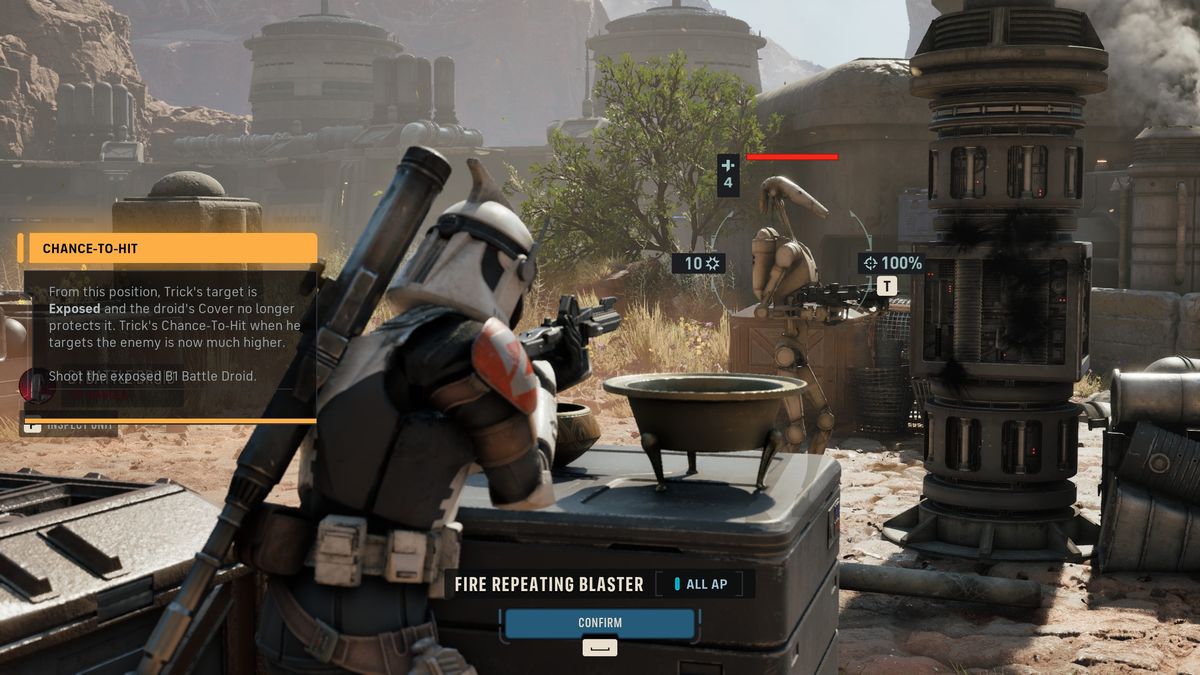
That one rule quietly rewrites how you play. Positioning stops being about cover and starts being about lines of sight that overlap. Moving someone to a worse tile so that two other people get an angle becomes a real decision. And because Hawks carries a passive called Fearless Leader that raises Assist for the whole squad while he — or she — is on the field, keeping your commander alive and central stops being a fail condition you tolerate and becomes an incentive you want.
Advantage is the other half of that maths. It is a squad-wide pool rather than a per-operator resource, it caps at ten, and it ticks up by one every time one of your shots does damage. Ultimates spend from it. So Star Wars Zero Company pays you for shooting and then charges you for the spectacular thing, which is exactly why it keeps pushing you out of cover while XCOM keeps pulling you into it.
There is a third decision the game keeps handing you, and it is my favourite thing in the combat after Assist itself: you get to choose which enhancement to deny the enemy. Not how much damage to do — which advantage they do not get to have. It is a small window that turns a routine turn into an argument with yourself, and it is the sort of choice most tactics games resolve with a dice roll instead of a decision.
I have played a lot of games that ask you to think about a squad. This is one of very few where the squad thinks back.
Assist, in one sentenceBonds turn the roster into the real progression
The other system doing heavy lifting is the Bond system. Deploy the same people together and they build a relationship, and that relationship pays out in Focus points, which is how your operators actually grow. It is not a romance system — the developers have been clear about that — and it is better for it.
And the payout is not only Focus. Raising a bond hands out passives — more damage here, more health there — and a maxed bond can hand over something categorical, an immunity rather than a number. That is the part that turned rotation from a chore into a plan: you are not spreading experience thinly, you are deciding which two people should end up permanently better because they keep going out together.
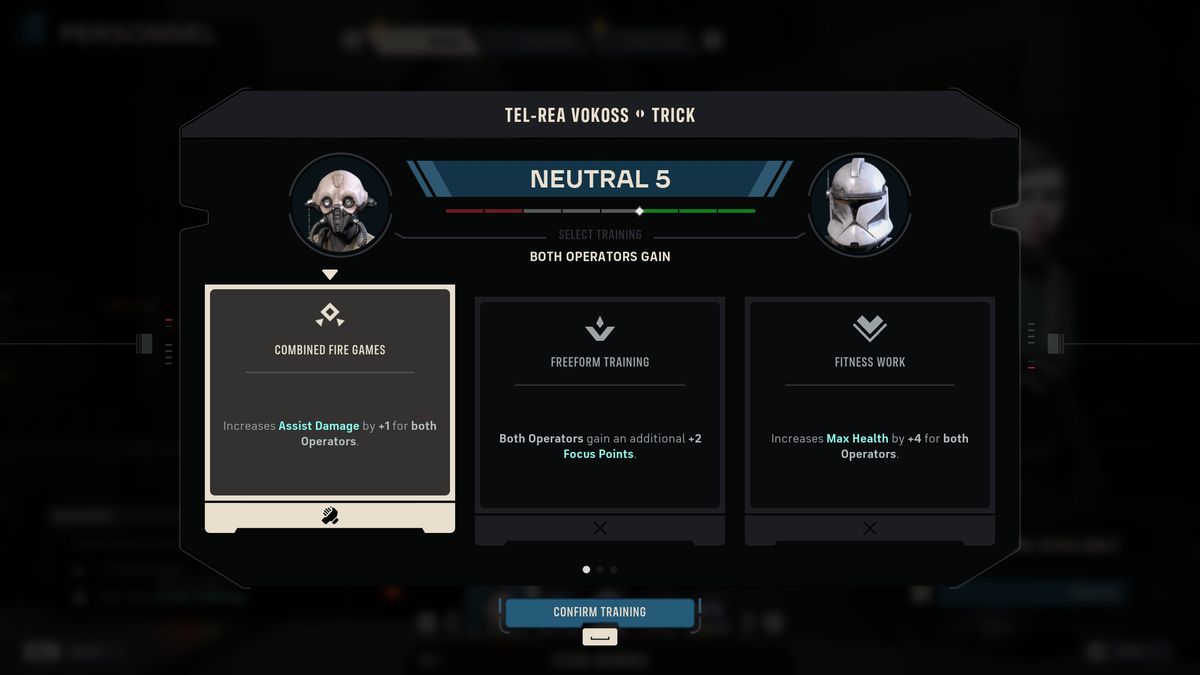
What it does is solve the problem every squad tactics game has: the pull toward fielding the same four units forever. Because Bonds only build between people who go out together, and because Focus is scarce, rotating your roster is the efficient play rather than the sentimental one. You end up running a company instead of a first team.
That matters here because the field limit is four. Hawks plus three, every mission. The roster is larger — EA has said it tops out at twenty, though the in-game recruitment screen shows a smaller starting capacity you expand later, and I have not yet confirmed where those two numbers meet. Either way most of your people are on the bench at any moment, and Bonds is the reason you take them off it.
Permadeath is on by default and can be switched off. On standard difficulty three injuries kill an operator, each injury costs ten per cent hit chance, and only a Medic can rally a downed operator back to full health. If Hawks goes down the mission is over. I left all of it on, and it is the right way to play — a roster only feels like a roster when losing someone costs you something.
The cast is strong, and it grows on you
The writing is better than it needed to be. Kabb, Trick, Jae, Cly, Luco and Tel-Rea each have a voice rather than a role, the conversations back at the Den are worth walking over for, and Gordy Haab’s score does the thing a Star Wars score is supposed to do. Dee Bradley Baker voices the clone Trick, which is exactly the casting you would hope for.
Not everyone lands straight away. Runa is written loud and written often, and for the first stretch I was quietly picking squads that did not include her. She gets better — the writing finds her somewhere in the middle, and by the back half I had stopped working around her. Worth knowing if she grates early: that is not where she stays.
The press is not unanimous on the writing either. Shacknews scored the game a 70 and called the character work “some of the most uninspired Star Wars-themed storytelling” they had dealt with. That is too harsh by a distance, but it is not coming from nowhere: recruits you build yourself are noticeably thinner than the main characters, which ScreenHub caught too.
And it escalates. The back half of the campaign has a turn in it that I am not going to put in plain text, because working out that it is coming is part of why it lands. Everything from here to the end of this section sits behind the bar, one screenshot included.
Spoiler
Anakin Skywalker turns up, and not as a cutscene flourish — he is staged as part of a playable mission, with the game confident enough not to hand him the scene. Matt Lanter is back to voice him.
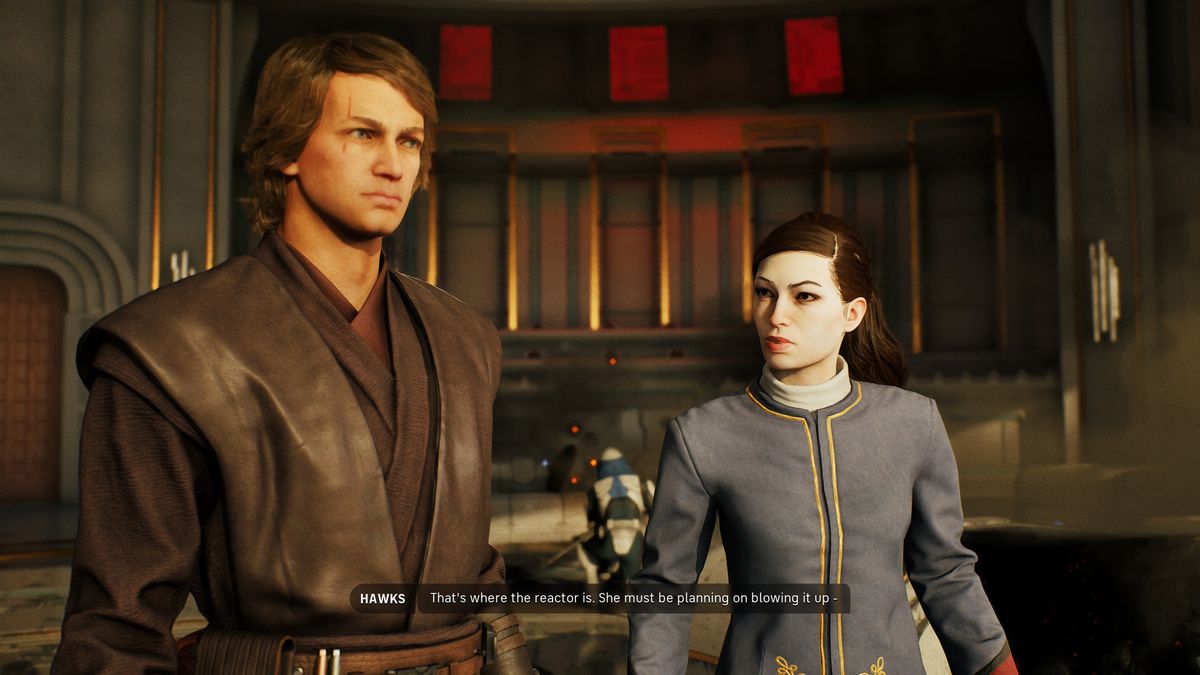
He is not the only one. Captain Rex turns up as well, and the game treats both appearances the same way: as people with a job in the scene rather than as merchandise walking through it.

Then Order 66 comes down, and Zero Company is on the wrong side of it. Trick — the clone you have been deploying all campaign, the one Dee Bradley Baker makes impossible to treat as a unit — is compelled to turn on the squad. And the Republic that dismissed Hawks at Antine stops being a flawed former employer and becomes the thing hunting you.
It is the best writing in the game, and it works for a reason that has nothing to do with the twist itself: the first half spent its time making you like a man it was always going to take away from you. That is the payoff a squad game is uniquely able to set up, and Zero Company is one of the few that actually collects it.
It looks the way Star Wars is supposed to look
The presentation is the least contested thing about this game and it earns the credit. Establishing shots of the Ring of Kafrene, of cities at dusk, of ships in dock — the game keeps stopping to show you something, and the something is always worth the stop. Armour reads as armour. Blaster fire reads as blaster fire. The Clone Wars aesthetic is handled with restraint instead of nostalgia.
Worth being straight about: the postcard moments are directed ones. The shot below with the rifle is a cutscene, not a camera you were holding. The tactical view is a good deal plainer, which is the correct trade — you need to read a board, not admire it — but a gallery like this flatters any game, and it is flattering this one.


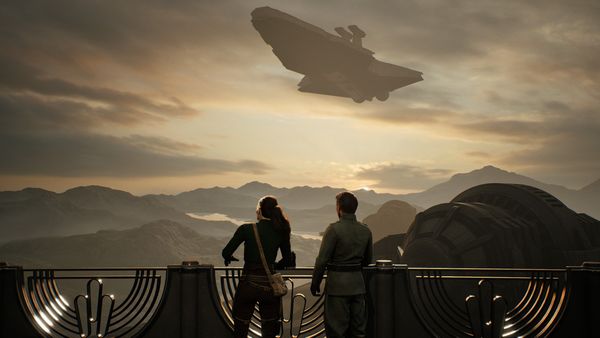
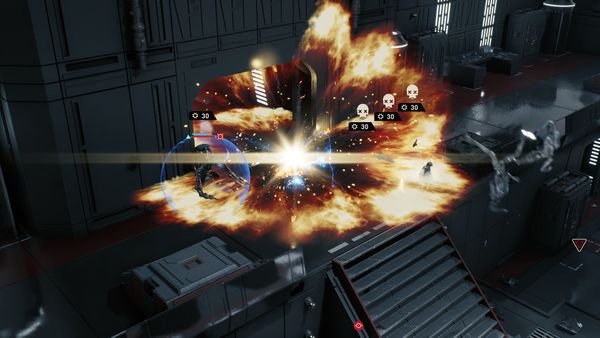

Reviewers describe it as an Unreal Engine 5 game, and IGN Deutschland’s 90 mentions “the usual UE5 performance issues” in the same breath as the praise. EA has not confirmed the engine anywhere I can find, so treat the engine as press consensus rather than as fact — but treat the performance note as a warning, because it is a good one.
Where a good tactics game runs out of mission ideas
Here is the first real complaint. The tactical combat is excellent and the missions built on top of it are not always worthy of it. Too many of them resolve into hold this point for three turns, and once you know how an encounter is going to be paced, the interest drains out of the setup and only the execution is left.
PCGamesN, at 80, described tactical battles that “could serve to be more complex and varied”, and that is the shape of the problem. No single mission is bad — the fighting is good enough that a mediocre objective still plays well. It is that by the end I could predict the objective from the loading screen more often than I should have been able to.
It is also where the Clone Wars setting is doing less work than it could. A war that ran across hundreds of worlds ought to produce more than one kind of objective, and Bit Reactor clearly knows how to build an encounter — the fights themselves are the proof.
The Operations, the short text-based storylets between missions, are a better idea than they are given room to be. They give the campaign texture and let a choice carry weight without another firefight. There should be more of them and fewer capture points.
One combat mechanic never made sense to me either: the drain the enemy gets. A finished campaign later I still do not know whether there is a clean way to avoid it or whether I simply never found it, and I would rather write that down than pretend otherwise. Either way it is the one part of the fighting that felt like it was happening to me rather than something I was playing against — and a game this good at teaching Assist and Advantage by example should be able to teach this too.
The catch: this build still stutters
This is the section where the number gets defended rather than assumed, because no Star Wars Zero Company review is worth much if it skips the state the game actually shipped in.
Bit Reactor launched Zero Company with performance issues its reviews did not test for, and that is not a conspiracy, it is a calendar. The embargo lifted on 26 August, one day before release, which means the press played pre-release builds without the day-one patch. Their scores are honest and they are also describing software nobody bought.
On my machine — a Ryzen 9 3950X, 32 GB of RAM and an RTX 4070 Ti, comfortably above EA’s recommended spec of a Ryzen 7 3700X and an RTX 3080 — performance is good, and it is not clean. Activating Overwatch produced a visible hitch, though only in some missions, and I took two crashes in the first fifteen hours. Metacritic user reviews from the same week describe the same thing in nearly the same words: lag spikes when new enemies load in. Overwatch triggers enemy reveals, so those are very likely one bug wearing two hats.
It also gets worse as the campaign goes on. The early hours are the clean ones; by the late missions the frame rate has given up a little more ground, and the long animations that are charming at hour five are a tax at hour twenty-five. None of it stopped me finishing — but I played this on holiday, in long sittings, which is the worst way to meet an animation you cannot skip. An hour an evening and you would barely notice.
I play on Linux through Proton, and this is where it gets interesting rather than merely annoying. Zero Company has no native Linux build — Steam lists Windows only — but it runs, and it runs well. I started on Proton GE with gamemoderun %command%, which was fine until one fight crashed on me repeatedly, and moved to Proton Hotfix to get past it. Performance improved noticeably after the switch, and the Overwatch hitch improved markedly with it. That deserves saying plainly: part of what I would otherwise have written up as a game bug turned out to be fixable by changing the runner. If you are on Linux, try Proton Hotfix before you file a complaint.
One more thing belongs in this section and nowhere else. A single-player game with no online mode requires an internet connection, an EA account, and your EA and Steam accounts linked in order to play. That is Steam’s own store page saying so. It is not a bug and it is not a surprise from this publisher, but it is the one item on this list that will outlive every patch.
What the character creator gives you, and what it doesn’t
You build Hawks at the start — origin, presets, appearance, outfits, specialization and weapon class, each its own step — and you build recruits later. The depth is there. Weapon class is genuinely independent of specialization, so a Medic carrying a longarm is a real build rather than a joke, and the longarm is a serious weapon: twelve base damage, another twelve on a critical, nine per cent critical chance, long range, and a flat two action points per shot because it counts as a Slow Weapon. Every operator gets three action points a turn, so a longarm shot costs two thirds of a turn — that is the whole trade, and it is why a Medic carrying one is a decision rather than a gimmick.
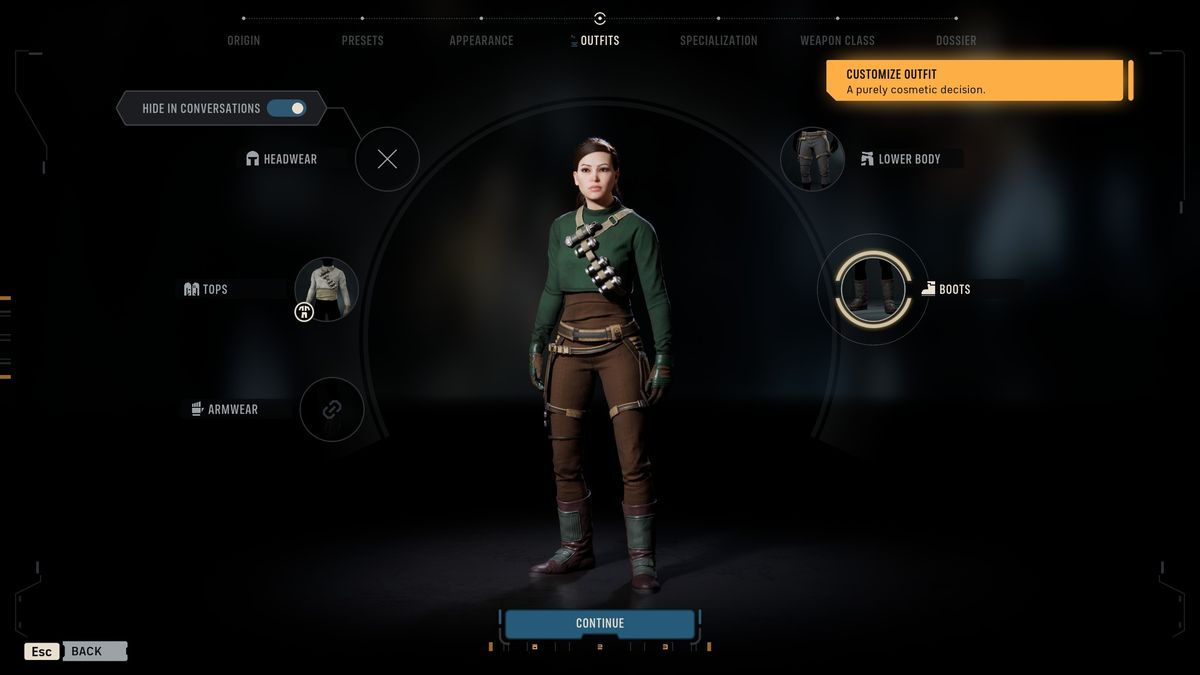
There is also a second specialization that opens up midway through the campaign, which is the point where a build stops being an opening choice and becomes a plan. What all twelve specializations actually do is a page of its own — the Zero Company class overview has them. If you want your squad to look like the Grand Army rather than like mercenaries, the clone trooper armour is cosmetic and it sits in the Deluxe Edition rather than the base game — the 100th Clone Company and ARC Trooper sets, per Steam.
The faces are the problem. The preset selection is mostly unflattering in a way that reads as a deliberate house style rather than an accident, and working the sliders yourself only gets you part of the way out. It is a small thing you look at constantly, which is exactly the kind of small thing that lodges. “Ugly faces” is a real search term for this game, so I am not the only one who noticed.
Press said 85, players say 77 — reading the gap
All four numbers below were read on 30 August 2026, four days after the embargo lifted, and all four will move — the user score has already climbed while the Steam percentage has slipped a point. Metacritic’s own page contradicts itself on the critic count, showing 43 in one place and 45 in another; I have used the figure attached to the score. The spread inside that 85 is wide: Gamers Heroes went to 100, IGN and PC Gamer to 90, and Shacknews to 70. That is a genre game the critics broadly agree on and disagree about only at the edges.
85
Metascore, PC
8.0
Metacritic user score
77%
Steam, 5,676 of 7,334
43
Critic reviews, 42 positive
The gap is not a mystery and it is not a review-bombing story. It is the patch calendar. Critics played a build without the day-one patch and scored the design. Players installed the shipped build and scored the experience. Both groups are telling the truth about different software.
That is also why mine is an eight. Everything I have taken off comes off for the performance and nothing else — the design is not what is wobbling. The problems in this game are the kind that get patched, and the things it does better than anything else in its genre — Assist, Bonds, a squad that behaves like one — are architecture, and architecture does not arrive in an update. If you want to know what the specializations actually do before you commit, the class overview has all twelve, and the game hub collects everything else.
Who Zero Company is for
This is not a game for everybody, and the reason is not the quality. It is the shape of it: a written campaign with excellent combat, a launch build that is still settling, and no second run waiting at the end of the first.
Buy it now
The tactics are worth the rough edges.
- You want a tactics game where positioning the whole team matters more than min-maxing one unit.
- You have wanted a Star Wars game about competent people instead of chosen ones.
- You are new to the genre — four difficulty levels plus a Beskar mode scale it from forgiving to brutal.
- You play on Linux and want something that works through Proton with one sensible tweak.
Wait a patch
Nothing here is unfixable, but nothing here is fixed yet.
- You need a launch build to be stable on day one. This one is not, quite.
- Replayability is what you buy tactics games for — there is no New Game Plus and no mod support planned.
- “Hold this point for three turns” already sounds like a chore to you.
- An internet connection and an EA account for a single-player game is a line you do not cross.
Questions
Is Star Wars Zero Company worth it?
Yes, with the reservations named. The tactical layer is the best in a Star Wars game in years, and Assist and Bonds do something genuinely new with squad play. The reservation is the launch build: two crashes in fifteen hours, a stutter when Overwatch fires, and mission objectives that start repeating sooner than they should.
Is Star Wars Zero Company multiplayer?
No. It is single-player only — no online mode, no co-op, no split-screen. It does still require an internet connection, an EA account, and your EA and Steam accounts linked before it will start, which is a separate and more irritating fact.
Does Star Wars Zero Company run on Linux?
There is no native Linux build; Steam lists Windows only. It runs through Proton and it runs well. Proton GE with gamemoderun %command% worked until one fight crashed repeatedly; Proton Hotfix fixed that and improved both performance and the Overwatch stutter. Steam Deck reports from other players describe it as choppy but playable.
How long is Star Wars Zero Company?
EA and lead producer Caydence Funk put the main story at around thirty to forty hours. It took me thirty on standard difficulty with every side mission I could find, so the bottom of that range is realistic rather than optimistic. The main story is one run and there is no New Game Plus at launch, so the replay case rests on different squad builds and different Operations choices rather than carrying anything over.
Is Star Wars Zero Company hard?
The game scales. Four difficulty levels plus a Beskar mode that removes save-scumming, permadeath on by default and switchable off, three injuries to kill an operator on standard, and instant failure the moment Hawks goes down. Standard with permadeath left on is tense without being punishing.
Why is the Steam user score lower than the reviews?
Because they are scoring different builds. The embargo lifted on 26 August, a day before release, so critics played pre-release code without the day-one patch and reviewed the design. Players installed the shipped build and reviewed the crashes. The 85 and the 77 are each accurate about the thing they measured.
Can you create your own character in Star Wars Zero Company?
Yes, and it goes deeper than it first looks. Hawks is customisable across origin, appearance, outfits, specialization and weapon class, and weapon class is independent of specialization, so any of the four weapon families works on any of the eight standard specializations. The weak spot is the preset faces, which are mostly unflattering and only partly fixable with the sliders.