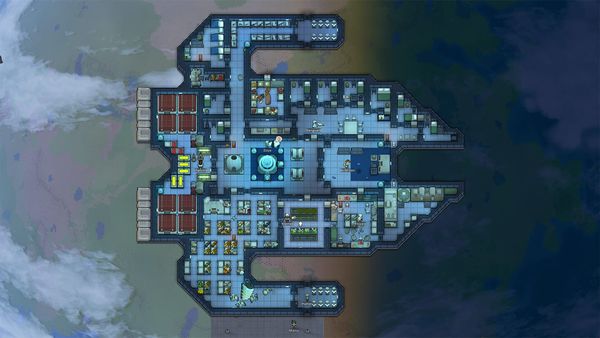
RimWorld Gravship Design: Layouts That Actually Fly
Three RimWorld gravship designs drawn to the tile, plus the exclusion-zone rule that stops most first ships flying. Range, fuel and substructure limits.

Most first gravships never leave the ground — or they leave with half the colony still standing on the lawn. Both failures come from the same two rules, and neither rule is explained anywhere in the game. Here they are — with three gravship designs you can copy tile for tile, and a calculator to size your own.
What RimWorld Odyssey changes
The gravship is the headline feature of the Odyssey DLC, which shipped on 11 July 2025 alongside the free 1.6 update. You will see it written both ways — gravship, or grav ship — and it is the reason a colony sim suddenly has a floorplan problem. A base that flies is a base whose walls have to obey physics.
The entry point is the grav engine, and it is not gated behind research. It arrives from a quest that always appears early in a new game — a mechanoid ship crashes onto your map carrying the engine, a pile of mechanoid corpses, and the initial supply of gravlite panels. You can also start with one outright in The Gravship scenario, which then sends mechs after you for sitting still too long, so nomadic is less a playstyle than a survival requirement.
From there the ship is built out of gravship substructure: a foundation layer costing 1 gravlite panel and 4 steel per tile. It is not a floor, it sits under the floors, and only things standing on substructure connected to the engine come with you when you launch. Everything below is vanilla — no mods, no workshop content, just the systems Ludeon shipped.
Rule one: the exclusion zone
Every thruster projects a rectangular exclusion zone out of its business end — 1×5 tiles for a small thruster, 2×7 for a large one. You can see it as a white rectangle when you select the thruster or hold its blueprint.
That zone has to be clear of gravship substructure and impassable buildings. Substructure is the part that catches people out. It is a floor. It looks like nothing. And it silently kills the thruster it sits under, which quietly contributes zero range to your ship.
Blocked — +0 tiles
Clear — +10 tiles
Same thruster, same ship, different tile. On the left the exhaust path runs across your own deck. On the right it fires off the edge into open ground. Only the right one counts.
Three things follow from this, and they are all counterintuitive:
- Thrusters live on the rim, firing outward. Not tucked in a neat engine room. The rim is the only place where the zone can escape the deck.
- Walls around a thruster are fine. Walls in the zone are not. You can brick a thruster into a sealed room and it still works — being enclosed is not the problem. Putting anything impassable in the exhaust rectangle is.
- Zones may overlap each other. Two thrusters can share exhaust space. The only thing you cannot do is park a thruster inside a zone — which is also why the rectangle starts beyond the thruster, not on top of it.
One honest caveat: the wiki flags the “impassable buildings” half of this rule as not fully confirmed, and notes that coolers and walls definitely block while some other buildings and trees do not. Substructure is the part nobody disputes — and it is the part that bites.
The minimum viable gravship
Five parts. That is the whole requirement list:
Everything else — walls, beds, a roof, power — is optional for flight. It is not optional for survival, but the engine does not care. A bare deck with those five parts on it will lift, cross the world map, land, and immediately become a colony.
That is the shape all three designs below grow out of. Each one is the same skeleton with more hull wrapped around it.
Gravship blueprints: three designs
Three blueprints, drawn to the tile. Every building sits at its real footprint, every exhaust rectangle is the real size, and every substructure count is inside the cap. Copy them straight, or read them for the pattern and draw your own.
The pattern is the same in all three — core in the middle, rooms around it, thrusters on the rim. That is not an aesthetic choice. It is the only arrangement that satisfies the exclusion zone, protects the fuel, and keeps the deck under the cap at the same time.
A · The Scout — 91 tiles
The get-out-of-here ship. Two small thrusters, one small tank, a bunk room and a hold. It cannot fight and it cannot go to orbit, but it can be flying within a day of the grav engine landing, and 20 tiles of range is enough to leave a map that has turned against you.
Read the bottom edge. The two thrusters sit on the hull line with nothing but open ground below them. Slide either one tile up and the deck swallows its exhaust rectangle — and the ship loses half its range without telling you.
B · The Nomad — 360 tiles
The one most people actually want: a colony that flies. Quarters, galley and storage fill the south block, the flight deck is a sealed room, and a corridor runs between them. Four large thrusters take the east and west walls, which is the only place their 2×7 rectangles can escape the deck.
Note where the tanks are: buried in the flight deck, behind two walls, as far from the hull as the deck allows. And note the single airlock — one hole, on one wall.
C · The Orbiter — 460 tiles
Everything the engine will carry without an extender, and every thruster the game allows: six large on the flanks, four small on the nose and tail. That is the 136-tile maximum — you can cross most of a planet in one jump. Two airlocks, a dedicated life-support room, and an airtight hull, because this one is built to leave the atmosphere.
Ten thrusters need ten clear rectangles. That is why the hull is a long slab rather than a square: a square of the same area has less rim, and rim is the only real estate an exhaust zone can be built on. Shape follows exhaust.
Why the tanks go inside
A chemfuel tank damaged to roughly 40% of its HP hisses, then dumps its entire contents as a chemfuel bomb sized by whatever was in it. A full large tank is 750 chemfuel of explosion. Put it on the outer wall where a raider’s first volley lands and you are flying a bomb with a bedroom attached. (There is no fuel plumbing in this game — a tank works wherever it sits. You are placing it for protection, not for pipe runs.)
Why one airlock, and what a vac barrier actually does
Every door is a hole in your pressure envelope and a door raiders can path through. The standard build is a two-door chamber — a vac barrier on one side and a normal door on the other.
Be clear about which one does what. A vac barrier is airtight while powered and lets pawns walk straight through — that is its whole job. It draws 50 W, and the moment it loses power it is functionally an open door. It is not exempt from solar flares or component breakdown, and it does nothing to stop a raider. The ordinary door is the half that stops people. The vac barrier is the half that stops your atmosphere leaving. You want both.
The airlock. The cyan segment is the vac barrier, in the outer wall; the gold ring is an ordinary door in the inner wall; the shaded strip between them is the chamber. The vac barrier is airtight while powered but does not obstruct movement — pawns walk through, your atmosphere does not. Cut its power and it is just an open hole.
Going to orbit adds one more hard requirement: vacuum protection. That means an airtight hull plus an oxygen pump, or vacsuits on every pawn. Launch into orbit without either and the trip is very short and very final.
Life support: small rooms pressurise faster
The oxygen pump is the thing that makes a sealed room breathable. It needs Orbital tech research and Construction 6, costs 100 steel and 2 components, and draws 150 W while it is working (dropping to 15 W once the room is full). Two details change how you draw the plan.
It is wall-mounted, so it costs you no deck tiles. Unlike almost everything else on the ship, the pump hangs off a wall rather than standing on the floor. On a ship where every tile is steel and gravlite, that is a genuinely free building.
And it pressurises by area, not by room. A pump clears vacuum at roughly 1% per second per 100 tiles, scaling with how much space it has to fill. That means one pump drops a 25-tile room by about 4% a second, and a 200-tile room by about 0.5% a second — eight times slower for the same power draw. Big open halls need several pumps just to become breathable at a sensible rate.
Which is the real argument for the compartmented layouts above: a ship of small sealed rooms repressurises fast and fails locally. A ship that is one big open deck repressurises slowly and fails all at once. The room must also be fully airtight and roofed — an unroofed room never pressurises, no matter how many pumps you point at it.
One thing pumps do not do is warm the place up. A fully pressurised room in orbit is still lethally cold, so bring heaters. Be careful where you put temperature control on the rim, though: coolers are impassable, and an impassable building parked in a thruster's exhaust rectangle blocks it exactly like a wall would.
Defence: the shield has to reach the engine
The gravship shield generator is a 3×3 module that throws up a 500 HP bubble with a 25-tile radius, blocking incoming fire and mortar shells while letting your own colonists shoot out. It runs on 200 W, lasts about 100 seconds per activation, and then sits on a four-hour cooldown — which is why a ship can carry two, and why people cycle them in sequence to hold cover continuously. Like the fuel optimizer, you cannot build one: they come from quest rewards and sealed crates.
Past that, defence is walls. Put thick walls around the grav engine and around any gravcore power cells — those are the buildings you cannot replace. And if you run Anomaly, know that fleshbeasts tunnel: they will come up through the deck or spawn inside the hull outright, which no amount of perimeter wall prevents. Before a set-piece like the Anomaly ending, the community answer is simply to fly away and park the ship on an asteroid until the fight is over.
What to load before you launch
A gravship has no weight limit, so the only discipline is remembering. Four resources decide whether an expedition ends well: chemfuel to fly home, food to eat, medicine to treat what happens on arrival, and components to repair the ship — a landing mishap can fry your thrusters, and thrusters need components to fix. Loading a gravship is not packing a caravan; it is taking the house, so take the workshop too.
One landing rule worth knowing before you pick a tile: setting down on a faction base is an attack. There is no option to trade once you arrive. If you want to trade with a settlement, land nearby and caravan the last stretch.
Range & fuel calculator
Thruster range stacks additively and fuel burns at a flat rate per tile, so the whole thing is arithmetic. Drag the sliders to size your ship.
Two numbers worth staring at. A max-range ship is a fuel hog: all ten thrusters gets you 136 tiles, and that single jump burns 1,360 chemfuel — nearly two full large tanks, sitting in your hull, waiting to be shot. Fuel optimizers change the whole equation: two of them cut the burn from 10 chemfuel per tile to 4, turning that same 136-tile jump into 544 — which a single large tank covers with room to spare. There is a floor of 50 chemfuel on any jump, so they never make short hops free.
The practical sweet spot for most nomad runs is four to six large thrusters, plus whatever optimizers the world has handed you. You are not usually trying to cross the planet in one hop — you are trying to get somewhere better without emptying the tanks.
The hard limits
Design inside these and nothing will surprise you.
That last row is the one people underuse. A gravship has no weight limit at all. It will carry every pawn, every animal, every mech and every building that cannot normally be uninstalled. Compared to a caravan, you are not packing — you are taking the house.
Five mistakes that cost colonies
1. Building past the substructure cap
Go over 500 tiles and the excess turns red when you select the grav engine. Red substructure is left behind on launch — along with every building on it, and every pawn standing on it. Check the engine before every launch. Red is not a warning, it is a forecast.
2. Launching without a grav anchor
Leave a tile with no grav anchor installed and that map is deleted. Not abandoned — deleted. You cannot go back. Anyone still on it is gone. If you intend to keep a home base and use the ship as a shuttle, the anchor is not optional.
3. Ignoring launch ritual quality
Launching is a ritual, and its quality sets both your relaunch cooldown and your chance of a landing mishap. Thrusters chip in a bit (+1% small, +3% large) and crew adds 2% each up to five, but the big levers are the pilot's own piloting ability (up to +30%), a co-pilot (up to +15%), and the pilot subpersona core at +15% each, two allowed. Quality caps at 100%. Note the subpersona core is quest loot, not a build — so on most runs your pilot's skill is the lever.
Roll badly and you get one of four mishaps: light structural damage, fried thrusters that need components to fix, an overheated engine that extends your cooldown, or the whole crew nauseous for two to five hours — which is a real problem if you just landed on a faction base.
4. One pilot console
Only the console nearest the grav engine actually functions — but you can build more, and if the primary is destroyed the next intact one takes over immediately. Two consoles is 140 steel of insurance against an emergency evac you cannot start.
5. Forgetting that the deck is wealth
Every substructure tile is steel plus a gravlite panel, and every one of them counts toward colony wealth — which is what the storyteller reads when it sizes your raids. A 2,000-tile flying palace summons raids to match. On Losing is Fun and above, a lean ship is a survivable ship.
Every number on this page — tile caps, exhaust rectangles, fuel rates, power draws, shield radii — is checked against the RimWorld Wiki and its component pages, current as of July 2026. Where the wiki contradicts itself, we have left the number out rather than pick one.
FAQ
Why is my gravship thruster not working?
Almost always because its exclusion zone is blocked. A small thruster projects a 1×5 zone and a large one a 2×7 zone, and that rectangle must be clear of gravship substructure and impassable buildings. Substructure is the usual culprit — it is a floor, so it looks like empty space. Move the thruster to the hull edge so the zone fires off the deck. Being enclosed by walls is fine; walls sitting inside the zone are not. Two thrusters may share overlapping zones, and the only illegal placement is a thruster standing inside a zone.
How big can a gravship be in RimWorld?
A grav engine supports 500 tiles of substructure by default, all within a 19-tile radius of the engine. Each grav field extender adds 250 tiles, up to six extenders, for a hard ceiling of 2,000 tiles. Anything built past the cap shows red when you select the engine and is left behind on launch, including any buildings or pawns standing on it. There is no weight limit at all — only a tile limit.
What is the minimum a gravship needs to fly?
Five things: a grav engine, enough gravship substructure to connect everything, a pilot console, one chemfuel tank, and one thruster. No walls, no roof and no power are required for flight itself. That bare ship can hop between world tiles like a portable transport pod. Going into orbit is the exception — that needs vacuum protection, meaning an airtight hull plus an oxygen pump, or vacsuits on every pawn.
How much chemfuel does a gravship jump cost?
10 chemfuel per world tile travelled, with a minimum of 50 chemfuel for any jump. A maximum-range trip of 136 tiles therefore burns 1,360 chemfuel — close to two full large chemfuel tanks. Each fuel optimizer cuts the rate by 3 chemfuel per tile and a ship can carry two, dropping the burn to 4 per tile and bringing that same 136-tile jump down to 544, which one large tank covers on its own. The 50-chemfuel minimum still applies, so optimizers never make a short hop free. Important: fuel optimizers cannot be built or bought. They only drop from Odyssey quests and from sites you find with an orbital scanner.
Where should chemfuel tanks go on a gravship?
Inside the hull, next to the grav engine, never on the outer wall. A chemfuel tank that takes damage down to roughly 40% of its hit points hisses and then detonates, and the size of the explosion scales with how much fuel it was holding — up to 750 chemfuel for a full large tank. Keeping tanks in the protected core means a raider has to get through the hull and a room before they can turn your fuel supply into a bomb.
Do I lose my old map when I launch a gravship?
Yes, unless you install a grav anchor first. Launching from a tile with no grav anchor deletes that map permanently — you cannot return, and any pawns left behind are lost. With an anchor, the map persists and you can fly back. If you plan to keep a fixed home colony and use the gravship for expeditions, the anchor is mandatory rather than optional.
Does a gravship have a weight limit?
No. This is the most common misconception about gravships, and it is worth being blunt: there is no weight limit and no mass calculation anywhere in the system. Substructure does not “support weight”. The only cap is a count of tiles — 500 by default, up to 2,000 with six grav field extenders — and the engine lifts whatever is standing on them. Any number of pawns, any number of animals, any amount of cargo, and even buildings that normally cannot be uninstalled all travel for free. What a heavy ship actually costs you is not lift, it is wealth: every substructure tile is steel plus a gravlite panel, and wealth is what the storyteller reads when it decides how big your next raid should be.
Do you need oxygen pumps on a gravship?
Only if you are going to orbit or anywhere else without an atmosphere. On the planet surface a gravship needs no life support at all. In vacuum you need either an oxygen pump feeding a sealed, roofed, airtight room, or full vacuum resistance on every pawn aboard — vacsuits being the usual route. Pumps are wall-mounted, so they cost no deck tiles, but they pressurise by area: one pump clears a 25-tile room roughly eight times faster than a 200-tile one. That makes a compartmented ship of small sealed rooms much more practical in space than a single open deck. Pumps do not produce heat, so bring heaters as well.
Small thrusters or large thrusters?
Large, whenever you can afford them. A large thruster gives +16 tiles of range and +3% launch quality against the small thruster's +10 and +1%, and it is cheaper per component spent. There are two catches. First, vacstone blocks — 50 per large thruster, and vacstone only comes from mining orbital asteroids, which needs oxygen, heat and ideally vacsuits. Second, a large thruster is 2×2 where a small one is 1×2, so per substructure tile the small thruster is actually the better deal: 5 tiles of range per deck tile against the large thruster's 4. If you are pressed against the 500-tile substructure cap, that flips the answer. Most ships end up running a full set of both eventually: six large plus four small is the 136-tile maximum.
Last updated 12 August 2026 · checked against RimWorld 1.6.4850 (June 2026) + Odyssey. That build fixed four gravship bugs worth knowing about: takeoff could leave floating roofs on the launch map, buildings could stay connected to the power net of the map you left, jumps interrupted deathrest, and jumps from maps with grav anchors broke around the fleshmass heart — see Ludeon’s 1.6.4850 patch notes.