RimWorld mechanoids: the lore, explained
The game calls them killer machines and says little else. What RimWorld's lore confirms about the mechanoids' origins — and what it leaves open.

Mechanoids are RimWorld's killer machines — autonomous war robots of unknown origin that self-maintain for thousands of years and wake up hostile to everyone, including whoever built them. They show up two ways: as the hostile machines that drop on your colony, and — since the Biotech expansion — as a workforce you build and command yourself. That's the short version, and it's most of what the game will confirm. The longer version is a deliberate mystery: the in-game faction text gives you two readings side by side — leftover weapons from an ancient war, or, in tribal legend, the servants of a sleeping god — and never settles which is true. Here's what the fiction primer, the faction descriptions, and the Biotech and Odyssey expansions actually establish, what they only imply, and what they leave wide open.
What the game actually says
The faction text is careful to stay non-committal. It describes war machines whose origin nobody can pin down, machines that share a single purpose but don't fight as a coordinated army. Most mechs simply sit dormant for centuries until something wakes them, which is why a cluster reads more like an unstoppable mob than a tactical force. Then the text hands you two competing explanations and refuses to pick one. Local scholars read mechanoids as autonomous weapons left over from an ancient war. Tribal legend calls them something older and worse.
“Demonic servants of a sleeping god.”
— in-game mechanoid faction descriptionThat gap between the rational answer and the mythic one is the point. RimWorld treats mechanoid origin as unsettled on purpose, and almost everything past this line is implication rather than statement.
Who built them — the archotech question
The strongest thread in the canon points up the tech ladder, not back to a human army. An archotech is RimWorld's machine superintelligence — and, importantly, a human creation: the same species that once left Earth and scattered across the stars built it, then watched it bootstrap itself past anything its makers could follow. Left to its own goals, an archotech chases Transcendence, rebuilding whole worlds into raw computing power; nothing else in the RimWorld universe comes close to its reach. It's also described as able to build self-replicating mechanoids to do its work, which is the cleanest answer the game gives for where the most advanced machines come from.
That reframes the tech ladder as a ladder of builders. Ordinary spacer worlds can manage simple worker bots and combat units; only the most capable glitterworlds field the near-conscious ones; and the true horrors — self-replicating units, and human-passing infiltrators you'd never clock as machines — need an archotech to design them. The further up you go, the less the thing in front of you is a robot and the more it is a mind wearing one.
Meanwhile, the planet you crash on is covered in the wreckage of something enormous:
- Ancient war debris. Ruined tanks, troop carriers and warwalker remains sit half-buried across the map.
- Scarlands. Whole biomes that are the burned-out ruins of cities hit by weapons of mass destruction.
- Dormant mechs. Sealed in ruins, ships and clusters — intact after centuries, with no one left to give an order.
Whether that was one cataclysm or a long history of them, the game never says. The mechanoids are simply what outlasted it.
The prime directive
Here's the unsettling part. Mechanoids were built to be directed — a human or archotech commander supplies the strategy, the machines supply the force. Cut off from a commander, they don't power down. They fall back on the one instruction baked in deepest: kill. It isn't a malfunction; it's their nature — and unlike animals, a hostile mech can't be tamed or won over. The ancient mechs asleep in ruins are exactly that, soldiers whose officers died a thousand years ago and who never stood down.
Their commanders are long dead. The order they're still carrying out is not.
From mechanites to combat mechs
The same primer sorts them by how much intelligence each one carries; they range from microscopic to monstrous:
The two ends rarely meet in the wild. What drops on your colony is almost all the middle and top of that ladder — the combat mechanoids built for the battlefield. For a colony on the receiving end, that makes mechanoids the hardest test of its security: turrets and traps to soften them, then bodies to finish the job, with a solo colonist often better off running than standing.
Mechanites aren't mechanoids
The two mechanite strains pull in opposite directions: fibrous ones tune up a body's muscle and movement, sensory ones sharpen the senses — both at the cost of pain and broken sleep, and neither one fatal. The same microscopic swarm has a quieter job, too. It's what knits a new mechanoid together inside a mechanitor's gestation vat. The dust and the war machine are the same technology at two scales.
Worth flagging, because the names blur. There's a third relative, too. The lore frames RimWorld's giant insectoids as a genetically engineered ecosystem built to fight mechanoid invasions, which is why the two factions go for each other on sight — and why, in a pinch, you can sometimes step back and let them.
The mechhive — Odyssey's answer
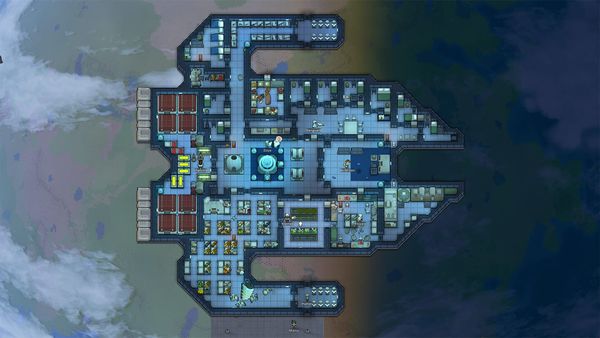
For years the canon stopped at "unknown origin." The 2025 Odyssey expansion finally put a mind behind the machines. High above the planet drifts a mechhive — the factory and command post that builds mechanoids and points them at human life. At its heart is the cerebrex core: a vast AI superbrain that powers the hive and, the game says plainly, commands every mechanoid on the planet at once.
The order to kill always came from somewhere. Odyssey finally shows you where.
That's the payoff to the prime-directive idea. The ancient mechs in the ruins were soldiers without an officer; the cerebrex core is the officer the rest of them never lost. Reaching it is a late-game undertaking: the hive's long-range scanners tear apart any ship that gets close, so it takes a signal jammer just to land. The climb ends at a choice. Tear the core down and mechanoids begin to shut off for good — here and everywhere on the planet. It's the first time the series has let you end the threat outright and save the world the hive was built to empty. Or leave it running and walk away with a sliver of its mind instead. Either way the decision reaches across the entire world.
It's the most concrete origin beat the series has handed over. It also doesn't close the older mystery. A hateful core in orbit explains the assault you've been surviving — not necessarily who forged the first mechanoids, or whether this hive is the source of them all or just one node of something much larger.
Your side of it — the mechanitor
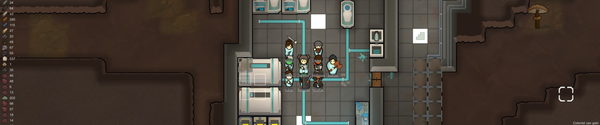
In the base game, mechanoids are only ever a threat. Biotech flips that: play a mechanitor and you stop running from them and start fielding them. It takes a mechlink — a control implant pulled from the corpse of a long-dead mechanitor — wired into one of your colonists. From then on they can gestate their own mechs in a vat — faster the higher the mechanitor's Crafting skill — and command them in groups, up to a bandwidth limit, the same leash the ancient commanders once worked under. The mechanitor can upgrade too, slotting in implants cut from that same dead tech to run more mechs and build them faster.
Combat-wise, the army splits into clear jobs — swarms of cheap gunners, melee chargers, and heavies for drawing fire, with shielders that throw a bullet shield to protect the line. The labor mechs never touch a fight.
The three commanders
To climb the tech tree you hunt them down one by one. Each is a boss fight, each wants a different approach, and each drops a chip that unlocks the next tier.
| Commander | What it is | Why you hunt it |
|---|---|---|
| Diabolus | A walking artillery piece with a hellsphere cannon that lobs explosive shells. | Keep moving or feed it cannon fodder. Its chip opens the mid tier. |
| War Queen | Carries a built-in gestator and births swarms of war urchins mid-fight. | Kill it fast — given time, it drowns you in its own brood. Drops the powerfocus chip. |
| Apocriton | A psychic commander whose weapon is hatred — it floods minds with rage, and its signature ability has the dead mechs around it resurrected mid-battle. | The top of the tree — and the one mech you can never build yourself. |
Two mechs stay off your roster no matter how far you climb: the termite and the apocriton (short of a mod). Some doors only open one way.
What the game still won't tell you
RimWorld's mechanoid lore is mostly negative space, and that's deliberate. The threads left hanging, as of 1.6:
- One war or many. The ruins could be a single cataclysm or a long chain of them. Unstated.
- Who gave the first order. The original commanders are gone; whether they were human, archotech, or both is never confirmed.
- The mechhive's reach. Odyssey names a hive mind, but not whether it's the origin of all mechanoids or one operation among many.
- Horax and the void. A named archotech said to exist in a plane called the void — the force behind Anomaly's horrors, marked in black and red where other archotech relics run gold and green. Nothing ties it to the mech hive, which hints the rimworld's machines may answer to more than one inhuman mind.
None of that is an oversight. The mechanoids work as horror precisely because you never get the full briefing — only the war machines, the empty ruins, and the order they're still following.
FAQ
Where do RimWorld's mechanoids come from?
Officially unknown. The game offers two readings — leftover weapons from an ancient war, or archotech-built war machines — and confirms neither. The Odyssey expansion adds an orbital mechhive as the mind driving their attacks, but doesn't pin down who built the first mechanoids.
Are mechanoids and mechanites the same thing?
No. Mechanites are microscopic machines — the cause of the fibrous and sensory mechanite "diseases." Mechanoids are the large war robots. Related technology, very different scale.
Did archotechs build the mechanoids?
It's the strongest hint, not a flat statement. Archotechs are described as able to build self-replicating mechanoids, and the fiction primer credits the most advanced units — including human-passing infiltrators — to archotech-level minds.
What controls the mechanoids?
Mechanoids are built to follow a commander; cut off from one, they fall back on a standing order to kill, which is why ancient mechs in ruins still attack. Odyssey reveals a central authority for the active threat — the mechhive's cerebrex core, an AI that directs every mechanoid on the planet.
Why are insectoids and mechanoids always fighting?
The lore frames insectoids as an engineered ecosystem built to fight mechanoid invasions. The two stay permanently hostile to each other — which you can sometimes turn to your advantage.
Can you control mechanoids in RimWorld?
Yes, with the Biotech DLC. A colonist fitted with a mechlink becomes a mechanitor: they create and command their own mechs, up to a bandwidth limit.
What is the mechhive in Odyssey?
The hive intelligence behind the mechanoid assault, sitting in orbit. Odyssey's endgame lets you destroy it or take its power, changing mechanoid activity across the whole planet.