RimWorld story ideas: seven colonies that play nothing alike
Seven RimWorld runs I actually played, what I set out to do, and how each one ended — plus twenty more premises that work.

Two players can own the same copy of RimWorld, run the same version, and finish with stories that share almost nothing. I have a genetics project that got quietly taken over by the anomalies it was supposed to ignore, a company town that got overrun by its own success, and a vampire who was supposed to build a village and ended up taking the planet.
Below are the runs, what I set out to do, and what the game did with that. Not mod reviews, not build orders — the actual shape these premises take once you commit to one and refuse to break it.
Seven is nowhere near the limit. Five expansions, four base scenarios plus the ones the DLCs add, a world generator that never repeats a map, three storytellers and a Workshop nobody has finished reading — the combinations run out long after you do. The seven below are just far enough apart to show how wide the space is, and there is a much longer list further down.

Why RimWorld stories diverge so hard
RimWorld has no script. The AI storyteller watches your colony and decides what happens next based on wealth, population and how long it has been quiet. Every event resolves through the simulation rather than a cutscene, so a lightning strike is genuinely just a lightning strike until it hits your wood stockpile in a drought while your only firefighter is down with a broken spine.
That is the engine. What makes stories diverge is that the engine is indifferent to your premise. It does not know you are roleplaying a corporate expansion or a vampire court. It throws the same manhunter pack at both, and the two colonies interpret it completely differently.
A raid on a research station reads as containment failure. The same raid on a vampire's village reads as a peasant uprising. Same event, same code, two stories.
The research station that ended up somewhere else
Set-up: a normal colony with a void monolith sitting on the map, and a genetics project I actually cared about. Outcome: the genetics became a footnote and the anomalies took over.
I started this one for Biotech. Gene assembly, xenotypes, rebuilding my colonists into something better — that was the plan. The monolith was scenery.
Then somebody attuned to it and the colony acquired a second job. Containment strength is a real number that comes off wall HP, door HP, light level and bioferrite flooring, and if you are under the minimum every hour of Dark Study is worth half what it should be. So the build queue changed. Then it changed again when the batteries went flat in a cold snap and I hooked a contained entity to an electroharvester for 2000W — knowing it costs 25 containment strength, halves the study rate and periodically sets the specimen on fire. I made that trade anyway.
By the late game the gene work was still running, but it was not what the colony was for anymore. I set out to rewrite people and ended up cataloguing things that should not exist.
One warning if you want this run: Ambient Horror is not a storyteller. It is an Anomaly playstyle you set at world generation alongside Cassandra, Phoebe or Randy, added by Ludeon in May 2024. Pick it and the monolith never spawns — the entities get threaded into the normal event pool instead and the void endgame is gone. You cannot change it once the run has started.
The vampire who started with one human
Set-up: Sanguophage start, one immortal and one ordinary colonist. Goal was a village. Outcome: I took the planet.
The premise is arithmetic. A sanguophage drains 10 hemogen a day, one bloodfeed on an adult gives 20, and that works out to roughly 1.48 humans to sustain one vampire indefinitely. I had exactly enough for one, with no margin. So the early game was not building, it was recruiting — every new person was food security.
Two things shaped the run more than any raid. First, daylight: Mild UV sensitivity costs her 6 mood and 10 percent move speed, so my unkillable protagonist was mediocre at noon and genuinely dangerous at night. Second, deathrest — roughly monthly, four days in a casket, completely helpless, in a colony that knew exactly where the box was.
And I could not convert my way out of it. Absorb Xenogerm has a two-year cooldown, and sanguophage genes are archite genes needing eight archite capsules, so the assembler was never an option. Everything had to happen at the speed of a human lifetime.
Which is why it took so long, and why it worked. The village stopped being the goal somewhere in the middle. It ended in control of the map — every faction allied or gone. I set out to survive and arrived at conquest without noticing the handover.
The company town that got overrun
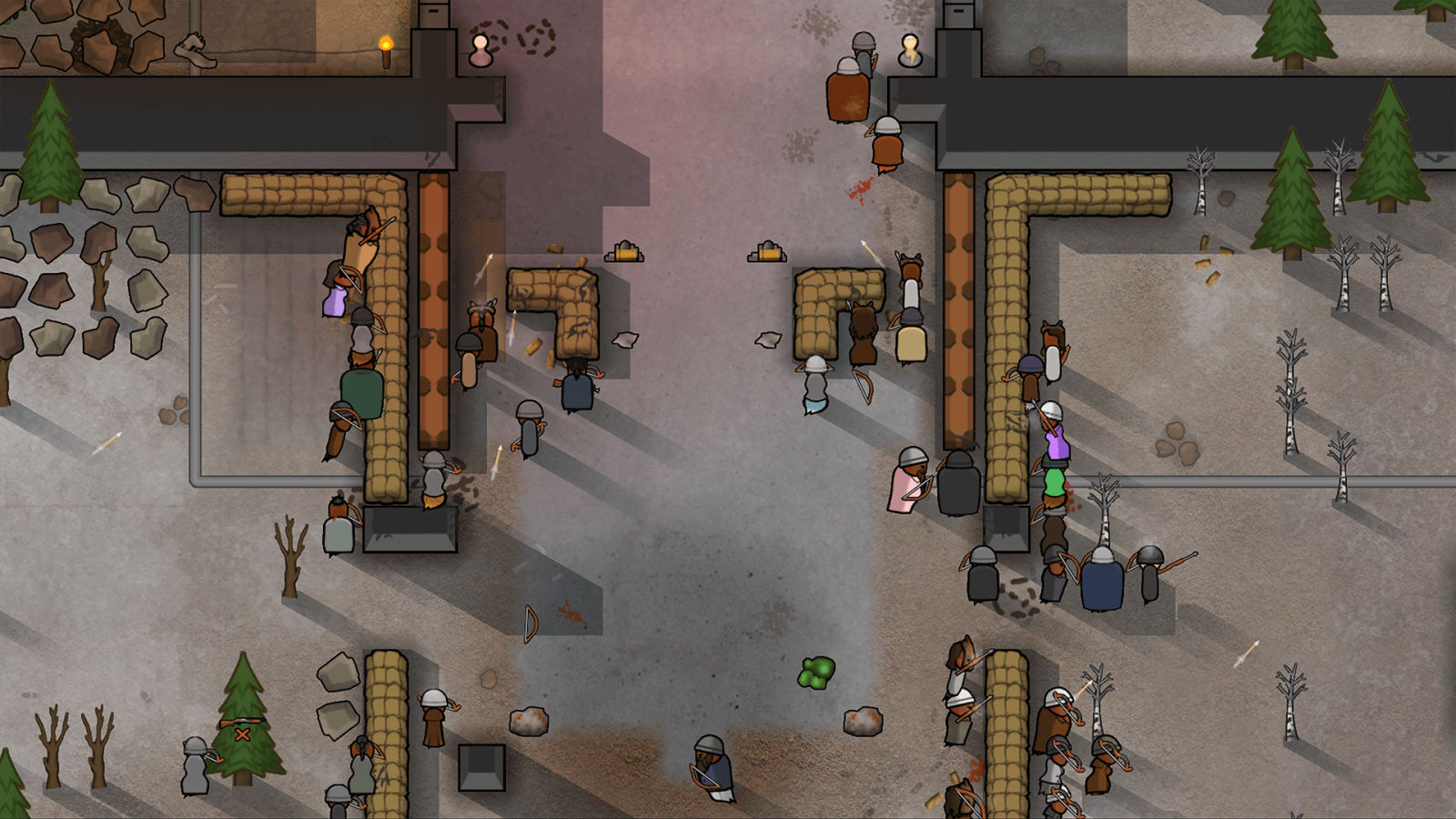
Set-up: Ideology charter — Transhumanist, Supremacist, Collectivist, Loyalist. A corporation, not a settlement. Outcome: overrun.
Ideology looks like a mood layer and is actually a premise generator. Transhumanist unlocks the Techist style, which is the visual grammar of a corporate campus. The precepts pay out in real numbers — Drugs: Essential raises crop yield, synthesis speed and sale price, so the pharmaceutical division was profitable because the charter said it should be.
The charter also has a clause you write without noticing. Every ideoligion gets a Leader, a Moral Guide and up to two specialist types, and you cannot have shooting, plants and research at once. I took production and research.
Then the part I underestimated: the storyteller sizes raids against colony wealth, and a corporation is a wealth machine by design. Every upgrade was also a raise in the difficulty setting. There was no single catastrophic mistake — the raids simply scaled past what a colony with no shooting specialist could hold, and one got through.
The document that made the company rich is the same one that said it could not defend itself.
For the look: Vanilla Furniture Expanded – Spacer Module, Vanilla Races Expanded – Android, Altered Carbon 2: ReSleeved, EPOE-Forked. All current on 1.6.
The expedition that did not come back
Set-up: magic and dungeon-crawling. Outcome: the whole squad died underground.
The magic mod is A RimWorld of Magic by Torann — note the leading A, the short name does not exist and searching for it gets you nowhere. Over 35 classes with their own levelling trees. Crucially, enemy pawns get class abilities too, so you never outgrow the world.
For dungeons the scene is thinner than the old guides claim. Dungeon Core is the only one still alive on 1.6. Dungeon Pack and Dungeons Core are stuck on older versions, and Dungeons Core is the one that required A RimWorld of Magic outright — which is why 2022 forum threads recommend the pair and why following that advice today gets you a broken load order.
The vanilla option is better than people think. Anomaly's pit gate opens into the undercave, a 100 by 100 pocket map, and killing the dreadmeld at the bottom unlocks the Provoke Pit Gate ritual so you can reopen it whenever you want. Raids only hit the surface while you are down there, so it doubles as a bunker. I started scheduling descents around the raid timer.
Then one of them didn't come back up. All of them, at once, on a map the rest of the colony could not reach or even see. No siege, no raid, nothing at home to react to — the base simply stopped receiving anybody. I had made a routine out of something the game only ever offered as an expedition.

The castle I stopped playing
Set-up: medieval village, nothing past medieval, no exceptions. Outcome: I got a castle, went Royal, and let the save go quiet.
The tension in a tech-ceiling run comes from asymmetry. Your neighbours are not medieval, and a mechanoid cluster does not care about your aesthetic. Every raid is a referendum on whether you break your own rule, and researching the first gun would have been a real narrative beat rather than a tech unlock.
Pair it with Ideology and the ceiling stops being a house rule — a precept forbidding advanced technology means the colonists believe in it and take a mood hit when you cross it.
Royalty was the natural next step and also, it turns out, the ending. Titles come with obligations: throne rooms, bedroom standards, a noble who will throw a tantrum over the wrong meal. Satisfying those obligations is building a castle. The DLC took the thing I wanted and turned it into a checklist.
I completed the checklist. Then there was no disaster, no last stand — just a safe, titled, architecturally finished colony with nothing left to want. A premise that fully resolves stops producing story.
What to install: Medieval Overhaul is the backbone at 1.6 — treat it as a starting collection, it expects Vanilla Expanded Framework and [SYR] Processor Framework (Continued) underneath, and most people add Medieval Madness: Tools of the Trade. Vanilla Factions Expanded – Medieval 2 (2025) replaces the original pack and is save-incompatible with it. Skip the original VFE – Medieval (stops at 1.4) and the Lord of the Rims series (deprecated, continuations never got past 1.3) — half the guides still recommend both.
The hackers who upgraded themselves out of a story
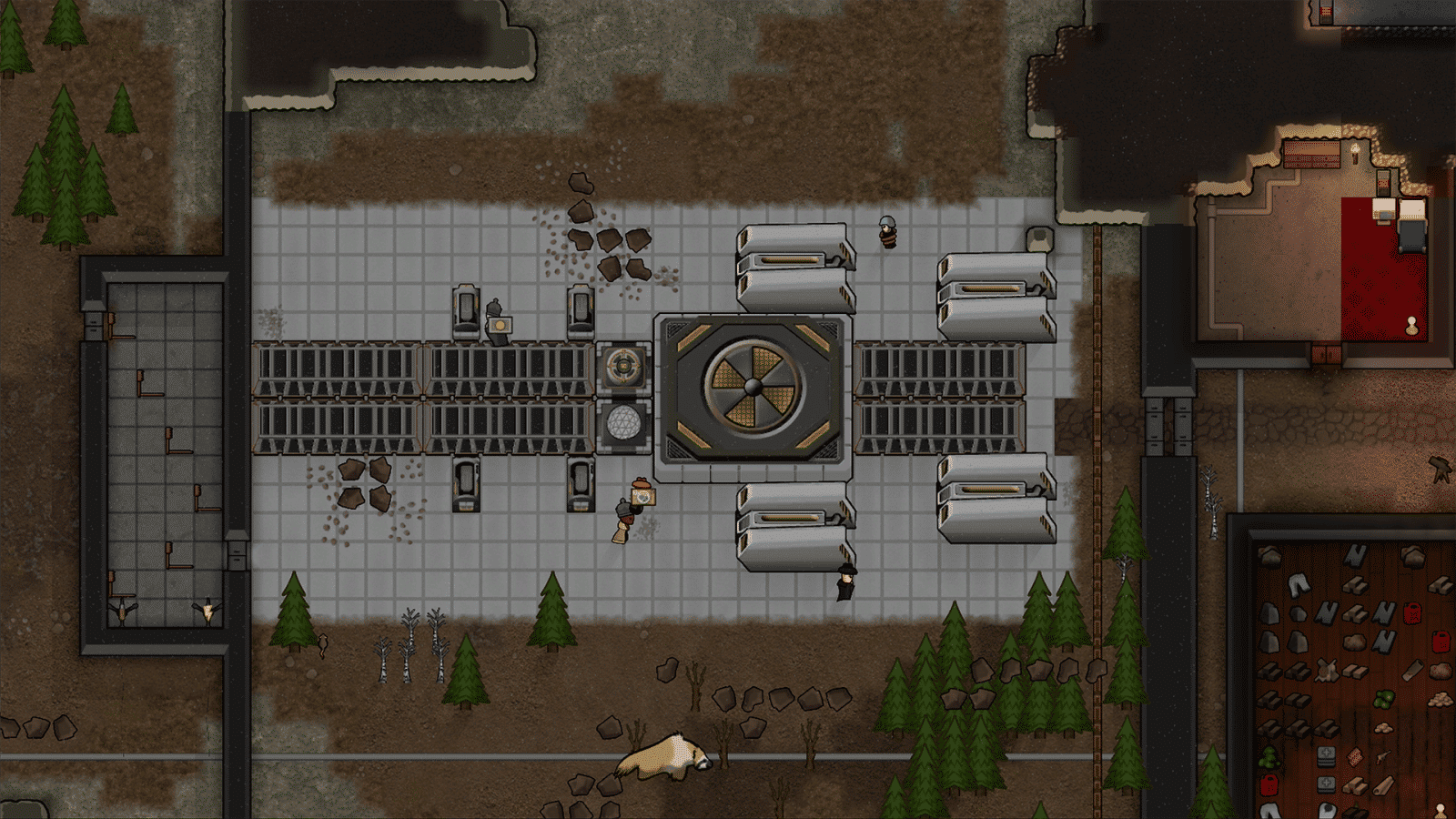
Set-up: a hacker crew living off other people's technology and rebuilding themselves with it. Outcome: solved, then abandoned.
Vanilla already contains the whole argument. You can capture raiders and harvest their organs, and the interface has the same neutral tone as the one for cooking a meal. The only pushback is a mood penalty on the colonists who watch — and if your ideoligion approves, not even that.
Questionable Ethics Enhanced and EPOE-Forked turn prisoner-to-inventory-to-installed-bionic into a production line. Elite Bionics Framework keeps the numbers sane. Save Our Ship 2 makes the endgame orbital infrastructure rather than an escape.
Here is the part nobody warns you about. Colony wealth normally raises the difficulty, but a fully bionic pawn outruns that curve. The raids kept scaling and my people scaled faster. By the time I had super soldiers, nothing arriving on the map was a question — a raid was an interruption.
The horror I built the run around was how efficient are you willing to get. It had an answer, the answer was very, and there was nothing left to ask. So I started a new run. Not because it failed. Because it was solved.
Stealing a premise from Rat Knight
If you want proof that the premise-first habit scales, Rat Knight has 798 videos and 188,000 subscribers built almost entirely on it. Every series starts as a sentence, gets its own heavily modded setup, and runs as episodes until the premise resolves itself one way or the other. He publishes the Steam Workshop modlist for each one, so the runs are reproducible rather than just watchable.
Scrolling his playlist page is the fastest way I know to understand how wide this game is. A sample of what is sitting there right now:
The ones that are pure premise
RimWorld The Human Farm — five episodes, and the title is the entire pitch. It is the same arithmetic my vampire run turned on, played without the supernatural excuse.
RimWorld Warcrimes — five episodes of finding out exactly how far the simulation will let you go before it objects. Spoiler: it doesn't.
RimWorld Sea Ice — six episodes on a map where nothing grows. Every calorie is imported, hunted or grown under lamps you cannot afford to power.
RimWorld The Army Of Fetid Corpses — four episodes, and you can reconstruct the entire run from the name.
RimWorld Insect Hive and RimWorld Mech Hive Build — the two "what if the colony isn't human" runs, five and six episodes.
The ones that are a whole setting
RimWorld Fallout Episodes is the flagship at 38 videos, with a separate Fallout RimWorld Universe supercut playlist on top. RimWorld Halo has both an episode and a supercut track. RimWorld Wild West! runs ten episodes. RimWorld Zombieland 1.6, RimWorld Monster Hunter Series and the eight-part RimWorld Necromancer Series each take a genre and commit to it completely.
My favourite title on the page is RimWorld Farming (Napoleonic) — six episodes — because it is two unrelated ideas welded together, and that is exactly the kind of premise this game rewards.
The ones chasing the new DLC
Odyssey gets three separate series: Gravship Fleet, an eight-part Volcano Playthrough, and a general Odyssey DLC run. RimWorld Colonizing The Solar System is the logical endpoint of that, and RimWorld Archotech Universe goes the other direction entirely.
What actually transfers
Not the mod lists. The habit.
Every one of those playlists is a sentence somebody committed to before the first pawn landed, and then refused to abandon when the run got inconvenient. That is the same thing the Anomaly DLC does for you in vanilla — it hands you a premise and makes the colony bend around it. Rat Knight just does it by hand, 798 times.
Twenty more premises that already work
None of these need a custom mod list to become a story. Each one is a sentence plus the one thing in the game that makes it bite.
Vanilla, no mods at all
The lost tribe that stayed neolithic. Take the Lost Tribe scenario and never research past medieval. Your entire tech tree becomes a moral position.
Naked Brutality, one pawn, no restarts. The scenario hands you nothing. Every object in the colony has a story about the day you made it.
The Rich Explorer who spent it all in year one. Start wealthy, buy everything, then discover that colony wealth is what the storyteller uses to size raids against you.
The mechanitor who never recruited a human. Biotech's mechlink start, played as a solo operator with a machine workforce. The mood system barely applies, which changes what failure even looks like.
The colony that refused to kill. No executions, no organ harvesting, recruit or release only. Prison management becomes the hardest job on the map.
The caravan that never settled. Pack up and move every season. You give up storage, defences and hydroponics, and you get a story about a place you keep leaving.
The ice sheet run. Nothing grows. Every calorie is imported, hunted or grown under lamps you cannot afford to power. Winter is not an event, it is the setting.
The gravship crew. Odyssey turns the endgame into travel rather than escape. The ship becomes the colony and the map becomes disposable.
One DLC does the heavy lifting
The imperial vassal. Royalty's titles come with obligations: throne rooms, bedroom standards, and a noble who will throw a tantrum over a bad meal. Ambition as a maintenance cost.
The cult that cannot research. Anomaly's Ritualist meme forces Psychic rituals: Exalted and a Research: Slow precept. You are choosing faith over progress, and the game makes you pay for it in tech.
The cannibal commune. Ideology's Cannibal meme turns a taboo into a food strategy with a positive mood attached. The horror is that it stops being horror for your colonists.
The tunnellers. Tunneler meme plus a mountain. Your people are unhappy outdoors, so the story happens entirely underground — and so do the insects.
The sanguophage clinic. The vampire premise above, run as medicine instead of predation. Same genes, opposite ethics.
The growth-vat dynasty. Biotech children, raised deliberately, trait by trait at each growth moment. A multi-generational story in a game most people play for forty hours.
The pollution problem. Mechanitor toxic wastepacks have to go somewhere. Play the run where they go in the river.
Modded, and worth the load order
The high-fantasy kingdom. A RimWorld of Magic plus Medieval Overhaul. Mages defending a village that does not understand what they are.
The android factory. Vanilla Races Expanded – Android, played as manufacturing rather than companionship.
The wild west outpost. Black-powder weapons, a saloon, and a sheriff who is one bad raid from being the villain.
The zombie outbreak. The colony stops being about growth and becomes about the perimeter and who is inside it.
The monster hunter's lodge. Anomaly entities plus a mod-heavy bestiary, run as a business. Contracts, trophies, and one specialist who is becoming what she hunts.
If you want the game to pick for you instead, our run generator rolls a setting, biome, scenario and storyteller in one click.
Where the setting and the storyteller fit in
Two things underpin all seven runs, and both already have their own home on this site rather than a summary here.
The first is the fiction. RimWorld is set around the year 5500 A.D., roughly 3,400 years after humanity first left Earth at sublight speed and fragmented, because without faster-than-light travel nothing holds together. That is why your neighbours can be a neolithic tribe, a pirate band and a feudal ultratech aristocracy within walking distance, and it is why all seven premises fit without breaking canon. The full picture, including the mechanoids still running orders nobody remembers giving and the Empire's exile from Sophiamunda, is in our RimWorld lore hub.
The second is pacing. Cassandra escalates on a curve, Phoebe leaves you room to breathe, Randy ignores both. Which one you pick should follow from your premise, not the other way round — a village growing over decades needs Phoebe, and the research station wants Cassandra's build-up. We compared them properly in our storyteller guide.
What actually generates the diversity
Seven runs, and none of them needed a different game. Anomaly and Biotech ship their premise in the box. Ideology turns a mood system into a charter. The mods change the props, not the engine.
The variable that matters is the constraint you accept at the start and refuse to break. The storyteller supplies pressure that does not care what your colony is for. Your premise is what turns that pressure into a story instead of a setback.
Look at how those seven actually finished. Two were killed — the company town got overrun, the expedition never came back up. One got away with it and took the planet. One turned into something I had not planned, a genetics project that woke up as an anomaly programme.
And two of them simply ran out. The castle was finished and the crew became unkillable, and in both cases the story stopped before the colony did. That is the failure mode nobody warns you about, and it is more common than dying: a premise that fully resolves has nothing left to generate.
So the useful question was never what should I build. It is what do I want to still be arguing with in eighty hours. Pick a premise that can lose, and the game will do the rest.
Portions of the materials used to create this content are trademarks and/or copyrighted works of Ludeon Studios Inc. All rights reserved by Ludeon. This content is not official and is not endorsed by Ludeon.